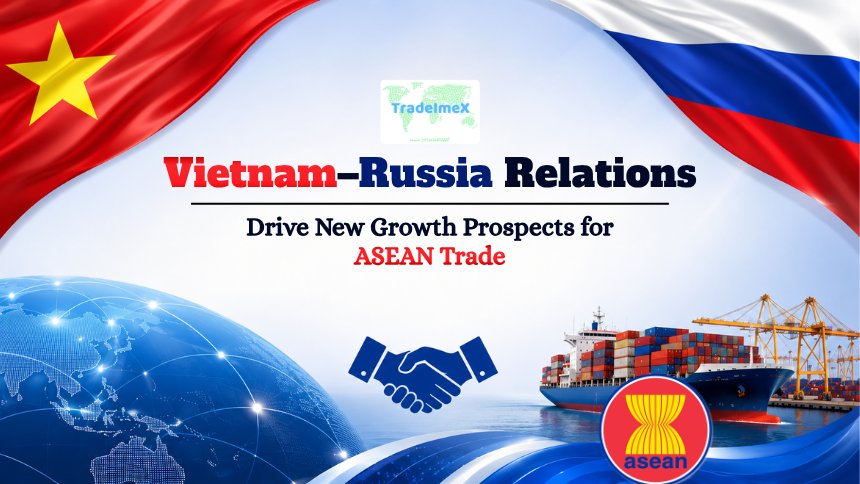
Vietnam–Russia Relations Drive New Growth Prospects for ASEAN Trade
Explore how strengthening Vietnam-Russia relations is driving ASEAN trade growth. Access Vietnam-Russia trade data, top traded goods, EAEU trade benefits.

Introduction
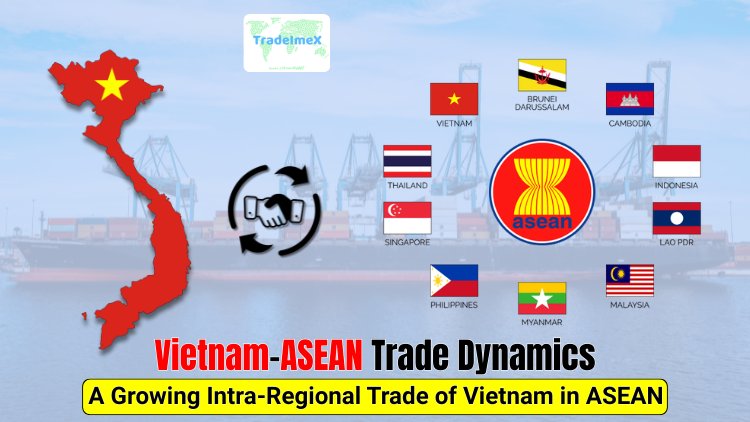
The strengthening relationship between Vietnam and Russia is creating new opportunities for trade, investment, and economic cooperation across Southeast Asia. As ASEAN continues to emerge as one of the world's fastest-growing economic regions, Vietnam is increasingly positioning itself as a strategic bridge connecting Russia with ASEAN markets. Recent diplomatic developments, including high-level discussions between Vietnamese and Russian leaders and Vietnam's renewed commitment to enhancing ASEAN-Russia cooperation, signal a new chapter in regional economic integration. According to the latest Vietnam export data and Russia import data, the total value of Vietnam-Russia trade reached $5.9 billion in 2025, a 6% increase from the previous year, improving the Vietnam-Russia relations.
In the fiscal year 2025-26, Vietnamese imports into Russia and Russian exports to Vietnam also increased, with Russia providing record amounts of pork, fertilizers, and fresh LNG exports. According to Vietnam's Ministry of Foreign Affairs, Vietnam has reaffirmed its intention to strengthen its role as a bridge in the ASEAN-Russia partnership, supporting broader economic, trade, and investment cooperation between Russia and ASEAN member states. This comes at a time when global supply chains are evolving, geopolitical dynamics are shifting, and both ASEAN and Russia are seeking new avenues for economic growth.
With ASEAN's combined GDP exceeding $4 trillion and Russia seeking to diversify its trade partnerships beyond traditional markets, the Vietnam-Russia relationship could become a major catalyst for ASEAN's future trade expansion.
Vietnam's Strategic Role in ASEAN-Russia Relations
Vietnam has long maintained strong diplomatic and economic relations with Russia. The two countries share a comprehensive strategic partnership that spans:
-
Trade and investment
-
Energy cooperation
-
Defense and security
-
Education and cultural exchanges
-
Science and technology
-
Agriculture and food trade
As one of ASEAN's fastest-growing economies, Vietnam is uniquely positioned to facilitate deeper economic engagement between Russia and Southeast Asia. During recent discussions on ASEAN-Russia cooperation, Vietnamese officials emphasized the country's commitment to strengthening multilateral partnerships and serving as a gateway for Russian businesses seeking access to ASEAN's market of over 680 million consumers.
Vietnam's growing influence within ASEAN further enhances its ability to coordinate trade initiatives, investment projects, and regional cooperation frameworks involving Russia.
ASEAN-Russia Trade Relations: Current Overview
Economic ties between ASEAN and Russia have expanded steadily over the past decade despite global economic uncertainties. Recent estimates indicate:
-
ASEAN-Russia trade exceeds $22 billion annually
-
Russia remains an important supplier of:
-
Energy products
-
Fertilizers
-
Metals
-
Agricultural commodities
-
ASEAN exports:
-
Electronics
-
Machinery
-
Agricultural products
-
Consumer goods
-
Textiles
Although ASEAN-Russia trade remains relatively small compared to ASEAN's trade with China, the United States, or the European Union, growth potential remains substantial. Several ASEAN nations are actively exploring opportunities to increase exports to Russia while attracting Russian investments into manufacturing, trade, and energy sectors.
Vietnam-Russia Bilateral Trade Continues to Expand
Vietnam has become one of Russia's most important economic partners in Southeast Asia. According to Vietnam-Russia trade statistics:
Vietnam-Russia Bilateral Trade in the Last 5 Years
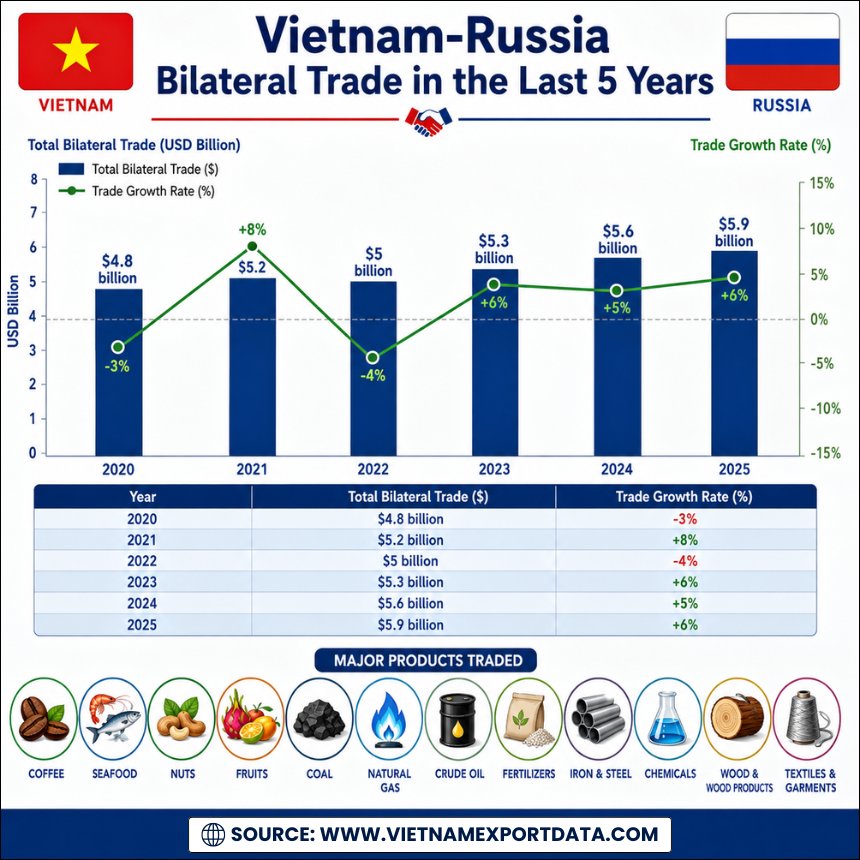
|
Year |
Total Bilateral Trade ($) |
Trade Growth Rate (%) |
|
2020 |
$4.8 billion |
-3% |
|
2021 |
$5.2 billion |
+8% |
|
2022 |
$5 billion |
-4% |
|
2023 |
$5.3 billion |
+6% |
|
2024 |
$5.6 billion |
+5% |
|
2025 |
$5.9 billion |
+6% |

Despite temporary disruptions from sanctions, payment challenges, and global trade issues, trade between the two countries has remained resilient. Major Vietnamese exports to Russia include:
-
Electronics
-
Mobile phones
-
Seafood
-
Coffee
-
Fruits and vegetables
-
Garments and textiles
-
Footwear
Meanwhile, Russia exports:
-
Petroleum products
-
Coal
-
Fertilizers
-
Wheat
-
Metals
-
Industrial machinery
Top Products Vietnam Imports from Russia
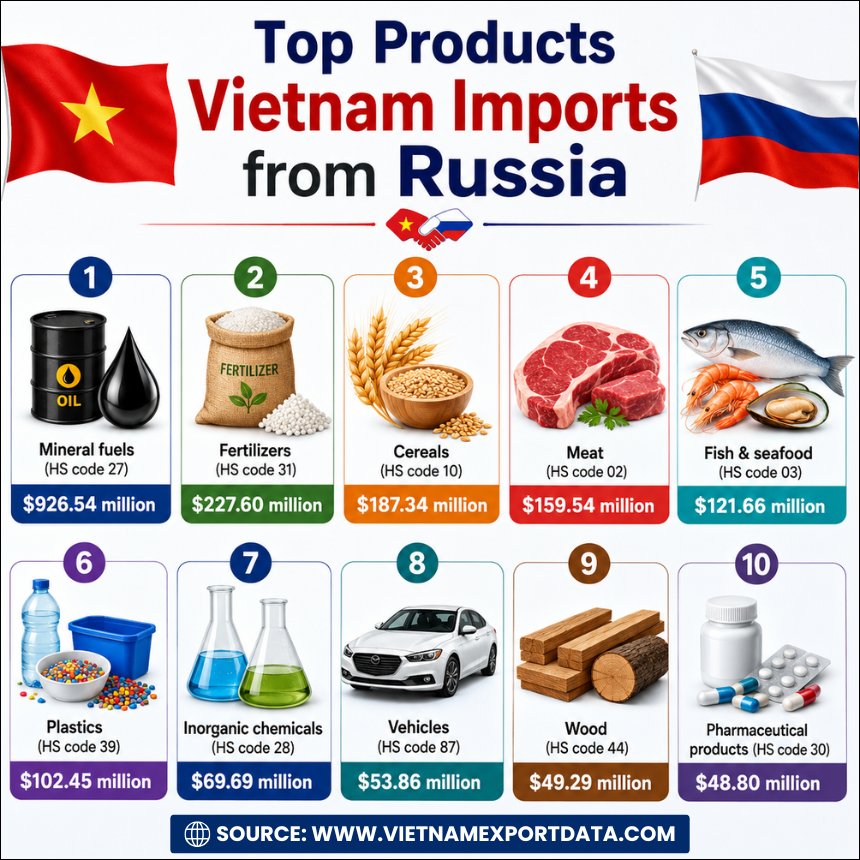
Vietnam's top imports from Russia encompass a wide array of goods, reflecting the strong economic ties between the two nations. Among the standout products in this bilateral trade relationship are minerals like coal and oil, machinery and equipment, chemicals, and grains such as wheat, as per the data on Vietnam imports from Russia. These imports not only meet Vietnam's industrial and agricultural needs but also underline the diversity of goods exchanged between the two countries. The top 10 products that Vietnam imports from Russia, as per the Russia export data and Vietnam-Russia trade data for 2025, include:
1. Mineral fuels & oils (HS code 27): $926.54 million
2. Fertilizers (HS code 31): $227.60 million
3. Cereals (HS code 10): $187.34 million
4. Meat & edible meat offal (HS code 02): $159.54 million
5. Fish & seafood (HS code 03): $121.66 million
6. Plastics & articles thereof (HS code 39): $102.45 million
7. Inorganic chemicals (HS code 28): $69.69 million
8. Vehicles (HS code 87): $53.86 million
9. Wood & articles of wood (HS code 44): $49.29 million
10. Pharmaceutical products (HS code 30): $48.80 million
Top Products Vietnam Exports to Russia
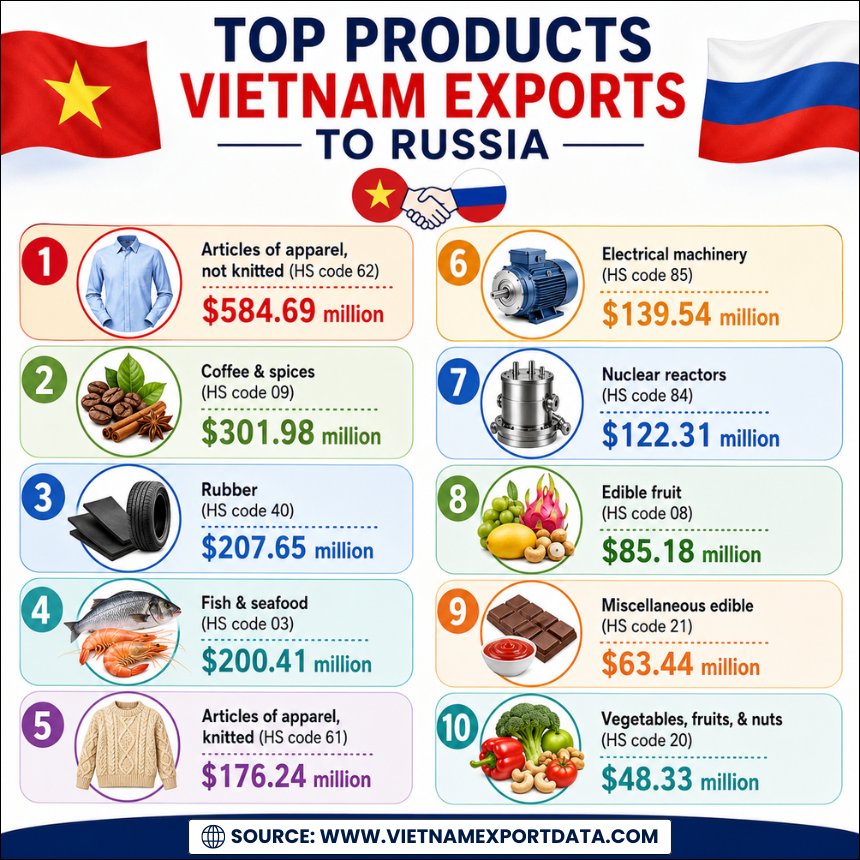
Vietnam's export market to Russia encompasses a diverse range of goods with strong economic significance. The leading exports from Vietnam to Russia include electronic equipment, textiles, footwear, machinery, and seafood, as per the data on Vietnam exports to Russia. These top goods play a crucial role in strengthening the bilateral trade relationship between the two countries and highlight Vietnam's position as a key player in the global market. The top 10 commodities that Vietnam exports to Russia, as per the Vietnam shipment data for 2025, include:
1. Articles of apparel, not knitted (HS code 62): $584.69 million
2. Coffee, tea, & spices (HS code 09): $301.98 million
3. Rubber & articles thereof (HS code 40): $207.65 million
4. Fish & seafood (HS code 03): $200.41 million
5. Articles of apparel, knitted (HS code 61): $176.24 million
6. Electrical machinery & equipment (HS code 85): $139.54 million
7. Nuclear reactors & machinery (HS code 84): $122.31 million
8. Edible fruit & nuts (HS code 08): $85.18 million
9. Miscellaneous edible preparations (HS code 21): $63.44 million
10. Preparations of vegetables, fruits, & nuts (HS code 20): $48.33 million
The Vietnam-EAEU Free Trade Agreement Advantage
One of the key drivers of Vietnam-Russia trade is the Vietnam-Eurasian Economic Union (EAEU) Free Trade Agreement, which entered into force in 2016. The EAEU includes:
-
Russia
-
Belarus
-
Kazakhstan
-
Armenia
-
Kyrgyzstan
This agreement has provided preferential tariff access for thousands of products, benefiting exporters on both sides. Key advantages include:
-
Reduced tariffs
-
Simplified customs procedures
-
Improved market access
-
Greater investment opportunities
-
Enhanced business cooperation
Vietnam remains the only ASEAN country with a comprehensive FTA with the EAEU, giving it a unique position as a trade gateway between Southeast Asia and Eurasia.
Russia's Pivot Toward Asia Creates New Opportunities
In recent years, Russia has increasingly focused on strengthening economic ties with Asian economies. Several factors have accelerated this shift:
-
Global geopolitical changes
-
Diversification of export markets
-
Growing Asian demand for energy
-
Expansion of regional trade agreements
-
Supply chain restructuring
ASEAN's economic growth makes the region particularly attractive. By 2030, ASEAN's economy is expected to surpass $5 trillion, making it one of the world's largest economic blocs. Vietnam's strategic location & strong diplomatic relations with Russia make it a natural partner in facilitating this transition.
Energy Cooperation Remains a Cornerstone
Energy has long been a central pillar of Vietnam-Russia relations. Russian companies have played a major role in Vietnam's energy sector through:
-
Oil exploration
-
Natural gas development
-
Offshore energy projects
-
Petrochemical investments
Key areas of cooperation include:
Oil and Gas
Joint ventures continue to operate successfully in Vietnam's offshore energy sector.
LNG Development
Vietnam's growing energy demand is creating opportunities for Russian LNG suppliers.
Renewable Energy
Both countries are exploring opportunities in:
-
Wind energy
-
Solar power
-
Green hydrogen
-
Energy infrastructure modernization
As ASEAN countries seek greater energy security, Russian expertise and resources could support regional energy development.
Agriculture and Food Trade Opportunities
Agriculture remains one of the most promising sectors for ASEAN-Russia trade expansion. Russia is among the world's leading exporters of:
-
Wheat
-
Fertilizers
-
Vegetable oils
-
Agricultural commodities
ASEAN countries, including Vietnam, export:
-
Coffee
-
Seafood
-
Rice
-
Tropical fruits
-
Processed foods
Vietnam's agricultural sector can play an increasingly important role in connecting Russian suppliers with Southeast Asian markets while expanding exports to Russia. Growing demand for food security across ASEAN is likely to strengthen these trade flows in the coming years.
Investment Cooperation Gains Momentum
Investment cooperation between Vietnam and Russia is expanding beyond traditional sectors. Emerging areas of interest include:
Manufacturing
Russian firms are exploring opportunities in:
-
Industrial production
-
Machinery
-
Automotive components
Technology
Collaboration is increasing in:
-
Artificial intelligence
-
Digital transformation
-
Cybersecurity
-
Software development
Infrastructure
Potential investments include:
-
Transport projects
-
Energy infrastructure
-
Industrial parks
Healthcare and Pharmaceuticals
Growing demand for healthcare products creates opportunities for joint ventures and technology transfer.
Vietnam as a Bridge for Russian Businesses Entering ASEAN
Vietnam's role extends beyond bilateral trade. The country increasingly serves as:
-
A regional manufacturing hub
-
A trade gateway
-
An investment destination
-
A diplomatic connector
Russian companies seeking access to ASEAN markets can leverage Vietnam's:
-
Extensive free trade agreement network
-
Competitive manufacturing base
-
Strategic geographic location
-
Business-friendly investment policies
Vietnam currently participates in major trade agreements, including:
-
CPTPP
-
RCEP
-
EVFTA
-
UKVFTA
-
ASEAN FTAs
This extensive network provides Russian businesses with indirect access to some of the world's largest markets.
Digital Economy Cooperation
The digital economy represents another area of future growth. Vietnam's digital economy is expected to exceed $50 billion by 2030, while ASEAN's digital economy could reach nearly $1 trillion. Potential cooperation areas include:
-
E-commerce
-
Fintech
-
Digital payments
-
Smart manufacturing
-
Artificial intelligence
Russian technology firms may find significant opportunities within Vietnam's rapidly growing digital ecosystem.
ASEAN Economic Growth Benefits from Diversified Partnerships
One of ASEAN's greatest strengths is its ability to maintain balanced economic relationships with multiple global partners. Strengthening ties with Russia offers:
-
Greater trade diversification
-
Enhanced energy security
-
Expanded investment opportunities
-
Reduced dependence on single markets
For ASEAN economies, diversification helps build resilience against global economic uncertainties. Vietnam's proactive engagement with Russia aligns closely with ASEAN's broader goals of promoting open, inclusive, and sustainable economic growth.
Key Highlights from Vietnam's Recent ASEAN-Russia Engagement
According to Vietnam's Ministry of Foreign Affairs, Vietnam has reaffirmed several important priorities:
-
Strengthening ASEAN-Russia cooperation mechanisms.
-
Expanding economic and trade partnerships.
-
Promoting connectivity and trade cooperation.
-
Supporting regional peace and stability.
-
Enhancing people-to-people exchanges.
-
Encouraging investment and business collaboration.
Vietnam also emphasized its commitment to serving as a constructive bridge between ASEAN and Russia while supporting regional economic integration efforts. These initiatives are expected to create new opportunities for businesses, investors, and exporters across both regions.
Future Outlook for ASEAN-Russia Trade
Several factors support a positive outlook for ASEAN-Russia trade over the next decade:
Rising Consumer Demand
ASEAN's growing middle class continues to drive import demand.
Energy Cooperation
Long-term energy partnerships remain highly attractive.
Agricultural Trade Expansion
Food security concerns are creating opportunities for exporters.
Infrastructure Investments
Improved connectivity will facilitate greater trade volumes.
Supply Chain Diversification
Businesses are increasingly seeking alternative sourcing and investment destinations. Analysts believe ASEAN-Russia trade could surpass $30 billion annually within the next several years if current cooperation initiatives continue to expand. Vietnam is expected to remain one of the primary beneficiaries of this growth.
Conclusion and Final Thoughts
Vietnam-Russia relations are entering a new phase characterized by stronger economic cooperation, deeper trade engagement, and expanding investment opportunities. As ASEAN continues to rise as a global economic powerhouse, Vietnam's strategic position allows it to serve as an effective bridge connecting Russia with Southeast Asia's dynamic markets.
The combination of the Vietnam-EAEU Free Trade Agreement, growing bilateral trade, energy partnerships, and digital economy cooperation creates significant potential for future growth. At the same time, ASEAN benefits from greater economic diversification, enhanced connectivity, and stronger regional resilience. As global trade patterns continue to evolve, Vietnam's efforts to strengthen ASEAN-Russia cooperation could play an increasingly important role in shaping the future of regional commerce, investment, and sustainable economic development.
Frequently Asked Questions (FAQs)
1. Why is Vietnam important in ASEAN-Russia relations?
Vietnam serves as a strategic bridge between Russia and ASEAN due to its strong diplomatic ties, growing economy, and free trade agreement with the Eurasian Economic Union (EAEU).
2. How much is Vietnam-Russia trade worth?
Vietnam-Russia bilateral trade exceeded $5 billion in 2025, with growth expected in energy, agriculture, manufacturing, and technology sectors.
3. What products does Vietnam export to Russia?
Vietnam mainly exports electronics, seafood, coffee, garments, footwear, fruits, and consumer goods to Russia.
4. What does Russia export to Vietnam?
Russia exports petroleum products, fertilizers, wheat, metals, coal, and industrial machinery.
5. How can ASEAN benefit from stronger Russia ties?
ASEAN can benefit through increased trade diversification, energy security, infrastructure investment, agricultural cooperation, and expanded market access.
Note for Our Readers
We hope this analysis of Vietnam-Russia Relations and ASEAN Trade Growth Prospects provides valuable insights for exporters, importers, investors, policymakers, and businesses tracking emerging opportunities in Eurasian and Southeast Asian markets. For more insights into Vietnam trade data by country or HS code, company-level trade intelligence, and customized market research reports, contact VietnamExportdata at [email protected] and access comprehensive Vietnam import-export databases and business intelligence solutions.
Share
What's Your Reaction?
 Like
0
Like
0
 Dislike
0
Dislike
0
 Love
0
Love
0
 Funny
0
Funny
0
 Angry
0
Angry
0
 Sad
0
Sad
0
 Wow
0
Wow
0