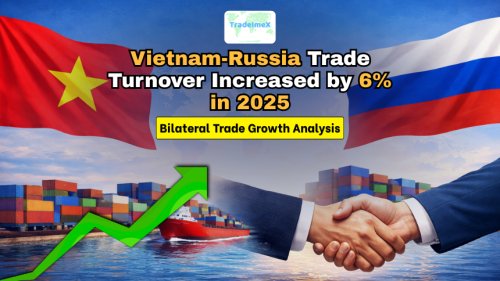
Vietnam-Russia Trade Turnover Increased by 6% in 2025: Bilateral Trade Growth Analysis
Vietnam-Russia trade turnover rose by 6% in 2025. Explore detailed bilateral trade growth analysis, key sectors, trends, and future outlook.

In 2025, Vietnam and Russia quietly strengthened one of Asia’s more under-the-radar trade partnerships. While global headlines focused on major trade corridors like US–China or EU–Asia, Vietnam–Russia bilateral trade grew by 6% in 2025, signaling resilience and strategic alignment in a shifting geopolitical environment. According to the latest Vietnam export data & Russia import data, the total value of Vietnam-Russia trade reached around $5.9 billion in 2025.
At first glance, a 6% increase may not seem dramatic. But in the current global context, marked by sanctions, supply chain disruptions, & slowing trade growth, this uptick is meaningful. It reflects not just recovery, but adaptation. This blog breaks down the numbers, key sectors, policy drivers, and future outlook shaping Vietnam–Russia trade in 2025.
Vietnam–Russia Trade in Context
Vietnam and Russia have maintained a steady trade relationship over the past decade, supported by diplomatic ties and institutional frameworks.
Key 2025 Snapshot
-
Total bilateral trade: $5.5–6 billion (estimated)
-
Growth rate: 6% YoY
-
Vietnam exports to Russia: $3.2–3.5 billion
-
Vietnam imports from Russia: $2.3–2.5 billion
While the trade volume remains modest compared to Vietnam’s trade with the US, China, or the EU, the growth trend is notable given the global environment.
Historical Trend: Slow but Steady Growth
Vietnam–Russia trade has followed a gradual upward trajectory.
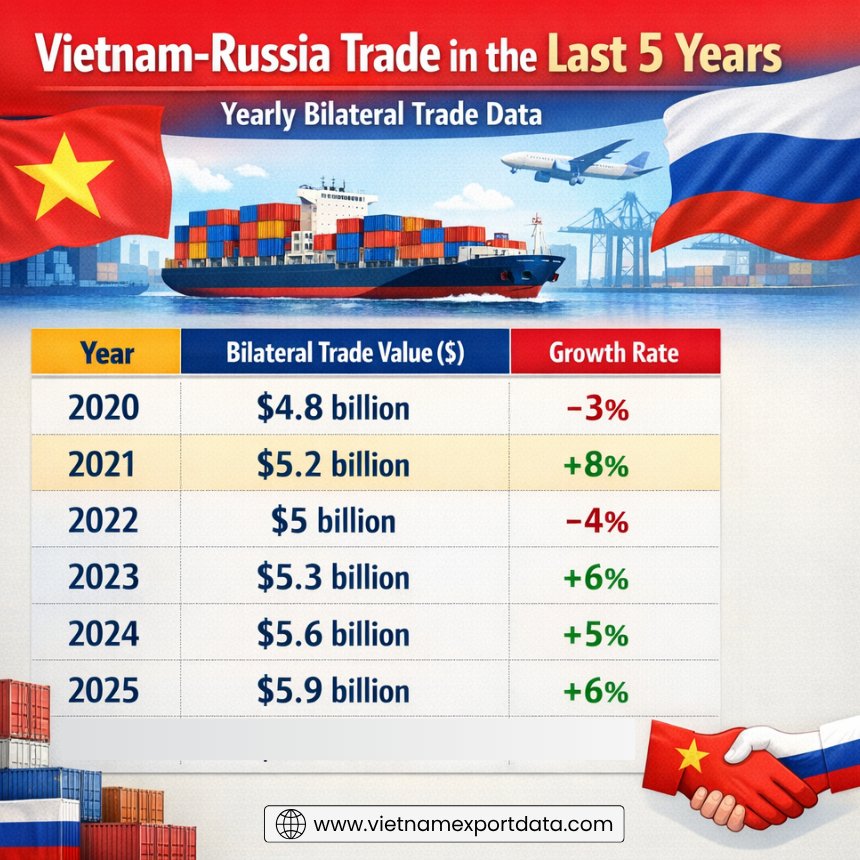
Vietnam-Russia Trade in the Last 5 Years: Yearly Bilateral Trade Data
|
Year |
Bilateral Trade Value ($) |
Growth Rate |
|
2020 |
$4.8 billion |
-3% |
|
2021 |
$5.2 billion |
+8% |
|
2022 |
$5 billion |
-4% |
|
2023 |
$5.3 billion |
+6% |
|
2024 |
$5.6 billion |
+5% |
|
2025 |
$5.9 billion |
+6% |
Key Insight: The relationship shows resilience despite global volatility, especially during periods of sanctions and trade disruptions affecting Russia.
Key Drivers Behind the 6% Growth
According to the Russian Ministry of Economic Development, Dmitry Chernyshenko, the country's deputy prime minister, made the announcement of Vietnam-Russia 6% trade growth during the Vietnam-Russia Business Forum in Moscow.
1. Trade Diversification Strategy
Both countries are actively diversifying trade partners:
-
Vietnam is reducing its overdependence on the US and China
-
Russia is pivoting toward Asia due to Western sanctions
This mutual alignment has created a natural expansion in trade.
2. Eurasian Economic Union (EAEU) Free Trade Agreement
The Vietnam–EAEU Free Trade Agreement (FTA), signed in 2015, continues to play a central role.
Impact of FTA
-
Tariff reductions on key goods
-
Simplified customs procedures
-
Increased market access
By 2025, most tariff lines between Vietnam and Russia will have either been reduced or eliminated, boosting trade volumes.
3. Currency and Payment Adjustments
Due to sanctions on Russia:
-
Trade settlements increasingly use local currencies (VND and RUB)
-
Reduced dependence on the US dollar
This has helped maintain trade flows despite financial restrictions.
Government-Level Momentum and Strategic Dialogue
One of the key factors behind the 6% growth in Vietnam–Russia trade in 2025 is renewed political and institutional engagement between the two countries.
In 2025, both governments emphasized strengthening bilateral economic ties through:
-
High-level diplomatic exchanges
-
Trade promotion forums
-
Intergovernmental committee meetings
Vietnam and Russia have continued to reaffirm their commitment to deepening economic cooperation despite global geopolitical tensions.
Key Policy Direction
-
Expanding trade beyond traditional sectors
-
Enhancing investment flows
-
Strengthening long-term strategic partnership
This political backing has played a critical role in maintaining trade growth even under external pressure, such as sanctions and trade constraints.
Energy Cooperation as a Core Pillar
Energy remains one of the most important pillars of Vietnam–Russia trade relations.
Key Developments in 2025
-
Continued collaboration in oil and gas exploration projects
-
Expansion of joint ventures between Vietnamese and Russian energy firms
-
Long-term supply agreements for crude oil and petroleum products
Russia has historically been a key partner in Vietnam’s offshore energy projects, and this cooperation has remained stable.
Why Energy Matters
-
Ensures energy security for Vietnam
-
Provides stable export demand for Russia
-
Strengthens long-term strategic ties beyond short-term trade
This sector alone contributes significantly to the resilience of bilateral trade.
Push Toward Expanding Trade Volume Targets
Both countries are not just satisfied with incremental growth. There is a clear push to scale up trade significantly in the coming years.
Strategic Trade Target
-
Aim to reach $10 billion in bilateral trade in the medium term
To achieve this, both sides are focusing on:
-
Removing trade barriers
-
Improving trade connectivity
-
Expanding product diversification
Key Focus Areas for Expansion
-
High-tech products
-
Agriculture and food processing
-
Industrial equipment
-
Renewable energy cooperation
This signals that the current 6% growth is part of a longer-term expansion strategy, not just a short-term recovery.
Role of the Vietnam–EAEU Free Trade Agreement
While the FTA was discussed earlier, its continued deepening impact in 2025 deserves more attention.
What’s Changing Now
-
More businesses are actively utilizing FTA benefits
-
Tariff advantages are becoming more visible in trade flows
-
Increased awareness among exporters and importers
Practical Impact
-
Vietnamese goods are becoming more competitive in Russia
-
Russian commodities are entering Vietnam at lower costs
The agreement is shifting from a policy framework to a fully operational trade accelerator.
Investment and Business Collaboration Trends
Trade growth is increasingly being supported by investment linkages.
Emerging Trends in 2025
-
Russian companies exploring opportunities in Vietnam:
-
Energy sector
-
Industrial manufacturing
-
Vietnamese firms expanding exports and partnerships in Russia
Business-Level Cooperation
-
Joint ventures
-
Technology transfer agreements
-
Industrial partnerships
This reflects a shift from pure trade to integrated economic cooperation, which tends to be more stable over time.
Sector Expansion Opportunities Identified by Both Countries
Both Vietnam and Russia are actively identifying new sectors for trade expansion.
Priority Sectors
1. Agriculture and Food Processing
-
Vietnam exports processed food, seafood, and coffee
-
Russia is exporting wheat and fertilizers
2. Manufacturing and Machinery
-
Increased demand for industrial equipment
-
Opportunities for technology exchange
3. Renewable Energy
-
Emerging area of cooperation
-
Aligns with global energy transition trends
4. Pharmaceuticals and Healthcare
-
Growing demand in both markets
-
Potential for long-term collaboration
Why the 6% Growth Matters More Than It Seems
After incorporating these developments, the 6% growth figure becomes more meaningful for the Vietnam-Russia trade relations.
It reflects:
-
Strong government backing
-
Active policy implementation (FTA, trade facilitation)
-
Growing business and investment ties
-
Strategic alignment in a changing global order
In other words, this is structural growth, not just cyclical recovery.
Top Goods Vietnam Imports from Russia
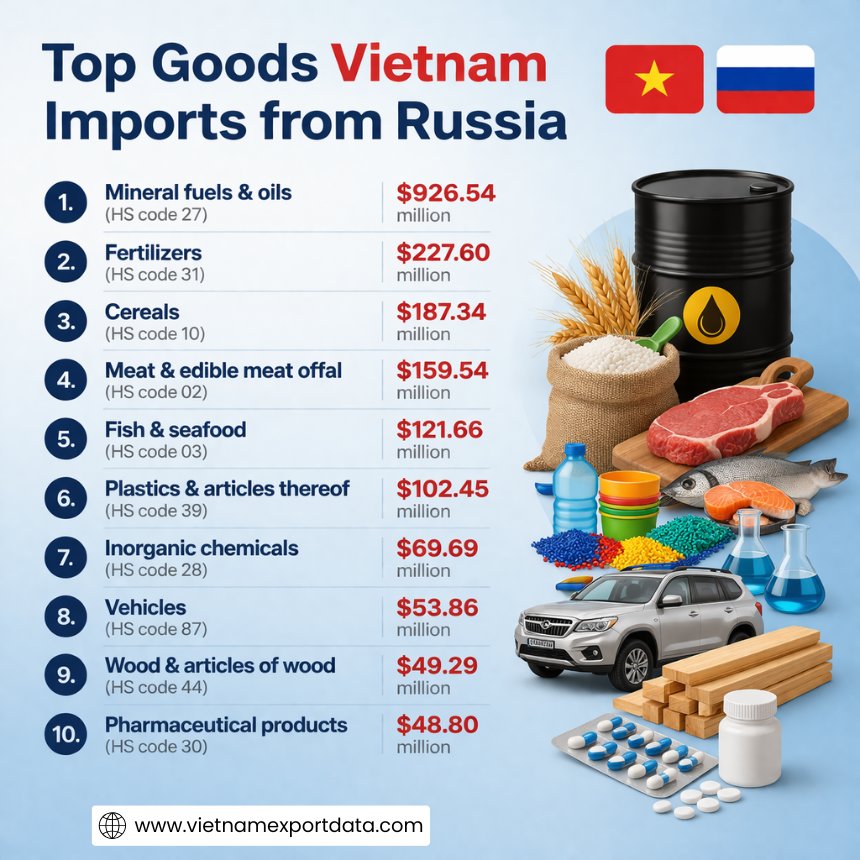
Vietnam extensively imports various goods from Russia, with key items dominating its trade relations. Among the top goods that Vietnam imports from Russia are mineral fuels like oil and gas, machinery, and equipment. These imported goods play a crucial role in supporting Vietnam's economy and infrastructure development. The consistent flow of these high-quality imports showcases the strong trade partnership between Vietnam and Russia, benefiting both nations economically and strategically. Mineral fuels & oils are the biggest Vietnam imports from Russia, as per the data on Vietnam imports from Russia by HS code. The top 10 products imported by Vietnam from Russia, as per the Russia export data and Vietnam customs data for 2025, include:
1. Mineral fuels & oils (HS code 27): $926.54 million
2. Fertilizers (HS code 31): $227.60 million
3. Cereals (HS code 10): $187.34 million
4. Meat & edible meat offal (HS code 02): $159.54 million
5. Fish & seafood (HS code 03): $121.66 million
6. Plastics & articles thereof (HS code 39): $102.45 million
7. Inorganic chemicals (HS code 28): $69.69 million
8. Vehicles (HS code 87): $53.86 million
9. Wood & articles of wood (HS code 44): $49.29 million
10. Pharmaceutical products (HS code 30): $48.80 million
Import Trend Insight: Vietnam relies on Russia for strategic commodities, especially energy and fertilizers, making the relationship structurally important.
Top Goods Vietnam Exports to Russia
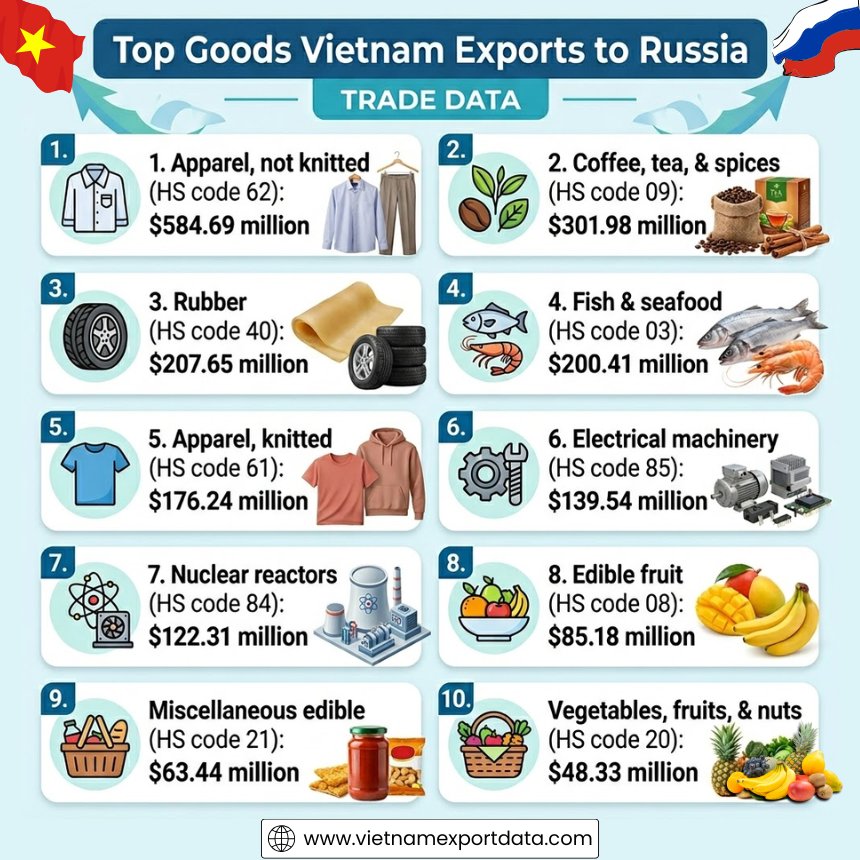
Vietnam's exports to Russia comprise a diverse range of top goods, showcasing the robust trade relationship between the two nations. The top goods Vietnam exports to Russia include electronics, textiles, agricultural products, and footwear. Non-knit apparel & clothing are the largest Vietnamese exports to Russia, as per the data on Vietnam exports to Russia by HS code. These key export items not only reflect Vietnam's manufacturing strength but also demonstrate the country's ability to cater to the demands of the Russian market. The top 10 goods that Vietnam exports to Russia, as per the Russia customs data & Vietnam import shipment data for 2025, include:
1. Articles of apparel, not knitted (HS code 62): $584.69 million
2. Coffee, tea, & spices (HS code 09): $301.98 million
3. Rubber & articles thereof (HS code 40): $207.65 million
4. Fish & seafood (HS code 03): $200.41 million
5. Articles of apparel, knitted (HS code 61): $176.24 million
6. Electrical machinery & equipment (HS code 85): $139.54 million
7. Nuclear reactors & machinery (HS code 84): $122.31 million
8. Edible fruit & nuts (HS code 08): $85.18 million
9. Miscellaneous edible preparations (HS code 21): $63.44 million
10. Preparations of vegetables, fruits, & nuts (HS code 20): $48.33 million
Export Trend Insight: Vietnam benefits from competitive manufacturing costs and an established export infrastructure, making it a reliable supplier for Russian markets.
Vietnam-Russia Trade Balance Dynamics
Vietnam maintains a trade surplus with Russia.
2025 Estimate
-
Exports: $3.4 billion
-
Imports: $2.4 billion
-
Surplus: $1 billion
What This Means
-
Vietnam gains from value-added exports
-
Russia benefits from commodity exports and strategic influence
Impact of Global Geopolitics
1. Western Sanctions on Russia
Sanctions have reshaped Russia’s trade flows:
-
Reduced access to European markets
-
Increased focus on Asia
Vietnam has emerged as a neutral and stable partner, benefiting from this shift.
2. Supply Chain Realignment
Global supply chains are evolving:
-
Companies diversifying production bases
-
Vietnam is gaining as a manufacturing hub
This indirectly boosts Vietnam–Russia trade.
3. Energy Market Volatility
Fluctuations in global energy prices impact:
-
Import values
-
Trade balance
Higher oil prices increase the value of Russia’s exports to Vietnam.
Challenges in Bilateral Trade
Despite growth, several constraints remain.
1. Payment Barriers
-
Limited banking channels due to sanctions
-
Delays in settlements
2. Shipment Costs
-
Longer shipping routes
-
Higher trade rates
3. Limited Market Awareness
-
Vietnamese products are still under-penetrated in Russia
-
Russian goods face competition in Vietnam
4. Regulatory Differences
-
Standards and certification issues
Opportunities for Expansion
1. Digital Trade and E-commerce
-
Growing online retail in Russia
-
Opportunity for Vietnamese SMEs
2. Energy Cooperation
-
Long-term oil and gas agreements
-
Potential joint ventures
3. Agriculture and Food Trade
-
Rising demand for seafood and coffee in Russia
4. Industrial Cooperation
-
Machinery, technology, and infrastructure projects
Future Outlook (2026–2030)
Scenario 1: Moderate Growth (Most Likely)
-
Annual growth: 5–7%
-
Trade value reaches $7–8 billion by 2030
Scenario 2: Accelerated Growth
-
Improved trade and payment systems
-
Trade exceeds $10 billion
Scenario 3: Stagnation
-
Escalating sanctions or geopolitical risks
-
Growth slows below 3%
Strategic Importance of the Vietnam-Russia Trade Relations
Vietnam–Russia trade is not just economic. It is strategic.
For Vietnam
-
Diversifies trade partners
-
Ensures energy security
For Russia
-
Expands presence in Southeast Asia
-
Offsets Western market losses
Key Takeaways
-
Bilateral trade grew 6% in 2025, showing resilience
-
Vietnam maintains a trade surplus
-
Key sectors: electronics, textiles, energy, fertilizers
-
Growth driven by FTA benefits and geopolitical shifts
-
Challenges remain in trade and payments
Conclusion and Final Thoughts
In conclusion, the 6% increase in Vietnam–Russia trade turnover in 2025 is more than just a number. It reflects a deeper shift in global trade patterns. As geopolitical tensions reshape traditional alliances, mid-sized trade relationships like this one are gaining importance. They offer flexibility, diversification, and resilience in an uncertain world. For businesses, policymakers, and analysts, the message is clear: Watch these emerging trade corridors closely, they may define the next phase of global trade.
Note For Our Readers
We hope you found this blog on Vietnam–Russia Trade Growth 2025 useful and informative. If you’re looking for deeper insights or need customized Vietnam trade data, or to search live Vietnam import-export data by country, feel free to connect with VietnamExportdata.
We provide comprehensive and up-to-date global trade databases, including buyer details, sourcing trends, and country-level trade analytics to support smarter business decisions. For exclusive access or tailored data solutions, contact us at info@tradeimex.in today.
Share
What's Your Reaction?
 Like
0
Like
0
 Dislike
0
Dislike
0
 Love
0
Love
0
 Funny
0
Funny
0
 Angry
0
Angry
0
 Sad
0
Sad
0
 Wow
0
Wow
0