Vietnam–Switzerland Trade Talks Signal Breakthrough in EFTA FTA Negotiations: A Data-Driven Analysis
Vietnam–Switzerland trade talks show major progress in EFTA FTA negotiations. Explore key data, trends, and insights shaping this potential breakthrough agreement.


Introduction: A Long-Awaited Turning Point
After more than a decade of negotiations, the Vietnam–EFTA Free Trade Agreement (FTA) is finally approaching a decisive moment. Recent high-level engagements between Vietnam and Switzerland have injected fresh momentum into the process, signaling what many analysts now describe as a “breakthrough phase.” According to the Vietnam import data & Vietnam export data, the total value of Vietnam-Switzerland trade reached a record-high $2.4 billion in 2025, a 12% increase from the previous year.
The latest developments, emerging from the 19th round of negotiations in Geneva and subsequent bilateral talks, show a clear shift: from prolonged negotiation cycles to accelerated closure planning. Both sides are no longer debating frameworks. They are now resolving final differences, aligning legal texts, and targeting a mid-2026 conclusion timeline. Vietnam is Switzerland’s 4th largest trading partner in ASEAN, according to global trade data. This blog breaks down the significance of this shift using data, timelines, Vietnam-Switzerland trade metrics, EEFTA-FTA insights, and structural analysis. The goal is simple: to understand why this moment matters and what it could mean for global trade flows.
The Big Picture: What Is the Vietnam–EFTA FTA?
The agreement involves Vietnam and the European Free Trade Association (EFTA), a bloc comprising Switzerland, Norway, Iceland, and Liechtenstein. While smaller than the EU, EFTA punches above its weight economically.
-
Combined GDP: €1.3 trillion
-
Population: 13 million
-
High-income consumer base with strong demand for premium goods
Negotiations began in 2012 and have stretched across nearly 20 rounds, an unusually long duration even by global trade standards.
Why so long? Because this is not a basic tariff-cutting deal. It covers:
-
Goods and services trade
-
Investment protection
-
Intellectual property rights
-
Sustainable development
-
Government procurement
These are “high-standard” provisions, similar to modern trade agreements like the CPTPP or EU FTAs.
What Changed in 2026?
1. Strong Political Alignment
Recent meetings between Vietnam and Switzerland show a clear political push to conclude negotiations quickly. Both sides have:
-
Reaffirmed commitment to accelerate talks
-
Agreed not to introduce new issues
-
Focused on resolving remaining gaps flexibly
This matters. In trade negotiations, delays often happen when new demands are added late. Removing that risk signals maturity in the process.
2. Concrete Timeline Emerging
The most significant development is the shift from “ongoing talks” to “deadline-driven negotiation.”
Key milestones now include:
-
Target conclusion: June 2026 (EFTA Ministerial Conference in Iceland)
-
Next round: Scheduled for April 2026 in Hanoi
This is the clearest timeline the negotiations have ever had.
3. Technical Phase Underway
Negotiators are now:
-
Conducting legal reviews
-
Finalizing procedural details
-
Aligning regulatory language
This stage typically comes only when 90–95% of substantive issues are already resolved.
Trade Data: Why This Agreement Matters
1. Current Vietnam–Switzerland Trade
-
Bilateral trade volume: $2.4 billion (CHF 1.89 billion) (2025)
While modest compared to Vietnam’s trade with the US or China, the structure of this trade is crucial:
-
Switzerland exports: pharmaceuticals, machinery, high-tech goods
-
Vietnam exports: textiles, electronics, and agricultural products, as per the data on Vietnam exports to Switzerland by HS code.
This reflects complementary economies, not competing ones.
2. Vietnam–EFTA Trade
-
Total trade: €4.1 billion in 2024
Given the size of EFTA economies, this is relatively underdeveloped. That gap is exactly what the FTA aims to address.
3. Untapped Potential
EFTA markets are:
-
High-income
-
Stable
-
Quality-focused
This creates a strong opportunity for Vietnam to move up the value chain, from low-cost exports to high-value goods.
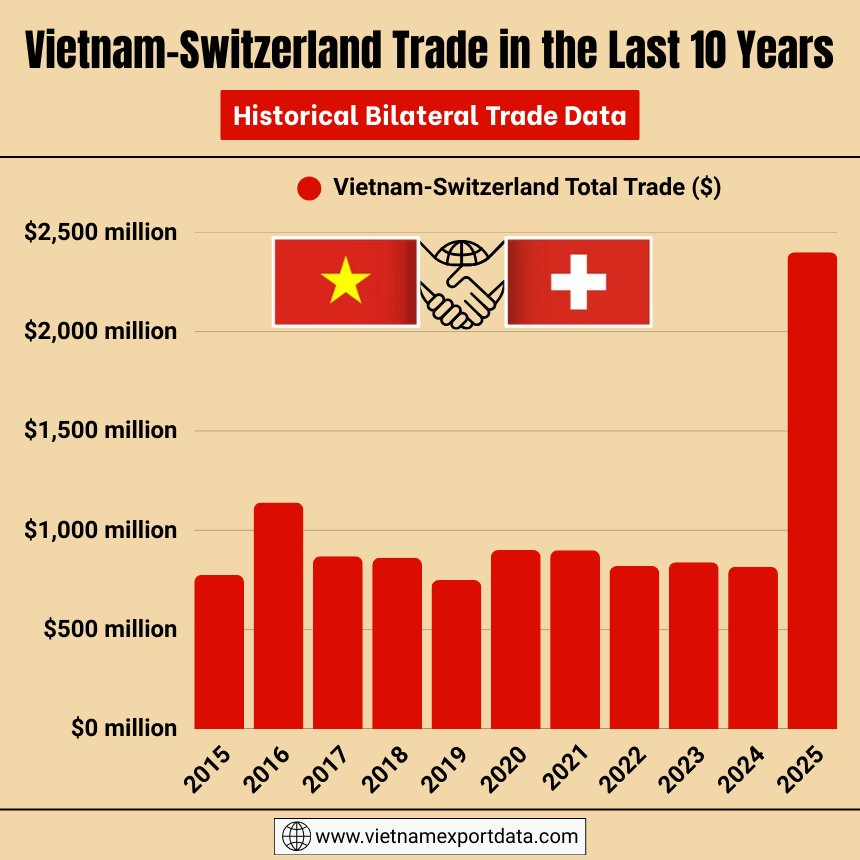
Vietnam-Switzerland Trade in the Last 10 Years: Historical Bilateral Trade Data
|
Year of Trade |
Vietnam-Switzerland Total Trade ($) |
|
2015 |
$775.38 million |
|
2016 |
$1.14 billion |
|
2017 |
$868.95 million |
|
2018 |
$861.89 million |
|
2019 |
$749.37 million |
|
2020 |
$900.63 million |
|
2021 |
$898.91 million |
|
2022 |
$820.40 million |
|
2023 |
$839.53 million |
|
2024 |
$816.75 million |
|
2025 |
$2.40 billion |
Structural Impact: What the FTA Will Actually Do
Once signed, the agreement is expected to deliver several measurable outcomes.
1. Tariff Reduction
The FTA will:
-
Reduce or eliminate tariffs on industrial and agricultural goods
-
Improve the price competitiveness of Vietnamese exports
This is especially important in sectors like:
-
Seafood
-
Textiles
-
Electronics
2. Investment Flows
EFTA countries, especially Switzerland, are known for:
-
High-quality foreign direct investment (FDI)
-
Technology-intensive industries
The agreement will:
-
Strengthen investor protections
-
Increase transparency
-
Encourage long-term capital inflows
3. Supply Chain Integration
The deal is expected to:
-
Strengthen Vietnam’s role in European supply chains
-
Improve resilience against global disruptions
This is particularly relevant in a world reshaped by geopolitical tensions and supply chain diversification.
Why Switzerland Matters More Than It Looks
Although the agreement is with EFTA, Switzerland plays a central role.
1. Economic Weight
Switzerland is:
-
The largest economy in EFTA
-
A global hub for finance, pharmaceuticals, and innovation
2. Investment Presence in Vietnam
-
100 Swiss companies operate in Vietnam
These include companies in:
-
Manufacturing
-
Healthcare
-
Engineering
3. Strategic Influence
Switzerland often sets the tone for:
-
Regulatory standards
-
Investment frameworks
-
Negotiation priorities
This explains why bilateral Vietnam–Switzerland trade talks are being highlighted as a “breakthrough signal.”
Comparing With Other Trade Deals: Lessons from India–EFTA
A useful benchmark is the India–EFTA agreement, concluded after 16 years of negotiation.
Key features included:
-
Tariff reductions on over 90% of goods
-
$100 billion investment commitments
-
Large-scale job creation
The Vietnam–EFTA FTA could follow a similar trajectory, though with different sectoral impacts.
Key insight: Once EFTA commits, it tends to deliver long-term investment, not just trade liberalization.
Sector-Level Opportunities
1. Manufacturing
Vietnam’s manufacturing sector stands to gain from:
-
Lower export barriers
-
Access to high-tech inputs
-
Integration with European production networks
2. Agriculture
EFTA markets demand:
-
High-quality, certified agricultural products
The FTA will help Vietnam:
-
Meet standards
-
Expand exports of coffee, seafood, and processed foods
3. Services
The agreement includes:
-
Market access for services
-
Digital trade provisions
This opens doors for:
-
IT services
-
Financial services
-
Trade
Risks and Challenges
Despite the optimism, several challenges remain.
1. High Standards Barrier
EFTA markets have:
-
Strict quality requirements
-
Strong regulatory frameworks
Vietnamese firms must:
-
Upgrade production
-
Improve compliance
2. Domestic Readiness
The success of the FTA depends on:
-
Policy alignment
-
Business preparedness
-
Institutional reforms
3. Competition Pressure
Lower tariffs also mean:
-
Increased competition from European firms
This could impact:
-
Domestic industries
-
Small and medium enterprises
Strategic Context: Why Now?
1. Global Trade Fragmentation
The world is seeing:
-
Rising protectionism
-
Supply chain realignment
Vietnam is responding by:
-
Diversifying trade partners
-
Reducing dependence on major markets
2. Vietnam’s FTA Strategy
Vietnam already has:
-
CPTPP
-
EVFTA
-
RCEP
Adding EFTA strengthens its position as:
-
A global manufacturing hub
-
A key link between Asia and Europe
3. EFTA’s Motivation
EFTA countries want:
-
Better access to fast-growing Asian markets
-
Reduced competitive disadvantage compared to EU firms
What Happens Next?
Based on current data and signals, the roadmap looks like this:
-
April 2026: Final negotiation round in Hanoi
-
Q2 2026: Legal scrubbing and final alignment
-
June 2026: Potential announcement of conclusion
-
Post-2026: Ratification and implementation
This is the most concrete timeline since negotiations began in 2012.
Conclusion: A Breakthrough Years in the Making
The latest Vietnam–Switzerland trade talks are not just another round of negotiations. They mark a structural shift in one of the longest-running trade discussions in Asia–Europe relations.
The signs of a breakthrough are clear:
-
Political alignment at the highest levels
-
Agreement on negotiation discipline (no new issues)
-
Defined timelines for conclusion
-
Transition into the technical finalization phase
From a data perspective, the case is equally strong:
-
€4.1 billion trade base ready for expansion
-
CHF 2.19 billion bilateral trade with Switzerland
-
€1.3 trillion EFTA market waiting to be tapped
If successfully concluded, the Vietnam–EFTA FTA will not just boost trade numbers. It will reshape supply chains, attract high-quality investment, and push Vietnam further up the global value chain. After more than a decade of slow progress, the negotiations have finally reached a point where momentum, economics, and geopolitics are aligned. And that is what makes this moment different.
Note For Our Readers
We hope you found this detailed, data-driven analysis of the Vietnam–Switzerland trade talks and the broader Vietnam–EFTA FTA negotiations insightful and practical. As Vietnam moves closer to concluding one of its most complex trade agreements, understanding the underlying data becomes essential for businesses, policymakers, and trade professionals looking to anticipate market shifts and identify new opportunities across Europe and Asia.
Looking to dive deeper into Vietnam’s trade performance or monitor sector-specific export-import activity? Access the latest Vietnam trade statistics or search live Vietnam shipment data by HS code, product, or country, with VietnamExportdata. For customized trade intelligence, verified importer-exporter databases, buyer insights, or tailored market research reports, feel free to reach out to us at info@tradeimex.in today.
Share
What's Your Reaction?
 Like
0
Like
0
 Dislike
0
Dislike
0
 Love
0
Love
0
 Funny
0
Funny
0
 Angry
0
Angry
0
 Sad
0
Sad
0
 Wow
0
Wow
0