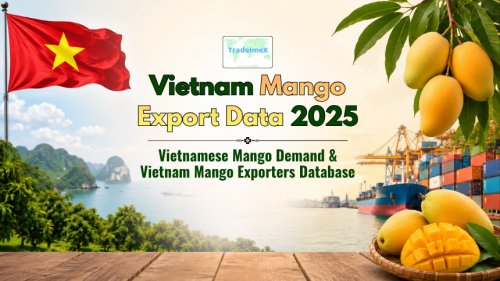
Vietnam Mango Export Data 2025: Vietnamese Mango Demand & Vietnam Mango Exporters Database
Explore Vietnam mango export data 2025, Vietnamese mango exporters database, leading buyer countries, & market analysis for Vietnam mango trade.

Vietnam’s mango industry is rapidly becoming one of Southeast Asia’s strongest fruit export sectors. Known for its tropical climate, fertile agricultural land, and expanding global trade network, Vietnam has significantly increased mango production and exports over the past decade. Vietnamese mangoes continue gaining popularity across major international markets due to their quality, competitive pricing, year-round availability, and growing compliance with global food safety standards. According to the latest Vietnam export data and Vietnam customs export data of Mango, Vietnam mango exports reached $420 million in 2025, a 3% increase from the previous year. Vietnam mango exports exceeded 350,000 metric tons in 2025, according to Vietnam mango export data.
Vietnam is the 13th largest exporter of Mangoes in the world, according to global trade data. As international demand for tropical fruits rises, Vietnam is positioning itself as a major supplier of fresh mangoes to countries across Asia, Europe, the Middle East, and North America. Vietnam’s mango export sector is also benefiting from free trade agreements, improved trade infrastructure, & increasing investments in post-harvest processing and cold chain systems. This blog provides a detailed analysis of Vietnam mango export data in 2025, including export value, production statistics, top importing countries, major mango varieties, demand trends, export opportunities, and insights into the Vietnam mango exporters database.
Overview of Vietnam’s Mango Industry
Vietnam is one of the leading mango-producing countries in Asia. Mango cultivation is concentrated mainly in the Mekong Delta region and southern provinces, where tropical conditions support large-scale fruit farming. The cultivation of mango in Vietnam has expanded rapidly due to rising global demand and improved farming practices across key producing regions. Today, mango Vietnam exports are gaining strong momentum in international markets, supported by better quality standards, modern packaging, and increasing trade partnerships with countries in Asia, Europe, and North America. The country currently cultivates mangoes across more than 115,000 hectares of agricultural land, with annual production exceeding 1 million metric tons. Provinces such as:
-
Dong Thap
-
Tien Giang
-
An Giang
-
Vinh Long
-
Khanh Hoa
-
Son La
They are among the largest mango-producing regions in Vietnam. Vietnam grows several commercial mango varieties, including:
-
Cat Chu Mango
-
Cat Hoa Loc Mango
-
Keo Mango
-
Taiwan Mango
-
Green Mango
-
Australian Mango varieties
Among these, Cat Chu and Cat Hoa Loc mangoes are highly valued in export markets due to their sweetness, aroma, texture, and premium quality.
Vietnam Mango Export Data 2025
Vietnam’s mango exports have continued growing steadily in 2025 due to rising international demand for tropical fruits. According to recent agricultural trade estimates:
-
Vietnam’s mango exports exceeded $420 million in 2025
-
Export volume crossed 350,000 metric tons
-
Average annual export growth remains between 10% and 15%
Fresh mango exports account for the majority of shipments, although processed mango products such as:
-
Dried mango
-
Frozen mango
-
Mango puree
-
Mango juice
-
Mango pulp
These are also witnessing strong international demand. Vietnam currently exports mangoes to more than 40 countries worldwide.
Vietnam Mango Exports by Country: Top Importers of Vietnamese Mangoes in 2025
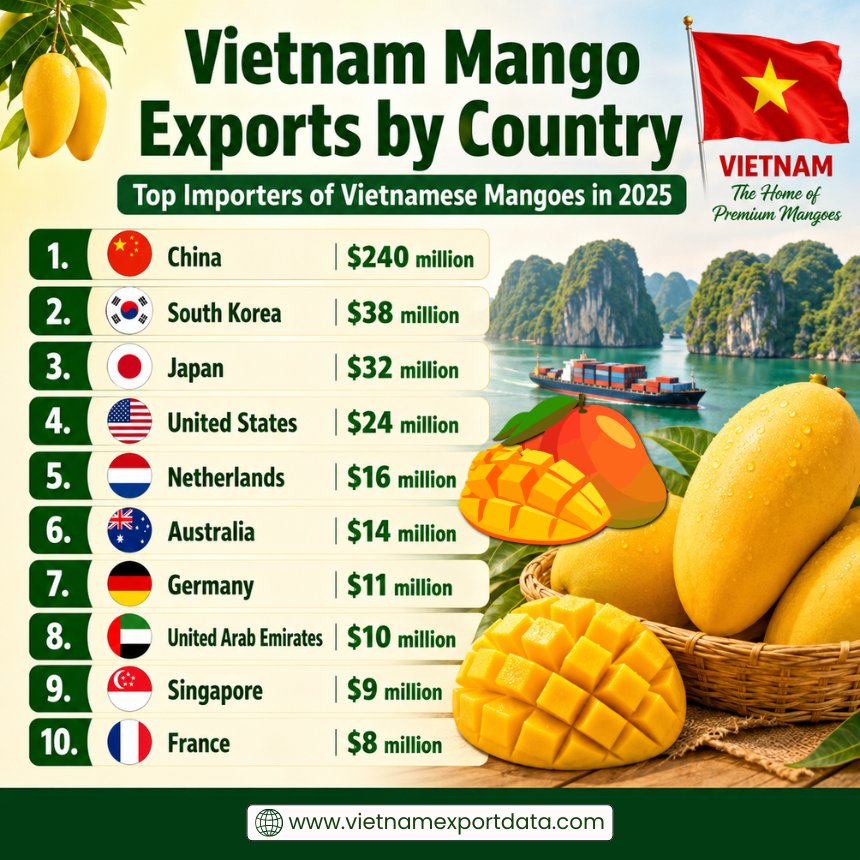
Vietnamese mango exports are widely distributed across Asia, North America, Europe, and the Middle East. In 2025, Vietnam’s total mango export value surpassed $420 million, with China continuing to dominate as the largest destination market, as per the data on Vietnam mango exports by country. Below are the top 10 importers of Vietnamese mangoes in 2025 based on export value and export share:
1. China: $240 million (57.1%)
2. South Korea: $38 million (9.0%)
3. Japan: $32 million (7.6%)
4. United States: $24 million (5.7%)
5. Netherlands: $16 million (3.8%)
6. Australia: $14 million (3.3%)
7. Germany: $11 million (2.6%)
8. United Arab Emirates: $10 million (2.4%)
9. Singapore: $9 million (2.1%)
10. France: $8 million (1.9%)
These top 10 countries together account for more than 95% of Vietnam’s total mango exports, highlighting the growing international demand for Vietnamese tropical fruits.
1. China
China remains the largest importer of Vietnamese mangoes, accounting for around 57.1% of total exports in 2025, as per the data on Vietnam mango exports to China. Several factors support strong exports to China:
-
Geographic proximity
-
Lower transportation costs
-
High consumer demand
-
Cross-border agricultural trade agreements
Chinese consumers prefer Vietnamese mangoes because of:
-
Competitive pricing
-
Sweet taste
-
Fast delivery timelines
-
Availability throughout the year
Border trade through northern Vietnam continues playing a critical role in mango shipments to China.
2. South Korea
South Korea is the second-largest importer, contributing around 9% of Vietnam’s mango export revenue, as per the data on Vietnam mango exports to South Korea. Vietnamese mango exports to South Korea have increased steadily due to:
-
Rising tropical fruit consumption
-
Strict quality compliance improvements
-
Expanding Vietnamese agricultural branding
South Korean buyers particularly demand:
-
High-quality Cat Chu mangoes
-
Fresh premium mangoes
-
Certified pesticide-free produce
3. Japan
Japan accounts for nearly 7.6% of Vietnamese mango exports by value. Vietnamese mangoes entering Japan must comply with:
-
Strict phytosanitary standards
-
Irradiation treatment requirements
-
Food safety regulations
Although export volumes are smaller compared to China, profit margins are significantly higher because Japanese consumers prefer premium-quality tropical fruits.
4. United States
The United States contributed approximately 5.7% of Vietnam’s mango export value in 2025. Vietnamese exporters benefit from:
-
Growing Asian consumer populations
-
Rising tropical fruit demand
-
Increased supermarket availability
The U.S. market mainly imports:
-
Fresh mangoes
-
Frozen mango products
-
Organic mango varieties
5. Netherlands
The Netherlands serves as a major European distribution hub and accounts for around 3.8% of Vietnam’s mango exports. Dutch importers play a critical role in redistributing Vietnamese mangoes across Europe, especially to:
-
Germany
-
Belgium
-
France
-
Scandinavia
The EU-Vietnam Free Trade Agreement (EVFTA) has further supported export growth into the European market.
6. Australia
Australia contributes nearly 3.3% of total mango export revenue. Australian consumers increasingly prefer imported tropical fruits due to:
-
Off-season demand
-
Diverse multicultural food markets
-
Growing Asian population
Vietnamese mangoes exported to Australia must meet strict biosecurity and quarantine standards.
7. Germany
Germany accounts for approximately 2.6% of Vietnam’s mango exports in 2025. Demand is growing due to:
-
Rising health-conscious consumers
-
Increased demand for organic produce
-
Expanding tropical fruit retail availability
German importers also prefer:
-
Sustainably sourced fruits
-
Traceable supply chains
-
Eco-friendly packaging
8. United Arab Emirates
The United Arab Emirates contributes about 2.4% of the Vietnamese mango export value. The UAE acts as both:
-
A major consumer market
-
A re-export hub for the Middle East
Strong demand comes from:
-
Hotels and hospitality sectors
-
Supermarket chains
-
Foodservice industries
9. Singapore
Singapore accounts for nearly 2.1% of total exports. Despite its smaller population, Singapore imports large volumes of premium fruits because of:
-
High consumer purchasing power
-
Strong retail demand
-
Dependence on imported food products
Vietnamese mangoes are popular in Singapore:
-
Supermarkets
-
Restaurants
-
Juice and dessert industries
10. France
France contributes around 1.9% of Vietnam’s mango exports. French consumers increasingly prefer:
-
Exotic tropical fruits
-
Organic agricultural products
-
Sustainably sourced produce
Vietnamese mango exporters are gradually expanding their presence in French retail and wholesale markets through improved quality certifications and a cold chain.
Vietnam Mango Exporters Database 2025
The Vietnam mango exporters database has become highly valuable for:
-
Importers
-
Food distributors
-
Supermarkets
-
Agricultural traders
-
Fruit wholesalers
-
International sourcing companies
A comprehensive exporters database typically includes:
-
Exporter company names
-
Shipment records
-
Product descriptions
-
Export destinations
-
Buyer details
-
HS codes
-
Port information
-
Quantity shipped
-
Pricing data
This data helps businesses:
-
Identify reliable suppliers
-
Analyze competitor activities
-
Track shipment trends
-
Discover new sourcing opportunities
-
Build direct trade partnerships
Major Vietnamese Mango Export Companies
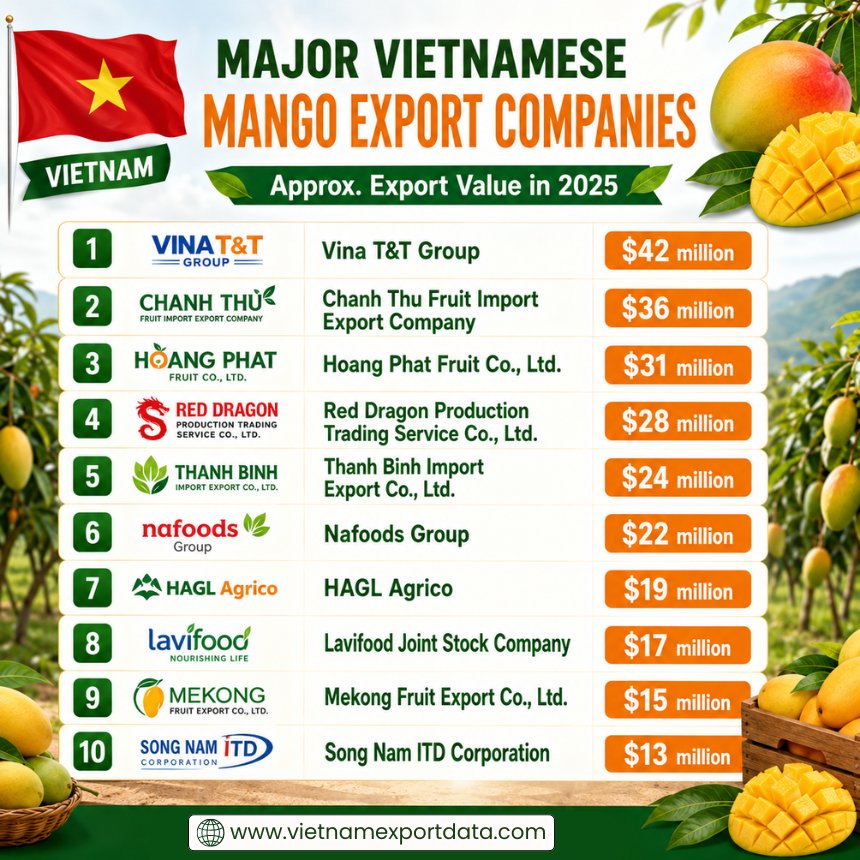
Several Vietnamese companies play an important role in mango exports. Key exporters often specialize in:
-
Fresh fruit exports
-
Processed fruit manufacturing
-
Frozen fruit supply
-
Organic agricultural products
Exporters are increasingly investing in:
-
Packaging technology
-
Traceability systems
-
International certifications
-
Sustainable farming partnerships
Vina T&T Group remains the largest mango exporter in Vietnam. The leading mango exporters in Vietnam, according to the Vietnam mango suppliers & mango exporters database for 2025, include:
1. Vina T&T Group
-
Approx. Export Value in 2025: $42 million
-
Top Exported Mango Types: Cat Chu Mango, Cat Hoa Loc Mango
-
Top Export Destinations: United States, Australia, Japan
2. Chanh Thu Fruit Import Export Company
-
Approx. Export Value in 2025: $36 million
-
Top Exported Mango Types: Cat Hoa Loc Mango, Green Mango
-
Top Export Destinations: China, South Korea, United States
3. Hoang Phat Fruit Co., Ltd.
-
Approx. Export Value in 2025: $31 million
-
Top Exported Mango Types: Keo Mango, Taiwan Mango
-
Top Export Destinations: China, Singapore, UAE
4. Red Dragon Production Trading Service Co., Ltd.
-
Approx. Export Value in 2025: $28 million
-
Top Exported Mango Types: Cat Chu Mango, Organic Mango
-
Top Export Destinations: Europe, Japan, South Korea
5. Thanh Binh Import Export Co., Ltd.
-
Approx. Export Value in 2025: $24 million
-
Top Exported Mango Types: Green Mango, Cat Hoa Loc Mango
-
Top Export Destinations: China, Malaysia, Thailand
6. Nafoods Group
-
Approx. Export Value in 2025: $22 million
-
Top Exported Mango Types: Frozen Mango, Mango Puree
-
Top Export Destinations: Europe, the United States, and South Korea
7. HAGL Agrico
-
Approx. Export Value in 2025: $19 million
-
Top Exported Mango Types: Taiwan Mango, Fresh Mango
-
Top Export Destinations: China, South Korea
8. Lavifood Joint Stock Company
-
Approx. Export Value in 2025: $17 million
-
Top Exported Mango Types: Frozen Mango, Dried Mango
-
Top Export Destinations: Japan, the EU, Australia
9. Mekong Fruit Export Co., Ltd.
-
Approx. Export Value in 2025: $15 million
-
Top Exported Mango Types: Cat Chu Mango, Keo Mango
-
Top Export Destinations: China, Singapore, UAE
10. Song Nam ITD Corporation
-
Approx. Export Value in 2025: $13 million
-
Top Exported Mango Types: Organic Mango, Fresh Mango
-
Top Export Destinations: Europe, Canada, Australia
Vietnam Mango Exports in The Last 10 Years
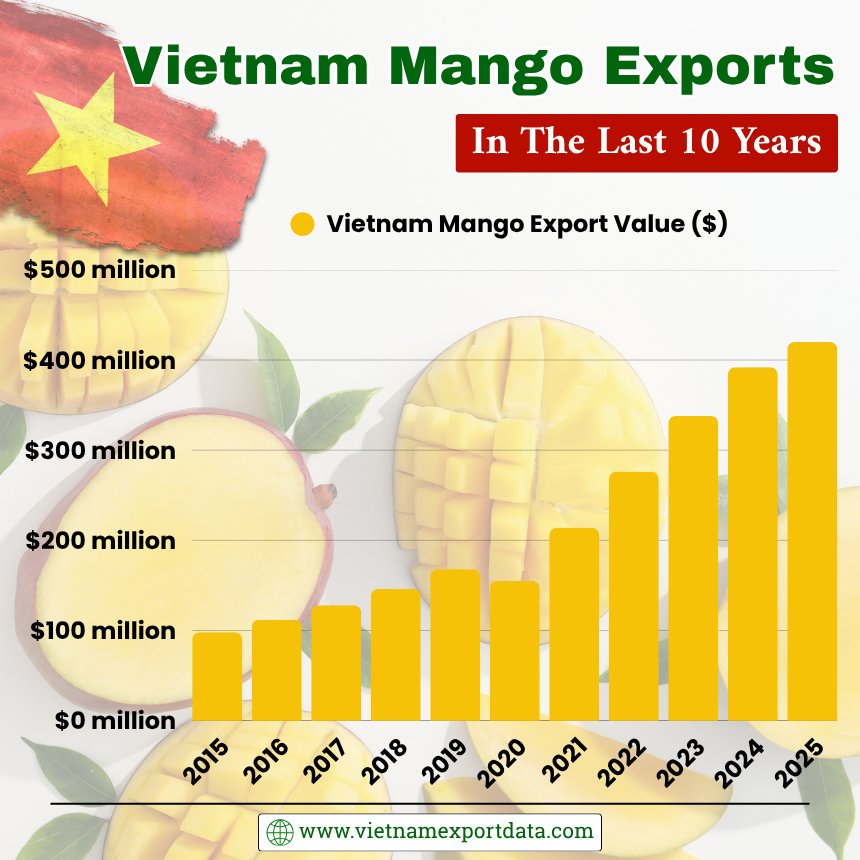
|
Year of Exports |
Vietnam Mango Export Value ($) |
|
2015 |
$98 million |
|
2016 |
$112 million |
|
2017 |
$128 million |
|
2018 |
$146 million |
|
2019 |
$168 million |
|
2020 |
$155 million |
|
2021 |
$214 million |
|
2022 |
$276 million |
|
2023 |
$338 million |
|
2024 |
$392 million |
|
2025 |
$420 million |

Vietnam Mango Production Trends in 2025
Vietnam’s mango production is benefiting from agricultural modernization and export-oriented farming practices.
Expansion of High-Quality Farming
Farmers are increasingly adopting:
-
GlobalG.A.P certification
-
Organic farming practices
-
Drip irrigation systems
-
Precision agriculture techniques
These improvements are helping Vietnam meet international import requirements and improve export competitiveness.
Growth of Cold Chain Infrastructure
Cold storage and trade investments are transforming Vietnam’s fruit export industry. Improved cold chain systems help:
-
Extend mango shelf life
-
Reduce spoilage during transportation
-
Maintain export quality
-
Support long-distance shipping
This is especially important for exports to Europe and North America.
Rising Demand for Processed Mango Products
Processed mango products are becoming a major growth segment in Vietnam’s agricultural exports. Global food manufacturers increasingly use Vietnamese mangoes for:
-
Smoothies
-
Desserts
-
Ice creams
-
Beverages
-
Snack products
The processed fruit segment offers:
-
Higher profit margins
-
Reduced wastage
-
Longer shelf life
-
Expanded market access
Key Drivers Behind Vietnamese Mango Demand
Several global factors are driving demand for Vietnamese mango exports in 2025.
1. Rising Global Consumption of Tropical Fruits
Consumers worldwide are increasingly choosing tropical fruits because of:
-
Health benefits
-
Natural sweetness
-
Nutritional value
-
Exotic flavor profiles
Mangoes are rich in:
-
Vitamin C
-
Fiber
-
Antioxidants
-
Vitamin A
This has boosted global mango consumption significantly.
2. Competitive Pricing
Vietnamese mangoes are competitively priced compared to exports from:
-
Thailand
-
India
-
Mexico
-
Philippines
Lower production and labor costs help Vietnamese exporters remain price-competitive in international markets.
3. Free Trade Agreements
Vietnam has strengthened agricultural exports through several trade agreements, including:
-
EVFTA
-
CPTPP
-
ASEAN trade agreements
-
RCEP
These agreements reduce tariffs and improve market access for Vietnamese agricultural products.
4. Supply Chain Diversification
Global buyers are increasingly diversifying sourcing away from single-country dependence. Importers now seek multiple sourcing destinations to reduce risks linked to:
-
Climate disruptions
-
Trade bottlenecks
-
Geopolitical uncertainty
Vietnam benefits from this diversification trend.
Challenges Facing Vietnam’s Mango Export Industry
Despite strong growth, the industry still faces several challenges.
1. Climate Change Risks
Extreme weather conditions such as:
-
Flooding
-
Droughts
-
Heatwaves
can impact mango yields and production quality.
2. Strict International Regulations
Export markets increasingly require:
-
Residue testing
-
Traceability
-
Sustainability certifications
-
Food safety compliance
Small-scale farmers may struggle to meet these standards consistently.
3. Strong Competition
Vietnam competes with major mango exporters, including:
-
India
-
Mexico
-
Thailand
-
Peru
-
Pakistan
-
Philippines
Maintaining quality and pricing competitiveness remains essential.
Opportunities for Global Importers
Vietnam’s mango industry offers significant opportunities for international buyers. Importers benefit from:
-
Competitive pricing
-
Diverse mango varieties
-
Growing export capacity
-
Expanding certifications
-
Year-round supply potential
The growing professionalization of Vietnam’s agricultural export sector is increasing buyer confidence globally.
Future Outlook for Vietnam Mango Exports
The future of Vietnam’s mango export industry looks highly promising. Industry analysts expect:
-
Continued export growth through 2030
-
Expansion into premium global markets
-
Increased processed mango exports
-
Higher adoption of organic farming
-
Greater investment in agricultural technology
As consumer demand for tropical fruits rises globally, Vietnam is likely to strengthen its position among the world’s leading mango-exporting countries.
Conclusion and Final Words
Vietnam’s mango export industry is entering a new phase of international growth and competitiveness in 2025. Rising production capacity, strong demand from global markets, expanding trade agreements, and improvements in agricultural quality standards are helping Vietnam become a major player in the global mango trade. China continues dominating as the largest importer, while markets such as Japan, South Korea, the United States, and Europe are creating new opportunities for premium Vietnamese mango exports.
At the same time, the Vietnam mango exporters database is becoming an essential resource for importers, wholesalers, distributors, and sourcing companies seeking verified supplier information and real-time trade insights. With increasing investments in trade, sustainability, food safety, and processing infrastructure, Vietnam’s mango sector is well-positioned for long-term global expansion.
Note For Our Readers
We hope this blog on Vietnam mango export data in 2025, Vietnamese mango demand trends, global market opportunities, and the Vietnam mango exporters database helps you better understand the current agricultural trade landscape, export patterns, sourcing opportunities, and international fruit trade dynamics.
If you’re looking for deeper market insights, customized Vietnam import-export data, or want to explore live Vietnam mango export data by country, buyer, supplier, or HS code, feel free to connect with VietnamExportdata. We provide comprehensive and updated global trade databases designed to support market research, buyer identification, competitor analysis, supplier sourcing, and international business expansion. For exclusive access or customized trade data solutions, contact us at info@tradeimex.in and make smarter import-export decisions with confidence.
Share
What's Your Reaction?
 Like
1
Like
1
 Dislike
0
Dislike
0
 Love
1
Love
1
 Funny
0
Funny
0
 Angry
0
Angry
0
 Sad
0
Sad
0
 Wow
1
Wow
1