Vietnam-Philippines Trade Relations: Latest Bilateral Trade Data & Top Traded Products
Explore Vietnam–Philippines trade relations with the latest 2025 bilateral trade data, top traded products, import-export trends, & future outlook.

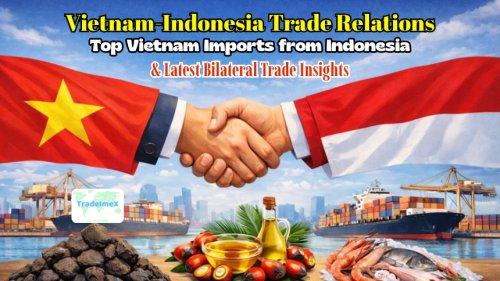
Bilateral Trade between Vietnam and the Philippines has gained increasing prominence in Southeast Asia’s evolving economic landscape. As two dynamic ASEAN economies with complementary production structures and growing consumer markets, both nations have steadily strengthened their commercial ties. In recent years, bilateral trade has not only recorded steady growth but also diversified across a broader range of product categories. According to the latest Vietnam import data and Philippines export data, the total value of Vietnam imports from the Philippines reached $2.47 billion, while Vietnam exports to the Philippines reached $6.17 billion in 2024-25, as per the Vietnam export data.
The total value of the Vietnam-Philippines trade accounted for $8.66 billion in 2024 and around $10 billion in 2025, showing consistent growth in the last decade, as per the Asia trade data. In this blog, we explore the latest trade data for 2024–25, analyze trends shaping the Vietnam-Philippines trading partnership, and break down the top exported and imported products. We also examine structural drivers, emerging opportunities, and challenges that could shape the next phase of bilateral commerce.
Overview of Bilateral Trade Growth
In 2024, bilateral trade between Vietnam and the Philippines reached a record level of approximately US$8.66 billion, marking a notable uptick from 2023. This figure represents an 11 % increase year-on-year, underscoring robust demand and deeper market integration between the two ASEAN partners.
Within this total trade volume:
-
Vietnam’s exports to the Philippines surged to US$6.19 billion in 2024, the highest on record.
-
Vietnam’s imports from the Philippines reached approximately US$2.47 billion, down modestly from 2023.
-
As a result, Vietnam posted a substantial trade surplus of about US$3.7 billion with the Philippines in 2024.
The growth of Vietnamese exports to the Philippines, the archipelago nation was particularly noteworthy, growing over 20 % versus 2023. Before this surge, bilateral trade had been relatively stagnant in the immediate post-pandemic years, but strategic market efforts and strong product demand shifted the trend upward.
Early 2025 Trade Snapshots
Trade figures during the first months of 2025 reveal a mixed picture:
-
In Q1 2025, Vietnam’s exports to the Philippines totaled around US$1.402 billion, though this was a slight decline of 3.8 % compared to Q1 2024.
-
Conversely, Vietnamese imports from the Philippines over the same period were US$672 million, also declining 4.6 % year-on-year.
-
Combined, bilateral trade for Q1 2025 hovered near US$2.07 billion.
Despite these short-term fluctuations, exporters on both sides remain optimistic about trade diversification and expansion, especially with shared goals for a US$10 billion trade target in the near term.
Top Goods Vietnam Imports from Philippines: What Does Vietnam Import from the Philippines?
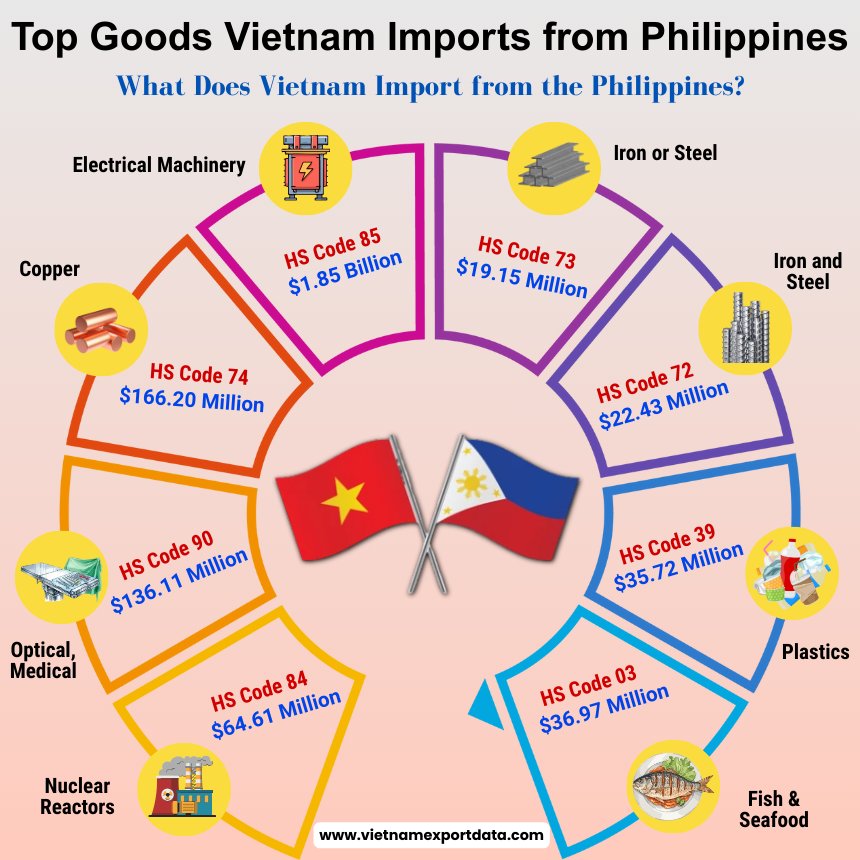
Vietnam mainly imports electronic products from the Philippines, such as semiconductors, electronic parts, and household appliances. These goods are essential for Vietnam's growing technology industry and contribute significantly to the country's economic development. Additionally, agricultural products like bananas and coconuts are also major imports from the Philippines, assisting Vietnam in meeting its food demands and diversifying its agricultural market. The top 10 products that Vietnam imports from Philippines, as per the Vietnam customs data for 2025, include:
1. Electrical Machinery & Equipment (HS Code 85): $1.85 Billion
One of the largest categories of goods that Vietnam imports from the Philippines is electrical machinery and equipment, as per the data on Vietnam electronics imports from Philippines by HS code. This includes items such as electrical appliances, sound and television equipment, and electrical parts. With a total value of $1.85 billion, electrical machinery and equipment are a significant part of Vietnam's import trade with the Philippines.
2. Copper & Articles Thereof (HS Code 74): $166.20 Million
Copper and articles thereof are another major category of goods that Vietnam imports from the Philippines. This includes items such as copper wire, cables, & other copper products. With a total import value of $166.20 million, copper is an important commodity that Vietnam relies on the Philippines for.
3. Optical, Medical, Surgical Instruments (HS Code 90): $136.11 Million
Optical, medical, and surgical instruments are also among the top goods that Vietnam imports from the Philippines. This category includes items such as eyeglasses, medical devices, and surgical equipment. With a total import value of $136.11 million, Vietnam depends on the Philippines for high-quality optical and medical instruments.
4. Nuclear Reactors & Machinery (HS Code 84): $64.61 Million
Nuclear reactors and machinery are another category of goods that Vietnam imports from the Philippines. While this category may not be as large as others, with a total import value of $64.61 million, it still plays a significant role in Vietnam's import trade with the Philippines.
5. Fish & Seafood (HS Code 03): $36.97 Million
As an island nation, the Philippines is known for its abundant fish and seafood resources. Vietnam imports a variety of fish and seafood products from the Philippines, with a total import value of $36.97 million. This includes fresh and frozen fish, as well as processed seafood products.
6. Plastics & Articles Thereof (HS Code 39): $35.72 Million
Plastics and articles thereof are also among the top goods that Vietnam imports from the Philippines. This category includes items such as plastic bags, containers, and other plastic products. With a total import value of $35.72 million, plastics are an essential part of Vietnam's import trade with the Philippines.
7. Iron and Steel (HS Code 72): $22.43 Million
Iron and steel products are another important category of goods that Vietnam imports from the Philippines. This includes items such as iron and steel bars, rods, and other iron and steel products. With a total import value of $22.43 million, iron and steel play a crucial role in Vietnam's manufacturing industry.
8. Articles of Iron or Steel (HS Code 73): $19.15 Million
In addition to raw iron and steel products, Vietnam also imports articles made of iron or steel from the Philippines. This category includes items such as iron or steel structures, tools, and other iron and steel articles. With a total import value of $19.15 million, articles of iron or steel are an important part of Vietnam's import trade with the Philippines.
9. Sugars & Sugar Confectionery (HS Code 17): $14.28 Million
Sugars and sugar confectionery are also among the goods that Vietnam imports from the Philippines. This category includes items such as sugar, candies, and other sugar-based products. With a total import value of $14.28 million, sugars and sugar confectionery play a small but significant role in Vietnam's import trade with the Philippines.
10. Fertilizers (HS Code 31): $12.86 Million
Lastly, fertilizers are among the top goods that Vietnam imports from the Philippines. Fertilizers are essential for Vietnam's agricultural industry, helping to boost crop yields and improve soil fertility. With a total import value of $12.86 million, fertilizers from the Philippines are crucial for Vietnam's agricultural sector.
Major Products Vietnam Exports to Philippines: What Does Vietnam Export to the Philippines?
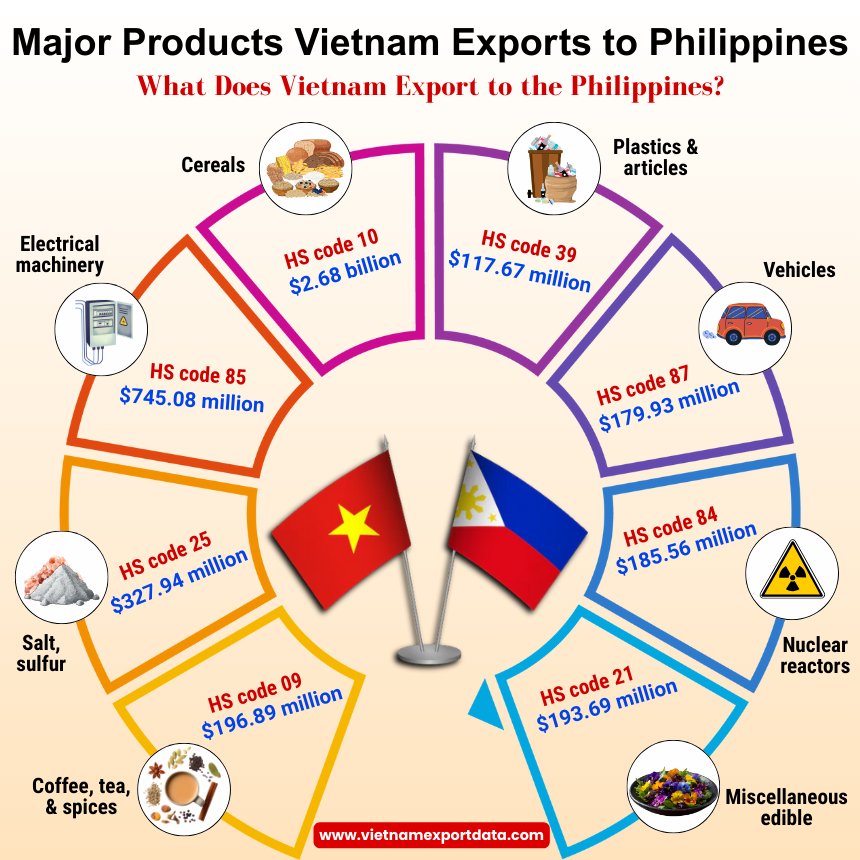
Vietnam is a key trading partner of the Philippines, with several major products being exported from Vietnam to the Philippines. Some of the notable items include electronics, textiles, footwear, and agricultural products such as coffee, rice, & seafood. These products contribute significantly to the bilateral trade relationship between the two countries, showcasing the mutual benefits of cooperation in the Southeast Asian region. The top 10 goods that Vietnam exports to Philippines, as per the Vietnam shipment data for 2025, include:
1. Cereals (HS code 10): $2.68 billion
Cereals are one of the top products that Vietnam exports to the Philippines, with a total export value of $2.68 billion. This category includes products such as rice, corn, and wheat. Vietnam is known for its high-quality rice production, and the Philippines is a major importer of Vietnamese rice, as per the customs data on Vietnam rice exports to Philippines.
2. Electrical machinery & equipment (HS code 85): $745.08 million
Electrical machinery and equipment are another significant export category for Vietnam, with an export value of $745.08 million. This category includes products such as electrical appliances, machinery, and telecommunications equipment. Vietnam has a growing electronics industry, and the Philippines is a key market for Vietnamese electronic products.
3. Salt, sulfur, lime, & cement (HS code 25): $327.94 million
Vietnam also exports a significant amount of salt, sulfur, lime, and cement to the Philippines, with a total export value of $327.94 million. These products are essential for various industries, including construction, agriculture, and manufacturing. Vietnam's proximity to the Philippines makes it a convenient source for these products.
4. Coffee, tea, & spices (HS code 09): $196.89 million
Coffee, tea, and spices are popular agricultural products that Vietnam exports to the Philippines, with a total export value of $196.89 million. Vietnam is known for its high-quality coffee and tea production, and these products are in high demand in the Philippines. Vietnamese spices are also valued for their unique flavors and aromas.
5. Miscellaneous edible preparations (HS code 21): $193.69 million
Miscellaneous edible preparations are another important export category for Vietnam, with a total export value of $193.69 million. This category includes products such as sauces, condiments, and food preparations. Vietnamese cuisine is popular in the Philippines, leading to a steady demand for these products.
6. Nuclear reactors & machinery (HS code 84): $185.56 million
Nuclear reactors and machinery are significant export products for Vietnam, with an export value of $185.56 million. This category includes equipment for power generation, industrial machinery, and other specialized machinery. Vietnam's engineering expertise makes it a reliable source for these products.
7. Vehicles (HS code 87): $179.93 million
Vietnam also exports vehicles to the Philippines, with a total export value of $179.93 million. This category includes cars, motorcycles, and other motor vehicles. Vietnamese vehicles are known for their affordability and reliability, making them popular in the Philippine market.
8. Plastics & articles thereof (HS code 39): $117.67 million
Plastics and articles made from plastics are another major export category for Vietnam, with an export value of $117.67 million. This category includes products such as plastic bags, containers, and packaging materials. Vietnam's plastic industry is well-developed, providing a wide range of products for export.
9. Footwear (HS code 64): $107.83 million
Footwear is a popular export product for Vietnam, with a total export value of $107.83 million. Vietnamese footwear is known for its quality and affordable prices, making it a competitive product in the international market. The Philippines imports a significant amount of Vietnamese footwear each year.
10. Fish & seafood (HS code 03): $104.29 million
Finally, fish and seafood are important export products for Vietnam, with a total export value of $104.29 million. Vietnam is a major producer of fish and seafood, with a diverse range of products such as shrimp, fish fillets, and squid. The Philippines imports a significant amount of Vietnamese fish and seafood to meet domestic demand.
Vietnam-Philippines Trade in the Last 10 Years: Historical Bilateral Trade Data
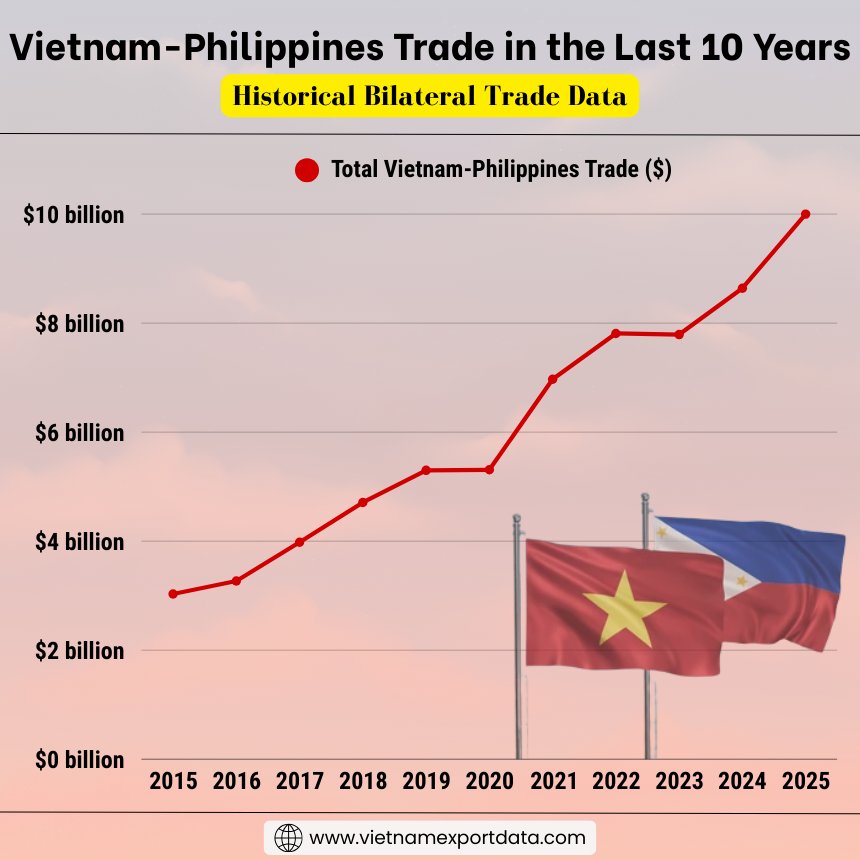
|
Year of Trade |
Total Vietnam-Philippines Trade ($) |
|
2015 |
$3.03 billion |
|
2016 |
$3.27 billion |
|
2017 |
$3.98 billion |
|
2018 |
$4.71 billion |
|
2019 |
$5.30 billion |
|
2020 |
$5.31 billion |
|
2021 |
$6.97 billion |
|
2022 |
$7.81 billion |
|
2023 |
$7.79 billion |
|
2024 |
$8.66 billion |
|
2025 |
$10 billion |
Trade Structure: Exports from Vietnam to the Philippines
Vietnam’s export profile to the Philippines in 2024 exhibits both traditional staples and manufactured goods as key drivers of the trade surge.
Top Vietnamese Export Categories
Based on official customs and trade office data, major export categories in 2024 included:
1. Rice and Agricultural Products
-
Rice is by far the largest Vietnamese export to the Philippines, with a value exceeding US$2.6 billion in 2024.
-
This reflects a near 50 % year-on-year increase in Vietnam rice export to Philippines, amid strong Philippine demand for staple food imports.
-
Historically, the Philippines has been one of the world’s largest rice importers, and Vietnamese rice traditionally captures a large share of this market.
Rice’s central role in food security for the Philippines underscores its importance, especially during periods of production shortfalls or rising domestic consumption. However, policy moves such as temporary import suspension to protect local farmers have created short-term challenges in 2025.
2. Machinery, Equipment & Spare Parts
Vietnam also exported significant quantities of machinery, equipment, and spare parts (including industrial components):
-
Machinery and equipment shipments were valued at around US$393 million in 2024.
This reflects growing Philippine industrial demand as sectors like construction, agriculture, and manufacturing modernize.
3. Building Materials (Clinker, Cement)
-
Exports of clinker and cement reached over US$319 million.
These materials support infrastructure projects in the Philippines, where urbanization and public works remain strong drivers of construction activity.
4. Coffee, Telephones & Transport Vehicles
Additional export highlights in 2024:
-
Coffee exports: US$288.5 million
-
Telephones and components (mobile devices): US$212.3 million
-
Transport vehicles & spare parts: US$200.4 million
These reflect the diversification of Vietnamese exports beyond agricultural staples into higher-value manufactured and consumer goods.
Other Notable Export Items
Earlier years’ data indicate additional Vietnamese exports, such as:
-
Computers and electrical products
-
Textiles & garments
-
Fishery products
-
Iron and steel products
-
Seafood and processed foods
These categories, while smaller in overall value than rice or machinery, contribute to Vietnam’s export breadth and help stabilize trade relations with resilient supply chains.
Imports: What Vietnam Buys from the Philippines
While Vietnam’s imports from the Philippines are smaller than its exports, the trade relationship still features important product flows.
Total Imports (2024)
-
According to the latest database, the Philippines exported about US$1.65 billion worth of goods to Vietnam in 2024.
-
Vietnam’s recorded imports from the Philippines in customs data (e.g., quarterly shipments) suggest an ongoing flow of electrical and machinery goods, as per the data on Philippines exports to Vietnam by HS code.
Primary Philippines Export Categories to Vietnam
Based on export profiles and recent customs snapshots:
1. Computers, Electrical Products & Components
This category consistently dominates Philippine exports to Vietnam:
-
In several months of 2025, computers and electrical products accounted for more than 60 % of Philippine exports to Vietnam.
-
In a September 2025 snapshot, computers and electronics accounted for US$122 million out of US$190 million in imports from the Philippines.
This reflects the Philippines’ strong electronics assembly industry and niche specialization in certain components.
2. Machinery, Equipment, Tools
-
Philippine exports in machinery and equipment contributed significantly, though below electrical goods (e.g., $28.9 million in a September 2025 snapshot).
3. Insulated Wires & Cables
-
Insulated wires and cables, while smaller share items, regularly appear in import rosters alongside electronics.
4. Fishery & Other Goods
-
Fishery products and vehicle parts show up as modest but stable components of imports from the Philippines.
Historical export profiles also highlight additional Philippine export categories, including:
-
Other base metals
-
Fertilizers
-
Plastic products
-
Animal feed
-
Pastries and cereals
These reflect a wider, albeit lower-value, diversity of trade.
Trade Patterns & Monthly Dynamics in 2025
Monthly data throughout 2025 reveal how trade flows continued:
-
Vietnam’s exports to the Philippines exhibited recurring monthly growth, including stronger shipments in August and September, with year-to-date totals approaching multi-billion-dollar levels.
-
Conversely, imports from the Philippines show relatively steady patterns, cumulatively around US$1.8 billion by late 2025, with computers and electronics driving much of this volume.
-
Time-series snapshots show variability month-to-month, influenced by seasonal demand, shipments contracting or expanding, and broader external conditions.
These dynamics illustrate how Vietnam-Philippines trade is not static; it responds to inventory cycles, policy changes, and shifts in both countries’ economic activity.
Drivers of the Vietnam-Philippines Bilateral Trade
Several structural factors have driven the expansion of trade between Vietnam and the Philippines:
1. ASEAN Economic Integration
Both countries benefit from ASEAN’s framework of reduced tariffs, freer movement of goods, and a shared economic space that encourages intra-regional trade.
2. Complementary Product Structures
Vietnam’s strengths in agricultural exports (e.g., rice) and manufactured products (machinery, textiles, electronics) align well with the Philippine import demand for food, machinery, and industrial components. Simultaneously, the Philippines’ competitive electronics sector supplies Vietnam’s manufacturing ecosystem.
3. Infrastructure and Trade Improvements
Improving port capacity, streamlined customs processes, and enhanced trade corridors have reduced trade costs and improved supply chain responsiveness between the two economies.
4. Strategic Policy Engagement
Both governments have focused on trade missions, promotional campaigns, and bilateral dialogues aimed at expanding export destinations and attracting investment.
Importantly, Vietnam’s Trade Office in the Philippines and Philippine agencies have supported exporters in navigating regulatory environments, harmonizing standards, and identifying market niches.
Challenges & Market Risks
Despite the positive trajectory, several challenges persist:
Rice Market Policies
The Philippines’ periodic rice import suspension policies to protect local farmers have at times dampened Vietnamese export volumes and created uncertainty for rice traders.
Standards and Compliance
As the Philippines tightens food safety and traceability standards, Vietnamese agricultural exporters must adapt to stricter compliance requirements to maintain market access.
Competition from Other Suppliers
Vietnamese exporters face competition from Thailand, China, and India for staple food and certain industrial goods in the Philippines.
Trade & Non-Tariff Barriers
Beyond tariffs, non-tariff barriers such as quarantine requirements and certification protocols can impose time costs and compliance expenses on exporters.
Future Outlook: Goals and Prospects
Both countries have signaled their intent to push bilateral trade toward a US$10 billion goal in the near term, building on the strong foundation of recent growth.
Key opportunities include:
-
Enhanced agricultural cooperation, especially as the Philippines continues to import staple foods.
-
Joint ventures in manufacturing, technology, and value-added processing.
-
Expanded export portfolios, for example, in renewable energy components, consumer electronics, and processed food products.
Additionally, diversification into services trade and digital economy engagements could further deepen overall economic ties.
Conclusion and Final Thoughts
In conclusion, Vietnam and the Philippines have forged a vibrant and expanding trade partnership, marked by a record US$8.66 billion in bilateral commerce in 2024 and significant export growth for Vietnam. The trade relationship balances traditional strengths like rice exports with emerging manufactured products and electronics. Philippines exports to Vietnam, though smaller in total value, show consistent growth in computers and electrical goods.
While challenges such as policy fluctuations and competitive pressures remain, both countries are positioned for continued commercial cooperation in the ASEAN context. With strategic market engagement and diversification, the bilateral trade landscape looks poised to remain resilient and dynamic in 2025 and beyond.
For more information on the latest Vietnam trade data, or to search live Vietnam import-export data by country, visit VietnamExportdata. Contact us at info@tradeimex.in for customized trade reports & market insights.
Share
What's Your Reaction?
 Like
0
Like
0
 Dislike
0
Dislike
0
 Love
0
Love
0
 Funny
0
Funny
0
 Angry
0
Angry
0
 Sad
0
Sad
0
 Wow
0
Wow
0