Vietnam–China Trade Relations 2026: Bilateral Trade Data & Supply Chain Insights
Explore Vietnam–China trade relations in 2026 with the latest bilateral trade data, key trends, & supply chain insights shaping regional & global markets.


Vietnam–China trade relations have entered a new phase of scale, complexity, and strategic importance in 2026. What was once a geographically convenient partnership has evolved into one of the most dynamic bilateral trade corridors in the world. According to the latest Vietnam import data, the total value of Vietnam's imports from China reached a record-breaking $186 billion in 2025, a notable 29% rise over 2024. With almost 40% of Vietnam's total imports, mostly manufacturing, machinery, and electronics components, China has cemented its position as the country's biggest import market. With a total turnover of around $70.4 billion in 2025, up 15% from the previous year, Vietnam's exports to China increased significantly, making China a crucial yet trade-deficit market.
Agriculture, phones, and electronics were the main exports. The total value of Vietnam-China trade reached a record high of $296.14 billion in 2025, according to Vietnam export data and China import data. China is Vietnam's largest trading partner, as per the Vietnam customs data. The data from 2025 confirms this trajectory: record-breaking trade volumes, deepening supply chain interdependence, and growing geopolitical relevance. This blog takes a detailed, data-driven look at Vietnam–China trade and explains what it means for global supply chains in 2026 and beyond.
The Big Picture: Record-Breaking Trade in 2025
Vietnam and China achieved historic highs in bilateral trade in 2025, reinforcing China’s position as Vietnam’s largest trading partner for over two decades.
-
Total bilateral trade: $296 billion (record high)
-
Growth rate: 26% year-on-year
-
Share of Vietnam’s total trade: 27%+ (largest partner)
There are variations in estimates, but all confirm the same trend: rapid acceleration and historic scale.
Key takeaway: Vietnam–China trade is no longer just large. It is structurally central to both economies.
Trade Structure: A Deep Imbalance
While trade volume is high, the structure reveals a clear asymmetry.
Vietnam to China (Exports)
-
Estimated: $70+ billion
-
Key exports:
-
Electronics components
-
Agricultural products (fruits, seafood, rubber)
-
Mobile phones and machinery parts
China to Vietnam (Exports)
-
Estimated: $182+ billion
-
Key exports:
-
Machinery and equipment
-
Industrial inputs and components
-
Chemicals and raw materials
Trade Balance
-
Vietnam’s deficit: $110–115+ billion
This imbalance highlights a critical reality that Vietnam is heavily dependent on China for upstream industrial inputs, while exporting more lower-value or assembly-linked goods.
Top Goods Vietnam Imports from China: What Does Vietnam Import From China?
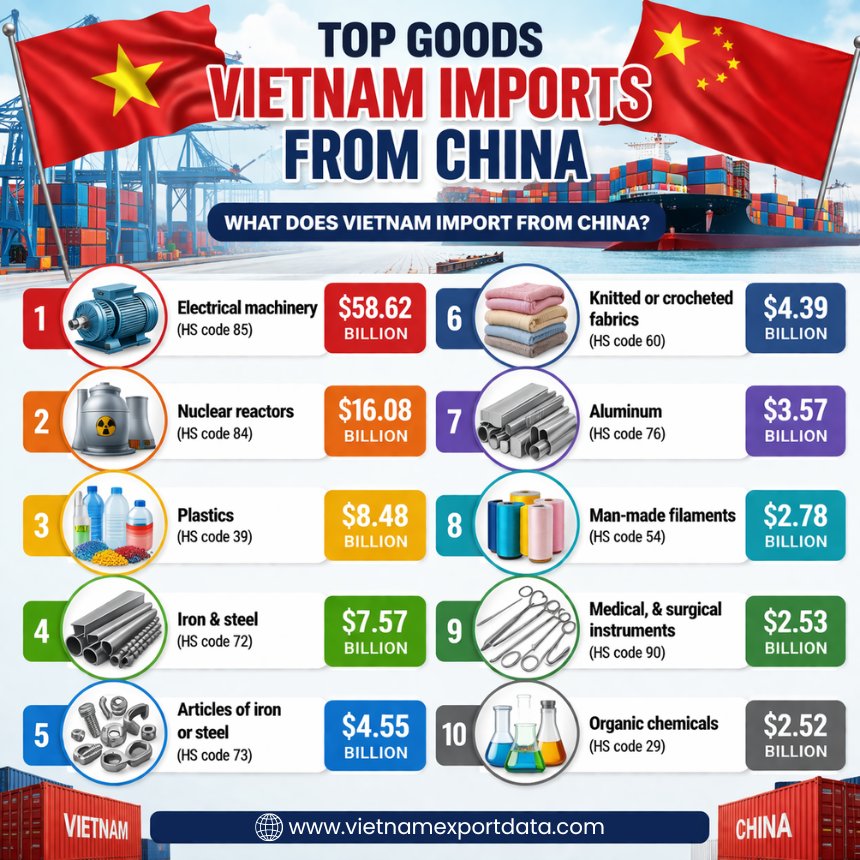
Vietnam's imports from China encompass a diverse range of goods that contribute significantly to its economy. The top goods imported from China into Vietnam predominantly include electronics, machinery, textiles, steel, and plastics. With a focus on economic growth and trade partnerships, Vietnam strategically imports these goods to meet domestic demand, support industries, and foster international trade relations. The top 10 products that Vietnam imports from China, as per the Vietnam shipment data & China export data for 2025, include:
1. Electrical machinery & equipment (HS code 85): $58.62 billion
Electrical machinery and equipment are among the top imports from China to Vietnam, with a total value of $58.62 billion. This category includes items such as computers, smartphones, televisions, and other electronic devices that are in high demand in the Vietnamese market.
2. Nuclear reactors & machinery (HS code 84): $16.08 billion
Nuclear reactors and machinery are another major import category for Vietnam, totaling $16.08 billion. These products are crucial for various industries, including energy production and manufacturing, making them essential imports for Vietnam's economic development.
3. Plastics & articles thereof (HS code 39): $8.48 billion
Plastics and articles made of plastic are also significant imports from China, with a value of $8.48 billion, as per the data on Vietnam plastic imports from China by HS code. These products are used in a wide range of applications, from packaging and construction to consumer goods, making them indispensable for Vietnam's industrial and commercial sectors.
4. Iron & steel (HS code 72): $7.57 billion
Iron and steel products are essential for infrastructure development, construction, and manufacturing industries in Vietnam. With a total import value of $7.57 billion, these materials play a crucial role in driving the country's economic growth and development.
5. Articles of iron or steel (HS code 73): $4.55 billion
In addition to raw iron and steel products, Vietnam also imports various articles made of iron or steel from China, amounting to $4.55 billion. These products include machinery parts, tools, and other essential components that are necessary for a wide range of industries in Vietnam.
6. Knitted or crocheted fabrics (HS code 60): $4.39 billion
Textile products, such as knitted or crocheted fabrics, are popular imports from China, with a total value of $4.39 billion. These materials are used in the garment and textile industry, which is a significant sector of Vietnam's economy, contributing to job creation and export revenue.
7. Aluminum & articles thereof (HS code 76): $3.57 billion
Aluminum and articles made of aluminum are important imports for Vietnam, amounting to $3.57 billion. These products are used in various industries, including construction, transportation, and manufacturing, playing a vital role in the country's industrial development.
8. Man-made filaments (HS code 54): $2.78 billion
Man-made filaments, such as synthetic fibers and textiles, are essential imports from China, with a total value of $2.78 billion. These materials are used in the production of clothing, home textiles, and industrial fabrics, supporting Vietnam's textile and garment industry.
9. Optical, medical, & surgical instruments (HS code 90): $2.53 billion
Optical, medical, and surgical instruments are crucial imports for Vietnam's healthcare sector, totaling $2.53 billion. These products include medical devices, equipment, and supplies that are essential for healthcare facilities, hospitals, and clinics across the country.
10. Organic chemicals (HS code 29): $2.52 billion
Organic chemicals are key imports for various industries, including pharmaceuticals, agriculture, and manufacturing, with a total value of $2.52 billion. These chemicals are used in the production of medicines, fertilizers, plastics, and other products, supporting Vietnam's industrial and agricultural sectors.
Top Goods Vietnam Exports to China: What Does Vietnam Export to China?
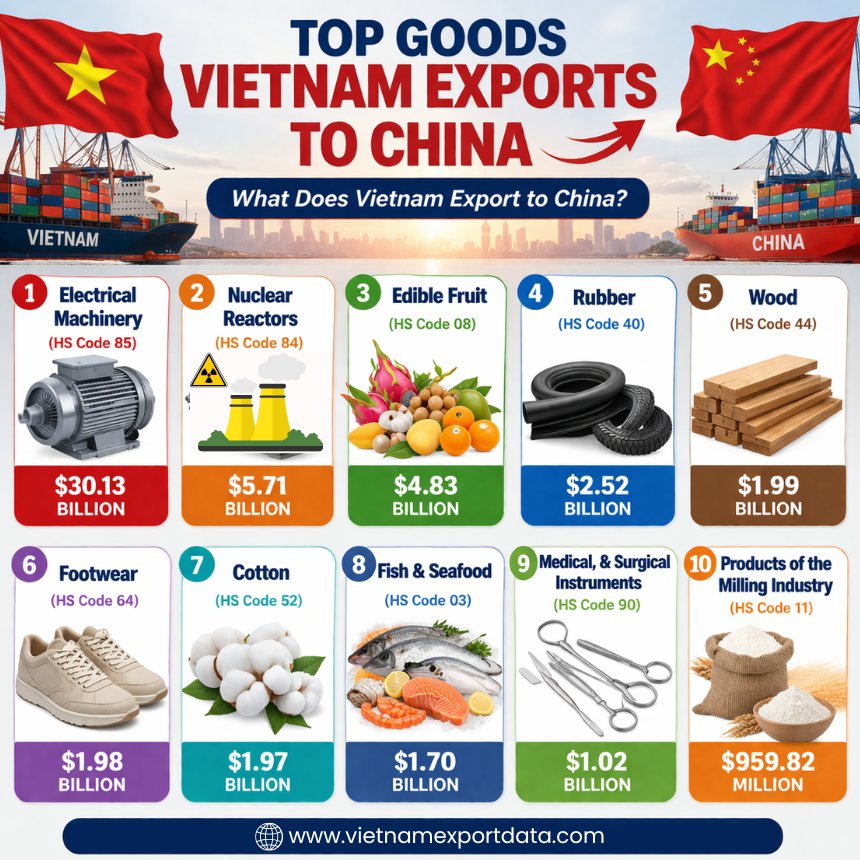
Vietnam exports a variety of goods to China, securing its place as one of the top trading partners in the region. Among the top goods that Vietnam exports to China are electronics, textiles, footwear, agricultural products, and seafood. The significant trade relationship between Vietnam and China showcases the diversity and strength of Vietnamese exports, contributing to the economic growth of both countries. The top 10 goods that Vietnam exports to China, according to Vietnam-China trade data for 2025, include:
1. Electrical Machinery & Equipment (HS Code 85): $30.13 billion
One of the largest categories of goods that Vietnam exports to China is electrical machinery and equipment. With a total value of $30.13 billion, this category includes a wide range of products such as electrical appliances, telecommunication equipment, and electronic components, as per the data on Vietnam electronics exports to China. Vietnam has been able to capitalize on its growing manufacturing industry to meet the demand for these products in the Chinese market.
2. Nuclear Reactors & Machinery (HS Code 84): $5.71 billion
Another significant category of exports from Vietnam to China is nuclear reactors and machinery. With a total value of $5.71 billion, this category includes equipment for power generation, industrial machinery, and mechanical appliances. Vietnam has been able to leverage its expertise in manufacturing to export these high-value products to China.
3. Edible Fruit & Nuts (HS Code 08): $4.83 billion
Vietnam is also a major exporter of edible fruit and nuts to China. With a total value of $4.83 billion, this category includes fruits such as bananas, mangoes, and lychees, as well as nuts like cashews and almonds. Vietnam's tropical climate and fertile land make it an ideal place for growing these products, which are in high demand in the Chinese market.
4. Rubber & Articles Thereof (HS Code 40): $2.52 billion
The rubber industry is another key sector for Vietnam's exports to China. With a total value of $2.52 billion, this category includes raw rubber, rubber products, and articles made of rubber. Vietnam is one of the top producers of natural rubber in the world, and its high-quality products are sought after by Chinese buyers.
5. Wood & Articles of Wood (HS Code 44): $1.99 billion
Vietnam's rich forest resources have made it a major exporter of wood and wood products to China. With a total value of $1.99 billion, this category includes timber, plywood, and furniture made from wood. Vietnam's sustainable forestry practices have made its wood products popular in the Chinese market.
6. Footwear (HS Code 64): $1.98 billion
Vietnam is also known for its footwear industry, which has seen significant growth in recent years. With a total value of $1.98 billion, this category includes shoes, sandals, and other footwear products. Vietnam's skilled workforce and competitive manufacturing costs have helped it become a leading exporter of footwear to China.
7. Cotton (HS Code 52): $1.97 billion
Cotton is another important category of goods that Vietnam exports to China. With a total value of $1.97 billion, this category includes raw cotton, cotton yarn, and cotton fabrics. Vietnam's cotton industry has benefited from favorable trade agreements with China, making it a key supplier of cotton products to the Chinese market.
8. Fish & Seafood (HS Code 03): $1.70 billion
Vietnam's coastal location has made it a major exporter of fish and seafood to China. With a total value of $1.70 billion, this category includes fresh and frozen fish, shrimp, and other seafood products. Vietnam's fishing industry is known for its sustainability and high-quality products, which are highly sought after in the Chinese market.
9. Optical, Medical, & Surgical Instruments (HS Code 90): $1.02 billion
Vietnam's growing healthcare industry has led to an increase in exports of optical, medical, and surgical instruments to China. With a total value of $1.02 billion, this category includes medical devices, optical lenses, and surgical equipment. Vietnam's expertise in manufacturing these high-tech products has made it a key supplier to the Chinese healthcare market.
10. Products of the Milling Industry (HS Code 11): $959.82 million
Lastly, Vietnam exports products of the milling industry to China, with a total value of $959.82 million. This category includes products such as rice, flour, and other milled grains. Vietnam's agricultural sector plays a crucial role in supplying these products to the Chinese market, where demand for staple foods remains high.
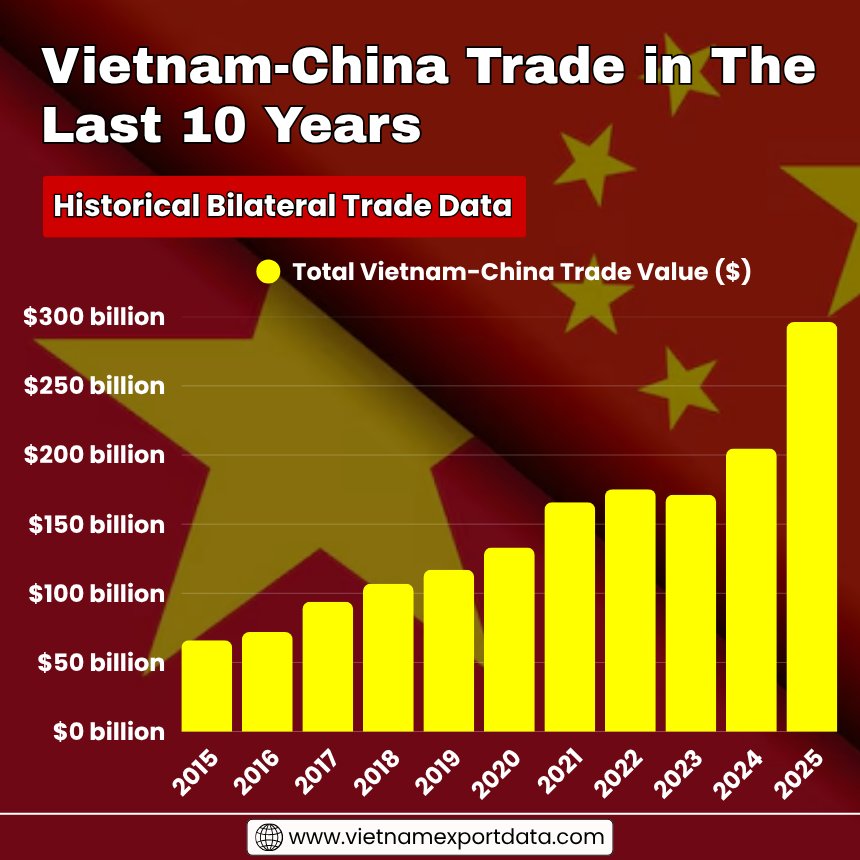
Vietnam-China Trade in The Last 10 Years: Historical Bilateral Trade Data
|
Year of Trade |
Total Vietnam-China Trade Value ($) |
|
2015 |
$66.01 billion |
|
2016 |
$71.98 billion |
|
2017 |
$93.92 billion |
|
2018 |
$106.87 billion |
|
2019 |
$117.01 billion |
|
2020 |
$133.06 billion |
|
2021 |
$165.77 billion |
|
2022 |
$175.32 billion |
|
2023 |
$171.22 billion |
|
2024 |
$204.65 billion |
|
2025 |
$296.14 billion |

Vietnam’s Role in China-Centric Supply Chains
The data clearly shows that Vietnam is not just a trading partner. It is a key node in China-linked production networks, as per the report on Vietnam-China trade relations.
The “Factory + Assembly” Model
-
China supplies:
-
Intermediate goods
-
Capital equipment
-
Technology inputs
-
Vietnam provides:
-
Labor-intensive manufacturing
-
Export-oriented assembly
-
Access to global markets via trade agreements
This relationship is often described as “complementary” rather than competitive.
Evidence from Trade Data
-
Imports from China surged due to manufacturing demand
-
Electronics, machinery, and components dominate bilateral flows
-
Vietnam’s export growth depends heavily on Chinese inputs
Practical example
A smartphone assembled in Vietnam may include:
-
Chinese semiconductors
-
Korean displays
-
Japanese sensors
Vietnam acts as the final assembly and export hub, often shipping finished goods to the US or EU.
Regional Trade Dynamics Inside China
Trade between Vietnam and China is not evenly distributed. It is concentrated in industrial powerhouse provinces:
-
Guangdong: $63+ billion trade with Vietnam
-
Jiangsu: $46+ billion trade
These regions are:
-
Export-driven
-
Manufacturing-heavy
-
Closely integrated with global supply chains
Why this matters: Vietnam is plugged directly into China’s most advanced industrial ecosystems, not its interior economy.
Vietnam in the China+1 Strategy
Global companies are actively diversifying away from China, but not abandoning it. This has given rise to the China+1 strategy, where Vietnam plays a leading role.
Key drivers:
-
Rising labor costs in China
-
US–China trade tensions
-
Supply chain resilience efforts
What the data shows
-
China’s exports to Vietnam grew 22.4% in 2025
-
Vietnam’s manufacturing imports from China surged
-
FDI-driven exports dominate Vietnam’s trade (72% share)
Interpretation: Companies are not replacing China. They are splitting production across China and Vietnam.
Supply Chain Integration: From Trade to Co-Production
In 2025, the relationship expanded beyond trade into supply chain integration.
Key developments:
-
Bilateral agreements on:
-
Supply chains
-
Rail infrastructure
-
Industrial cooperation
-
Over 6,000 Chinese investment projects in Vietnam
What this signals
The relationship is evolving into:
-
Shared production ecosystems
-
Cross-border industrial corridors
-
Trade integration
Sector-Level Insights
1. Electronics and Technology
-
Largest driver of trade growth
-
Vietnam imports components, exports finished electronics
2. Machinery and Industrial Inputs
-
China dominates the supply
-
Essential for Vietnam’s factories
3. Agriculture
-
Vietnam exports:
-
Fruits (durian, dragon fruit)
-
Seafood
-
China remains a major buyer
4. Energy and Raw Materials
-
Coal, rubber, and petroleum are still relevant but declining in share
Risks and Structural Challenges
Despite strong growth, the relationship has several vulnerabilities.
1. Trade Imbalance Risk
Vietnam’s large deficit exposes it to:
-
Currency pressure
-
Supply shocks
-
Strategic dependence
2. Overdependence on Chinese Inputs
Manufacturing disruptions in China can:
-
Halt Vietnamese production
-
Affect global exports
3. Transshipment Concerns
-
Some Chinese goods are rerouted via Vietnam to avoid tariffs
-
This has triggered scrutiny from the US
4. Geopolitical Pressure
Vietnam must balance:
-
China (largest trade partner)
-
United States (largest export market)
Vietnam’s Strategic Position in 2026
Vietnam now sits at the center of three major global trade forces:
1. China-Centric Supply Chains
-
Provides inputs and the industrial backbone
2. Western Demand (US/EU)
-
Drives Vietnam’s export growth
3. ASEAN Integration
-
Vietnam acts as a regional production hub
Notably:
-
Vietnam accounts for 25% of China–ASEAN trade
This positions Vietnam as a bridge economy between major global blocs.
What the Bilateral Trade Data Means for Businesses
1. Vietnam Is a Strategic Manufacturing Hub
Companies looking to diversify from China should:
-
Use Vietnam for assembly
-
Keep China for components
2. Supply Chains Are Regional, Not National
Production now spans multiple countries:
-
China to Vietnam to Global markets
3. Cost Advantages Still Matter
Vietnam offers:
-
Lower wages
-
Trade agreement access
-
Political stability
4. But China Remains Irreplaceable For:
-
Scale
-
Technology
-
Supplier ecosystems
Outlook for 2026 and Beyond
Based on 2025 data, several trends are likely to define 2026:
Continued Trade Growth
-
Bilateral trade could exceed $300 billion soon
Deeper Supply Chain Integration
-
More joint production
-
Increased Chinese investment in Vietnam
Infrastructure Expansion
-
Rail, ports, and border trade will improve
Strategic Balancing by Vietnam
-
Maintaining ties with both China and the US
Conclusion & Final Thoughts
In conclusion, Vietnam–China trade relations in 2026 are no longer just about bilateral exchange. They represent one of the most important supply chain relationships in the global economy.
The 2025 data tells a clear story:
-
Trade is growing fast
-
Supply chains are deeply interconnected
-
Vietnam depends on China for inputs
-
China depends on Vietnam as an export and production extension
For businesses, policymakers, and investors, the takeaway is simple: You cannot understand Vietnam’s rise without understanding its relationship with China. And you cannot understand modern global supply chains without understanding both.
Note For Our Readers
We hope you found this blog report on Vietnam–China Trade Relations 2026 useful and informative. If you’re looking to explore deeper insights, track bilateral trade flows, or analyze Vietnam import-export data by country or HS code at a granular level, feel free to connect with us at VietnamExportData. We provide comprehensive and up-to-date Vietnam import-export trade databases, including shipment-level records, buyer-supplier insights, and detailed trade analytics across key sectors such as electronics, machinery, and agriculture.
Whether you are evaluating supply chain dependencies, identifying sourcing opportunities, or planning market entry strategies in Vietnam or China, our data solutions are built to support your decisions with clarity and precision. For exclusive access, customized reports, or a tailored Vietnam trade database, reach out to us at info@tradeimex.in today.
Also Read
Share
What's Your Reaction?
 Like
0
Like
0
 Dislike
0
Dislike
0
 Love
0
Love
0
 Funny
0
Funny
0
 Angry
0
Angry
0
 Sad
0
Sad
0
 Wow
0
Wow
0