Vietnam Trade Deficit Hits $4.25 billion in the first half of April 2026: Latest Vietnam Trade Report
Vietnam reports a $4.25 billion trade deficit in early April 2026. Explore key export-import trends, insights, and the latest Vietnam trade data updates.

Vietnam’s economy has long been praised as one of Asia’s most dynamic export-driven success stories. Over the past decade, the country has built a strong reputation as a global manufacturing hub, benefiting from supply chain diversification, foreign direct investment (FDI), and competitive labor costs. But recent data tells a more complex story. In the first half of April 2026, Vietnam recorded a trade deficit of $4.25 billion, the largest short-term gap so far this year, according to the latest Vietnam import data and Vietnam export data. Vietnam Customs data indicate that this trend contributes to pressure on the overall balance of payments and reflects an increase in demand for industrial inputs.
At first glance, this seems alarming. A deficit of that scale in just two weeks raises questions about economic stability, external vulnerability, and structural weaknesses. But a deeper look reveals something more nuanced. This isn’t just a story of imbalance. It’s also a story of growth, industrial demand, and shifting global trade dynamics impacting the global trade data as well. Let’s break it down with a detailed analysis & data-driven article.
The Headline Numbers: What Happened in Early April?
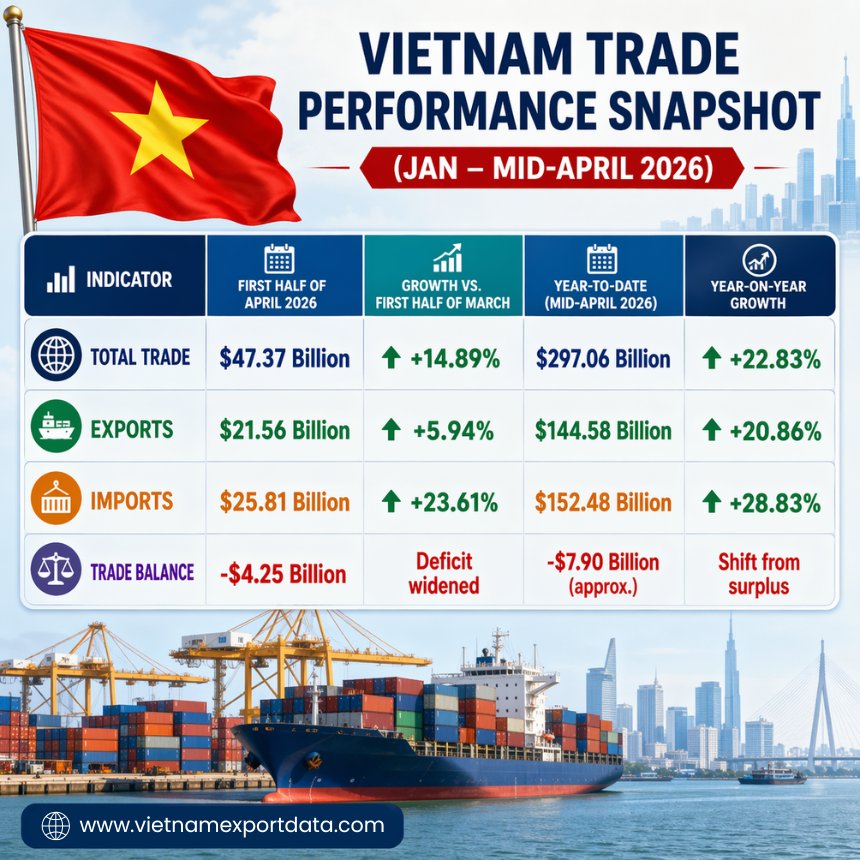
According to Vietnam Customs data, the country’s total import-export turnover reached $47.37 billion in the first half of April, marking a 14.89% increase compared to the first half of March. Vietnam’s $4 billion+ trade deficit in the first half of April indicates a structural change in the country’s economy.
Here’s the key breakdown:
-
Exports: $21.56 billion (up 5.94%)
-
Imports: $25.81 billion (up 23.61%)
-
Trade balance: -$4.25 billion (deficit)
The imbalance is clear: imports are growing nearly four times faster than exports. At a cumulative level, the picture looks even more striking:
-
Total trade value (Jan–mid-April): $297.06 billion (+22.83% YoY)
-
Total exports: $144.58 billion (+20.86% YoY)
-
Total imports: $152.48 billion (+28.83% YoY)
So while trade is expanding rapidly, imports are consistently outpacing exports, creating sustained pressure on the trade balance.
Not an Isolated Event: A Pattern Emerging in 2026
The April deficit isn’t a one-off anomaly. It fits into a broader trend that began earlier this year as Vietnam's trade deficit hit $2.98 billion in early 2026.
-
Jan–Feb 2026 deficit: $2.98 billion
-
Q1 2026 deficit: $3.64 billion
-
March 2026 deficit: $0.67 billion
This consistent pattern shows that Vietnam has shifted from a trade surplus position in previous years to a deficit cycle in 2026. That shift matters. For context, Vietnam recorded a $20 billion trade surplus in 2024, highlighting how quickly the balance has reversed.
Why Vietnam’s Imports Are Surging Faster Than Exports
To understand the deficit, we need to look at what Vietnam is importing. The short answer: production inputs. The long answer is more interesting.
1. Vietnam’s Role in Global Supply Chains
Vietnam is not just exporting finished goods. It is deeply embedded in global manufacturing networks. That means it imports:
-
Raw materials
-
Intermediate components
-
Machinery and equipment
In fact, over 90% of imports are production-related materials. This explains why imports spike before export booms. When factories anticipate higher global demand, they stock up. That’s exactly what seems to be happening now.
2. Inventory Build-Up Amid Uncertainty
The report highlights a key trend: firms are increasing stockpiles to hedge against supply chain disruptions.
This behavior is driven by:
-
Geopolitical instability
-
Energy price volatility
-
Supply chain uncertainty
For example, rising energy costs, linked partly to global conflicts, have already impacted Vietnam’s economy, pushing import costs higher and contributing to trade deficits. In simple terms, Companies are buying more now to avoid shortages later.
3. Strong FDI Sector Driving Import Demand
Foreign-invested enterprises play a dominant role in Vietnam’s trade structure.
-
They generate a large share of exports
-
But it also relies heavily on imported inputs
Interestingly, while the FDI sector often runs a trade surplus, the domestic sector runs a significant deficit. This creates a structural imbalance:
-
Domestic firms depend on imports
-
Foreign firms dominate exports
Export Growth Is Still Strong But Slower
Exports are still growing at a healthy pace.
Key highlights:
-
+20.86% YoY growth (Jan–mid-April)
-
Strong performance in:
-
Electronics
-
Machinery
-
Phones
-
Processed industrial goods
The manufacturing sector remains the backbone of Vietnam’s export economy. But here’s the catch: Export growth is not keeping up with import growth. That gap is what’s driving the deficit.
Vietnam Trade Performance Snapshot (Jan – Mid-April 2026)
Key Structural Insights
|
Category |
Key Insight |
|
Export Driver |
Processing & manufacturing industries dominate |
|
Import Composition |
Mostly raw materials & production inputs |
|
FDI Contribution |
Major contributor to export growth |
|
Trade Pattern |
Imports are growing significantly faster than exports |
|
Supply Chain Trend |
Rising stockpiling due to global uncertainties |
|
Risk Factors |
High-tech volatility, energy price fluctuations |
|
Outlook (Short-Term) |
Export recovery possible with global demand rebound |
|
Long-Term Challenge |
Heavy reliance on FDI & limited export diversification |
Vietnam Trade Balance in the Last 10 Years: Yearly Deficit & Surplus
|
Year of Trade |
Total Vietnam Trade Balance (Deficit/Surplus) |
|
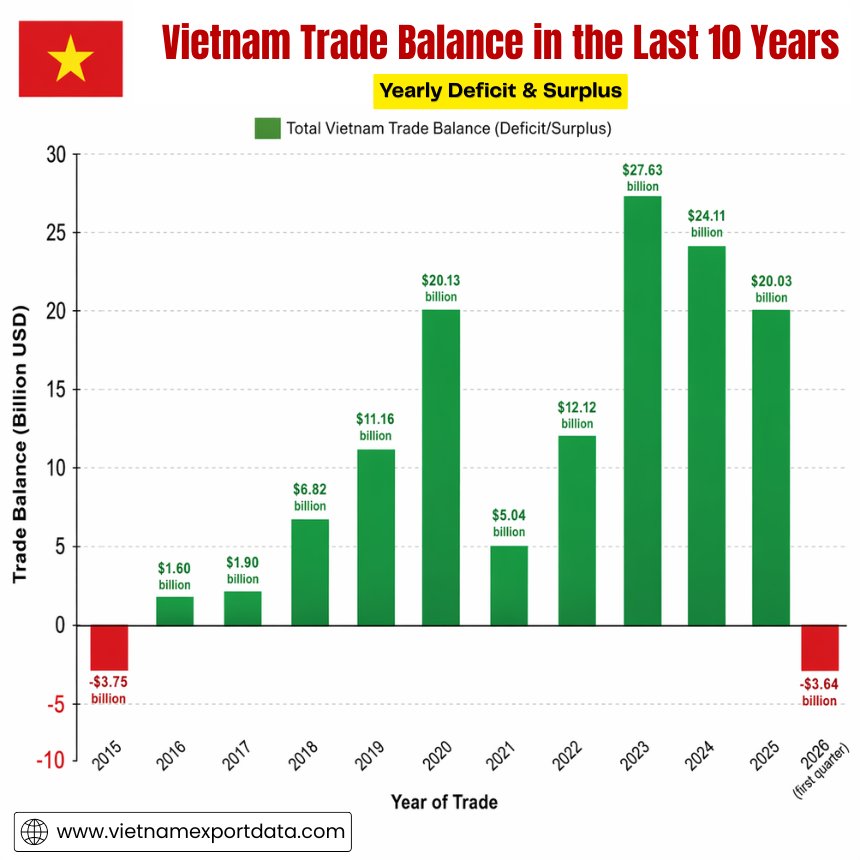
2015 |
-$3.75 billion (Deficit) |
|
2016 |
$1.60 billion (Surplus) |
|
2017 |
$1.90 billion (Surplus) |
|
2018 |
$6.82 billion (Surplus) |
|
2019 |
$11.16 billion (Surplus) |
|
2020 |
$20.13 billion (Surplus) |
|
2021 |
$5.04 billion (Surplus) |
|
2022 |
$12.12 billion (Surplus) |
|
2023 |
$27.63 billion (Surplus) |
|
2024 |
$24.11 billion (Surplus) |
|
2025 |
$20.03 billion (Surplus) |
|
2026 (first quarter) |
-$3.64 billion (Deficit) |

Sectoral Story: Manufacturing Still Dominates Vietnam Trade
Vietnam’s export structure hasn’t changed dramatically.
-
Processing and manufacturing industries lead exports
-
High-tech sectors and energy markets show volatility
This dependence creates both strength and vulnerability.
Strength:
-
Integration into global supply chains
-
High demand for electronics and industrial goods
Weakness:
-
Heavy reliance on imported components
-
Exposure to global demand fluctuations
The China Factor: A Persistent Trade Imbalance
One of the biggest contributors to Vietnam’s trade deficit is its relationship with China.
-
China is Vietnam’s largest import partner
-
Vietnam runs a massive trade deficit with China
In Q1 2026 alone, the deficit with China reached $33.3 billion, rising sharply year-on-year. This reflects a structural dependency:
-
Vietnam imports machinery and inputs from China
-
Processes them domestically
-
Exports finished goods elsewhere
This model works, but it comes with risks.
Is This Deficit a Bad Sign?
Not necessarily. A trade deficit isn’t always negative, especially for a fast-growing, export-oriented economy like Vietnam. Let’s look at both sides.
The Case for Concern
1. Rising External Vulnerability
A sustained deficit can weaken the balance of payments and increase dependence on external financing.
2. Domestic Sector Weakness
The domestic economy remains heavily reliant on imports, limiting value creation within the country.
3. Exposure to Global Shocks
Vietnam is highly sensitive to:
-
Energy price fluctuations
-
Supply chain disruptions
-
Geopolitical tensions
The Case for Optimism
1. Strong Industrial Demand
Rising imports suggest factories are preparing for higher output.
2. Export Recovery Potential
The report notes that exports could improve rapidly if global demand rebounds.
3. Continued Trade Expansion
Total trade volume is growing at over 20% year-on-year, showing strong economic momentum.
In other words, this deficit may be a short-term investment in future growth.
The Bigger Picture: Vietnam’s Economic Model Under Pressure
Vietnam’s trade growth model is built on three pillars:
-
Export-led manufacturing
-
Foreign direct investment
-
Integration into global supply chains
This model has worked extremely well. But 2026 is exposing its limitations.
Key Structural Challenges
1. Overreliance on FDI
Foreign companies dominate exports, limiting domestic value capture.
2. Narrow Export Base
A few industries, like electronics, machinery, and textiles, drive most exports.
3. Import Dependency
Domestic production relies heavily on imported inputs.
What Needs to Change?
To achieve sustainable growth, Vietnam will need to:
1. Diversify Exports
Move beyond core manufacturing sectors into higher-value industries.
2. Strengthen Domestic Enterprises
Reduce dependence on foreign firms and improve local supply chains.
3. Upgrade Technology and Skills
Invest in innovation, not just assembly.
4. Expand Trade Partnerships
Reduce reliance on a few major markets and suppliers.
Short-Term Outlook: What Happens Next?
The near-term trajectory depends on global demand.
Scenario 1: Global Recovery
-
Export orders increase
-
Trade deficit narrows
-
Industrial growth accelerates
Scenario 2: Continued Uncertainty
-
Imports remain high
-
Exports stagnate
-
Deficit persists
Most analysts expect a gradual improvement in exports later in 2026, especially if major economies stabilize.
Vietnam’s Early April Trade Snapshot: Key Takeaways
-
Vietnam recorded a $4.25 billion trade deficit in the first half of April 2026, the highest per-period deficit so far this year.
-
Despite the deficit, total trade activity remained strong, with import-export turnover reaching $47.37 billion, up 14.89% from the first half of March.
-
Year-to-date trade value hit $297.06 billion, marking a 22.83% increase year-on-year, showing continued overall expansion.
-
Exports grew modestly:
-
$21.56 billion in early April (+5.94%)
-
$144.58 billion year-to-date (+20.86%)
-
The processing and manufacturing sector remains the backbone of exports, with large-scale industrial goods leading performance.
-
The FDI sector continues to drive export growth, indicating stable production and strong participation in global demand.
-
Imports surged significantly, reaching:
-
$25.81 billion in early April (+23.61%)
-
$152.48 billion year-to-date (+28.83%)
-
Import growth is largely driven by production inputs and raw materials, reinforcing Vietnam’s role in global supply chains.
-
The sharp rise in imports reflects increased stockpiling of inputs, as businesses prepare for:
-
Supply chain disruptions
-
Geopolitical uncertainties
-
This import surge may also signal a potential rebound in export orders in the near future.
-
The trade pattern shows a dual trend:
-
Strong reliance on manufacturing exports
-
Sensitivity to fluctuations in the high-tech and energy sectors
-
Short-term outlook:
-
Exports could recover quickly if global demand improves
-
Increased production by major corporations could boost the trade balance
-
Long-term challenge:
-
Heavy dependence on the FDI sector and a narrow range of industries
-
Need for export diversification and stronger domestic enterprise capacity
-
Overall, the deficit reflects both economic pressure and underlying industrial activity, not just a slowdown.
Conclusion & Final Thoughts: A Deficit That Tells a Bigger Story
In conclusion, Vietnam’s $4.25 billion trade deficit in early April is not just a statistic. It’s a signal. A signal that:
-
The economy is expanding rapidly
-
Industry is ramping up production
-
But structural weaknesses remain
The key takeaway is that Vietnam is not slowing down. It is transitioning. The country is moving from a simple export-driven model toward a more complex, industrialized economy. That transition comes with imbalances. The real question is not whether Vietnam can avoid trade deficits. It’s whether it can turn today’s deficits into tomorrow’s growth. If it succeeds, this period may be remembered not as a warning sign but as a turning point.
Note for Our Readers
We hope you found this analysis on Vietnam’s recent trade deficit and import-export trends insightful and useful. If you’re looking to go beyond high-level insights and explore detailed & live shipment-level Vietnam import-export data, including product-wise exports, import dependencies, sector-specific trends, and partner-country analysis, feel free to connect with VietnamExportData.
We provide comprehensive and up-to-date Vietnam import-export databases covering key industries such as manufacturing, electronics, machinery, textiles, and raw materials. Our databases include shipment-level records, exporter-importer details, HS code analysis, pricing trends, and country-wise trade flows.
Whether you’re tracking Vietnam’s trade balance, identifying sourcing opportunities, analyzing supply chain risks, or exploring new market entry strategies, our data solutions are designed to support informed decision-making. For exclusive access, customized trade reports, or a tailored Vietnam import-export database, reach out to us at info@tradeimex.in to skyrocket your business.
Share
What's Your Reaction?
 Like
0
Like
0
 Dislike
1
Dislike
1
 Love
1
Love
1
 Funny
1
Funny
1
 Angry
0
Angry
0
 Sad
0
Sad
0
 Wow
0
Wow
0