Vietnam–Malaysia Agricultural Trade MoU Signed: New Opportunities in Rice, Poultry, & Food Security
Vietnam & Malaysia sign a new agricultural trade MoU, unlocking fresh opportunities in agri-exports, food supply chains, & bilateral trade growth.

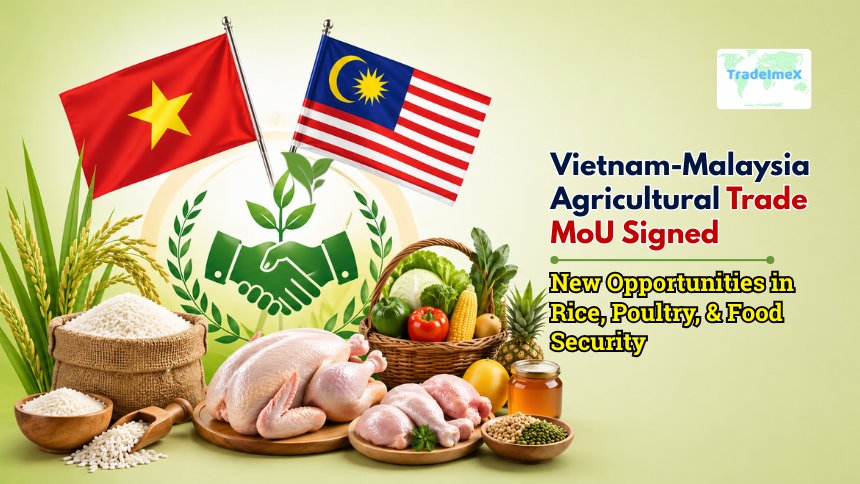
In a period marked by rising food insecurity, climate volatility, and shifting global trade patterns, regional partnerships are becoming more important than ever. The recent agricultural trade Memorandum of Understanding (MoU) between Vietnam and Malaysia is a clear signal of how Southeast Asian nations are responding by strengthening intra-regional cooperation, impacting the Vietnam trade data & the Malaysia trade data.
This agreement is not just a diplomatic gesture. It is a practical, forward-looking framework aimed at stabilizing food supply chains, boosting bilateral trade, & addressing shared vulnerabilities in agriculture. With a focus on key sectors such as rice and poultry, the MoU opens up new pathways for both countries to improve food security while creating tangible economic opportunities. This blog takes a closer look at the agreement, the data behind Vietnam–Malaysia agricultural trade, and what it means for farmers, exporters, policymakers, and the broader ASEAN region.
Background: Why This MoU Matters Now
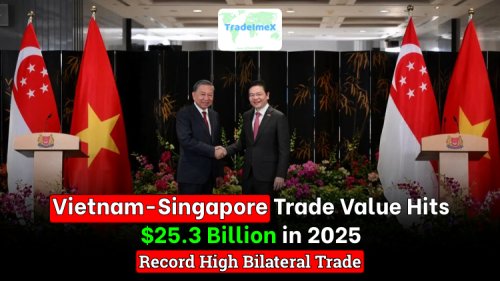
The timing of the Vietnam–Malaysia agricultural MoU is critical. Malaysian Minister of Agriculture and Food Security Datuk Seri Haji Mohamad Bin Sabu was welcomed in Hanoi on April 23 by Vietnam's Minister of Agriculture and Environment Trinh Viet Hung. The two ministers signed a Memorandum of Understanding to increase cooperation in food security, fisheries, & agriculture during the meeting. The pact lays the groundwork for more robust supply chains by emphasizing equality, respect for one another, and shared accountability. After a 2024 suspension, Malaysia has stated that it plans to start exporting processed poultry goods to Vietnam again. Main commodities consist of:
-
Pasteurized liquid eggs
-
Frozen duck meat
-
Bird’s nests
-
Animal feed
-
Pet food
Over the past few years, global food systems have faced multiple shocks:
-
Climate-related disruptions affecting crop yields
-
Supply chain bottlenecks following the pandemic
-
Export restrictions by major food-producing countries
-
Rising input costs (fertilizers, fuel, feed)
According to global food security assessments, over 700 million people worldwide still face food insecurity, with Southeast Asia particularly vulnerable due to its reliance on imports for certain staples.
Malaysia, for example, imports a significant portion of its food:
-
Around 30–40% of its rice consumption is imported
-
Over 50% of beef and dairy demand depends on imports
-
Poultry is largely domestic but sensitive to feed price volatility
Vietnam, on the other hand, is a major agricultural exporter:
-
One of the top 3 rice exporters globally, as per Vietnam rice export statistics.
-
A leading exporter of seafood, coffee, and pepper
-
A rapidly growing poultry producer
This complementary relationship sets the stage for deeper cooperation.
Key Highlights of the Vietnam-Malaysia MoU
The agricultural trade MoU between Vietnam and Malaysia focuses on several strategic areas:
1. Strengthening Rice Trade
Rice is at the heart of the agreement.
-
Vietnam exported over 8 million tons of rice in 2025, generating billions in revenue, as per the Vietnam customs export data of rice.
-
Malaysia relies on imports to meet domestic demand gaps.
The MoU aims to:
-
Ensure a stable rice supply for Vietnam rice exports to Malaysia.
-
Facilitate long-term contracts between exporters and importers.
-
Improve price stability through coordinated trade mechanisms.
This is especially important as global rice prices have been volatile due to export restrictions by major producers.
2. Expanding Poultry Cooperation
Poultry is another key focus area.
Malaysia has a strong domestic poultry sector, but has faced:
-
Periodic supply shortages
-
Rising feed costs (especially corn and soy imports)
-
Export restrictions during domestic shortages
Vietnam’s poultry sector, meanwhile, is expanding rapidly:
-
Increasing production capacity
-
Improving disease control measures
-
Attracting foreign investment in processing and cold chain infrastructure
The MoU encourages:
-
Cross-border trade in poultry products
-
Investment in processing and trade
-
Knowledge sharing on disease management and biosecurity
3. Enhancing Food Security Collaboration
Beyond specific commodities, the agreement emphasizes broader food security goals:
-
Joint efforts to stabilize supply chains
-
Information sharing on production forecasts
-
Cooperation in agricultural technology and innovation
This reflects a shift from transactional trade to strategic food partnerships.
Trade Data: Vietnam–Malaysia Agricultural Exchange
To understand the impact of this MoU, it helps to look at existing trade patterns.
Bilateral Trade Overview
-
Total trade between Vietnam & Malaysia exceeded $14 billion in recent years.
-
Agricultural trade is a growing component, though still underdeveloped relative to its potential.
Vietnam’s Agricultural Exports to Malaysia
Key exports include:
-
Rice
-
Coffee
-
Seafood
-
Fruits and vegetables
Rice exports alone have seen steady growth, especially during periods of global supply tightness.
Malaysia’s Agricultural Exports to Vietnam
Malaysia exports:
-
Palm oil (a top commodity, as per the Vietnam palm oil imports from Malaysia)
-
Processed food products
-
Animal feed ingredients
This creates a mutually beneficial trade structure where both countries rely on each other for key inputs.
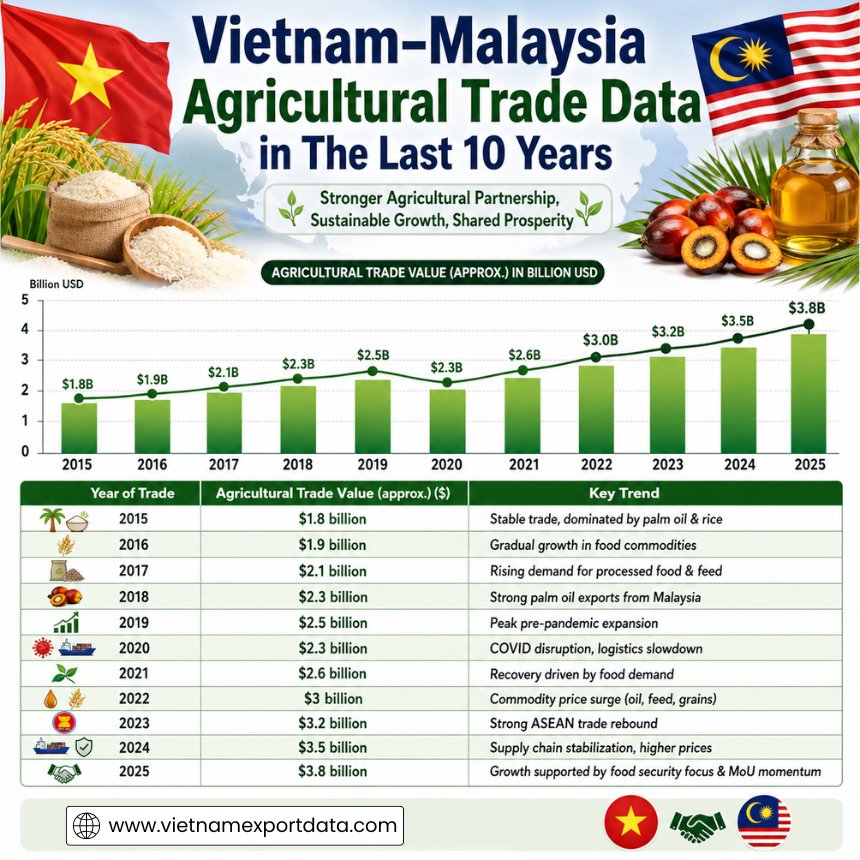
Vietnam–Malaysia Agricultural Trade Data in The Last 10 Years

Rice: The Core Opportunity
Vietnam’s Competitive Advantage
Vietnam’s rice sector has undergone a significant transformation:
-
Shift toward high-quality and fragrant rice varieties
-
Improved irrigation and farming techniques
-
Strong government support for exports
As a result:
-
Vietnam has increased its average rice export price
-
Expanded into premium markets
Malaysia’s Demand Dynamics
Malaysia’s rice consumption continues to grow due to:
-
Population growth
-
Urbanization
-
Changing dietary patterns
However:
-
Domestic production covers only about 60–70% of demand
-
Climate variability affects local yields
This creates a reliable import market for Vietnam.
Price Stability and Food Security
The MoU can help:
-
Reduce price volatility through long-term agreements
-
Ensure consistent supply during global shortages
-
Strengthen food security planning
For Malaysia, this means less exposure to global shocks. For Vietnam, it means a stable export market.
Poultry: A Sector on the Rise
Vietnam’s Growing Poultry Industry
Vietnam’s poultry sector is expanding due to:
-
Rising domestic demand
-
Investment in modern farming systems
-
Integration with global supply chains
Production has been growing steadily, with improvements in:
-
Feed efficiency
-
Disease control
-
Processing standards
Malaysia’s Poultry Challenges
Malaysia is a major poultry producer but faces:
-
High dependence on imported feed
-
Vulnerability to global price fluctuations
-
Periodic export bans to protect the domestic supply
The MoU offers a way to:
-
Diversify supply sources
-
Stabilize domestic markets
-
Encourage joint investment in feed and production
Regional Supply Chain Integration
A key opportunity lies in building integrated supply chains:
-
Vietnam could supply processed poultry products.
-
Malaysia could contribute feed inputs and trade expertise.
-
Joint ventures could target export markets
This would move both countries up the value chain.
Food Security: From National to Regional Strategy
The MoU reflects a broader shift in how countries approach food security.
1. Traditional Approach
-
Focus on domestic production
-
Use of stockpiles and subsidies
2. Emerging Approach
-
Regional cooperation
-
Diversified sourcing
-
Data-driven planning
Vietnam and Malaysia are moving toward this newer model.
3. ASEAN Context
The agreement aligns with broader ASEAN goals:
-
Enhancing intra-regional trade
-
Reducing dependence on external suppliers
-
Building resilient food systems
This is particularly important as global trade becomes more fragmented.
Investment Opportunities
The MoU is likely to unlock new investment flows in several areas:
1. Infrastructure
-
Cold storage facilities
-
Trade and transportation
-
Port and warehousing capacity
2. Processing
-
Rice milling and packaging
-
Poultry processing plants
-
Value-added food production
3. Technology
-
Precision agriculture
-
Climate-resilient farming
-
Supply chain digitization
These investments can improve efficiency and reduce waste.
Challenges and Risks
While the MoU creates opportunities, there are also challenges to consider.
1. Price Volatility
Global commodity prices remain unpredictable, which can affect trade agreements.
2. Climate Change
-
Floods and droughts can disrupt production
-
Both countries are vulnerable to extreme weather
3. Regulatory Differences
-
Food safety standards
-
Import/export regulations
-
Certification requirements
Harmonizing these will be key to successful implementation.
Economic Impact
For Vietnam
-
Increased export revenues
-
More stable demand for agricultural products
-
Opportunities for value-added production
For Malaysia
-
Improved food security
-
Reduced import risk
-
Greater supply chain resilience
For the Region
-
Stronger intra-ASEAN trade
-
Reduced reliance on distant suppliers
-
Enhanced economic integration
Long-Term Outlook
The Vietnam–Malaysia agricultural MoU could serve as a model for future agreements. The MoU reflects the larger ASEAN goals of sustainable trade and food security. In order to provide benefits for both farmers and consumers, Vietnam and Malaysia promised to coordinate their cooperation with regional frameworks. Improved supply chains will help regulate markets and protect vulnerable populations, both ministers stressed.
1. Expansion to Other Commodities
-
Fruits and vegetables
-
Seafood
-
Processed foods
2. Deeper Policy Coordination
-
Planning for food security
-
Shared data platforms
-
Joint crisis response mechanisms
3. Private Sector Engagement
-
Increased participation by exporters and importers
-
Growth in cross-border partnerships
What This Means for Businesses
For companies involved in agriculture and food trade, the MoU creates several actionable opportunities:
-
Exporters can explore long-term contracts
-
Importers can secure stable supply sources
-
Investors can identify high-growth sectors
Key areas to watch:
-
Rice export volumes and pricing trends
-
Poultry trade flows and investment projects
-
Infrastructure development
Conclusion: A Practical Step Toward Resilient Food Systems
In conclusion, the Vietnam–Malaysia agricultural trade MoU is more than a bilateral agreement. It is a strategic response to a changing global landscape where food security is becoming a top priority. By focusing on key sectors like rice and poultry, the agreement addresses immediate needs while laying the groundwork for long-term cooperation. It reflects a shift toward regional solutions in a world where global supply chains are increasingly uncertain. For Vietnam, it offers stable export opportunities and a chance to strengthen its position as a leading agricultural supplier.
For Malaysia, it provides a pathway to greater food security and reduced vulnerability. Most importantly, it shows how collaboration, not competition, can help countries navigate complex challenges and build more resilient food systems. As implementation unfolds, the success of this MoU will depend on execution, investment, and continued cooperation. But one thing is clear: this agreement marks a significant step forward in reshaping agricultural trade in Southeast Asia.
Note For Our Readers
We hope you found this blog on the Vietnam–Malaysia agricultural trade MoU, emerging opportunities in rice and poultry, and the broader implications for food security useful in understanding how regional trade partnerships are evolving. With growing demand for staple foods, increasing pressure on supply chains, and a stronger push toward food security across Southeast Asia, staying informed with accurate and reliable trade data is essential for making smart sourcing, investment, and policy decisions.
If you’re looking for deeper insights or customized Vietnam import-export data, or want to explore live Vietnam trade data by country, company, or HS code, feel free to connect with VietnamExportdata. We provide comprehensive and up-to-date trade intelligence to support your research and business needs. For exclusive access or tailored data solutions, contact us at info@tradeimex.in and move forward with clarity and confidence.
Share
What's Your Reaction?
 Like
0
Like
0
 Dislike
0
Dislike
0
 Love
0
Love
0
 Funny
0
Funny
0
 Angry
0
Angry
0
 Sad
0
Sad
0
 Wow
0
Wow
0