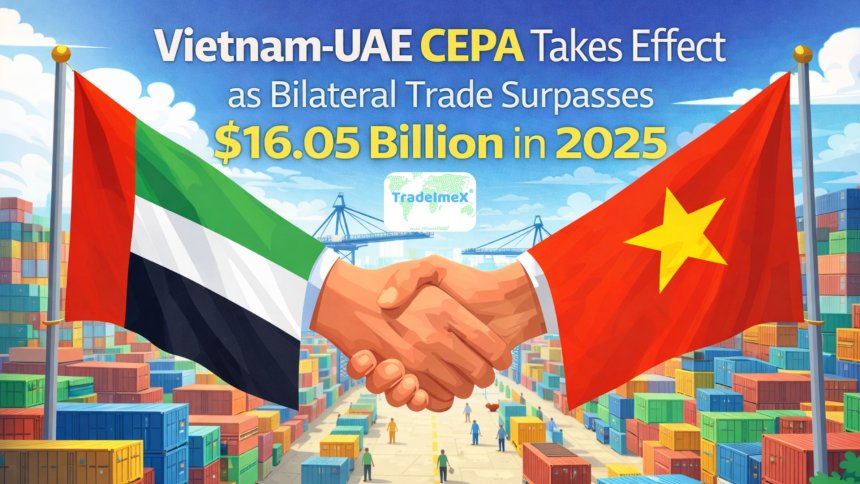
Vietnam-UAE CEPA Takes Effect as Bilateral Trade Surpasses $16.05 Billion in 2025
Vietnam-UAE CEPA officially takes effect as bilateral trade surpasses $16.05 billion in 2025. Explore trade growth, top imports & exports, & sectoral opportunities.

A Turning Point in Global South Economic Integration
On 3 February 2026, the Comprehensive Economic Partnership Agreement (CEPA) between the United Arab Emirates (UAE) and Vietnam officially came into force, marking a new chapter in the economic relationship between two dynamic, rapidly growing economies. This landmark event comes against the backdrop of robust trade growth between the nations, with bilateral trade surpassing USD 16.05 billion in 2025, up 27.4% from the previous year, according to the latest Vietnam export data and UAE import data. Vietnam emerged as the UAE’s largest trading partner in ASEAN, according to the Asia trade data and Vietnam customs data.
The CEPA is designed to eliminate tariffs on the majority of traded goods, deepen cooperation in critical sectors, and lay a durable institutional framework for long-term economic integration. For both the UAE and Vietnam, this pact combines strategic goals, diversifying trade, expanding investment networks, and positioning both countries as regional hubs for global commerce.
In this blog, we explore what the Vietnam-UAE CEPA entails, how trade has evolved, the economic rationale, sectoral opportunities, strategic implications, and future outlook.
What Is the UAE-Vietnam CEPA? A Framework for Economic Partnership
A Comprehensive Economic Partnership Agreement (CEPA) goes beyond traditional free trade agreements by covering:
-
Tariff elimination or reduction
-
Trade facilitation and customs cooperation
-
Trade in services
-
Investment protection
-
Rules of origin
-
Regulatory cooperation
-
Institutional mechanisms for dispute settlement and monitoring
The UAE-Vietnam CEPA specifically:
-
Eliminates or significantly reduces tariffs on over 90% of UAE exports to Vietnam (accounting for 99% of total export value).
-
Reduces tariffs on 95% of Vietnamese product categories entering the UAE, also representing 99% of export value.
-
Sets a platform for cooperation across renewable energy, technology, agriculture, manufacturing, and services.
The agreement is part of the UAE’s broader CEPA strategy, which was launched in September 2021 and has now concluded 30 agreements with partners across Asia, Africa, Europe, and the Americas, with 15 already in force.
For Vietnam, this is its first CEPA with a Middle Eastern country, reinforcing its global trade diversification strategy and aligning with its export-led growth model.
Vietnam-UAE Bilateral Trade Data: From Modest to Monumental Growth
Early Momentum Before the CEPA
Before the CEPA entered into force, economic ties between Vietnam and the UAE were already on a growth trajectory:
-
In 2023, bilateral trade between the countries was approximately USD 4.7 billion.
-
In 2024, non-oil trade climbed to USD 12.6 billion, a 4% rise from 2023.
These figures reflected increasing trade demand in sectors like electronics, consumer goods, and energy products.
Explosive Growth in 2025
In 2025, the total Vietnam-UAE trade surpassed USD 16.05 billion, a 27.4% increase year-on-year.
This surge was notable for several reasons:
-
It made Vietnam the UAE’s largest trading partner in ASEAN as measured by non-oil trade.
-
Growth occurred before the CEPA entered into force, highlighting the strong economic momentum already underpinning the relationship.
-
The rise suggests that trade flows were already responding to pre-CEPA liberalization expectations and commercial anticipation of deeper market access.
In detailed trade meetings, data showed that UAE non-oil exports to Vietnam rose sharply in early 2025, while Vietnamese goods, including electronics, garments, and agricultural products, saw expanding market penetration in the UAE and Gulf markets.
Economic Rationale: Why the CEPA Matters
The agreement is economically significant for both nations, but for different strategic reasons.
For the UAE
The UAE has been pursuing a non-oil trade expansion strategy. The government has set ambitious goals to reach AED 4 trillion (approx. USD 1.1 trillion) in non-oil trade by 2031, of which CEPAs are a key pillar.
Trade agreements like CEPA:
-
Diversify trade partners
-
Facilitate investment flows
-
Open markets for UAE products and services
-
Strengthen the UAE’s position as a trade and re-export hub for access to Africa, Asia, and beyond
Vietnam, as one of Southeast Asia’s fastest-growing economies, fits perfectly into these ambitions. The UAE’s demand for Vietnamese-manufactured goods, consumer products, and processed foods has grown steadily.
For Vietnam
Vietnam’s economy has historically been export-oriented, with manufacturing and trade as central pillars of growth. The CEPA with the UAE:
-
Opens the Middle East market more deeply for Vietnamese exports.
-
Reduces entry costs and tariff burdens.
-
Enhances Vietnamese access to capital, trade, and services through UAE business networks.
-
Serves as a bridge to wider access in the Middle East, Africa, and Europe, given the UAE’s global connectivity.
Vietnam’s expanding industrial base, particularly in electronics, machinery, and agriculture, complements demand patterns in the UAE and Gulf markets. Moreover, by forging closer ties with a wealthy Gulf economy, Vietnam can attract more diversification in foreign investment flows, moving beyond traditional partners in East Asia and Europe.
Top Traded Goods Between Vietnam and the UAE
The top traded goods between Vietnam and the UAE represent a diverse array of products that cater to the demands of both markets. This bilateral trading relationship showcases the mutual benefit and complementarity between the two nations, contributing to the growth of both economies.
Vietnam imports a variety of goods from the United Arab Emirates as part of its trade relations. Some of the top goods that Vietnam imports from the UAE include petroleum products, aluminum, machinery, and equipment. These imports play a crucial role in fulfilling Vietnam's industrial and economic needs, contributing to the country's growth and development. The total value of Vietnam imports from UAE reached $847.93 million in 2024-25.
Vietnam has established itself as a significant player in the export market to the UAE, with a diverse range of top goods making their way to this Middle Eastern country. The total value of Vietnam exports to the UAE reached $5.61 billion in 2024-25. Some of the main products exported from Vietnam to the UAE include electronics, textiles, footwear, and furniture. These goods showcase Vietnam's strength in manufacturing and offer high-quality products that cater to the demands of the UAE market.
Top Goods Vietnam Imports from UAE: What Does Vietnam Import from the UAE?
The major goods that Vietnam imports from the United Arab Emirates, as per the Vietnam import data for 2025, include:
1. Mineral fuels & oils (HS code 27): $547.94 million
One of the top goods that Vietnam imports from the UAE is mineral fuels and oils. With a value of $547.94 million, this category represents a significant portion of Vietnam's imports from the UAE. Vietnam relies on the UAE for its supply of mineral fuels and oils to meet its energy needs.
2. Plastics & articles thereof (HS code 39): $182.66 million
Another major category of goods that Vietnam imports from the UAE is plastics and articles thereof. With a value of $182.66 million, this category includes a wide range of plastic products that are essential for various industries in Vietnam, as per the data on Vietnam plastic imports from the UAE. The UAE is a key supplier of plastics to Vietnam.
3. Aluminum & articles thereof (HS code 76): $31.97 million
Vietnam also imports a substantial amount of aluminum and its articles from the UAE. With a value of $31.97 million, this category encompasses aluminum products used in various sectors, including construction, manufacturing, and transportation. The UAE is a reliable source of aluminum for Vietnam.
4. Prepared animal fodder (HS code 23): $21.68 million
Prepared animal fodder is another category of goods that Vietnam imports from the UAE. With a value of $21.68 million, this category includes feed for livestock and other animals. Vietnam relies on the UAE for its supply of prepared animal fodder to support its agriculture sector.
5. Wadding, felt, & nonwovens (HS code 56): $10.10 million
Lastly, Vietnam imports wadding, felt, and nonwovens from the UAE. With a value of $10.10 million, this category includes materials that are used in various industries such as textiles, construction, & manufacturing. The UAE is a key supplier of these materials to Vietnam.
Top Goods Vietnam Exports to UAE: What Does Vietnam Export to the UAE?
The top Vietnam exports to the UAE, as per the Vietnam shipment data for 2025, include:
1. Electrical Machinery & Equipment (HS code 85): $3.82 billion
One of the largest categories of goods that Vietnam exports to the UAE is electrical machinery and equipment, as per the data on Vietnam electronics exports to the UAE by HS code. This includes items such as electrical motors, generators, and other electrical equipment. In 2025, Vietnam exported a total of $3.82 billion worth of electrical machinery and equipment to the UAE, making it one of the country's top exports to the region.
2. Nuclear Reactors & Machinery (HS code 84): $392 million
Another significant category of goods that Vietnam exports to the UAE is nuclear reactors and machinery. This category includes items such as parts for nuclear reactors, machinery for isotopic separation, and other related equipment. In 2025, Vietnam exported a total of $392 million worth of nuclear reactors and machinery to the UAE, highlighting the country's expertise in this sector.
3. Footwear (HS code 64): $219.73 million
Vietnam is well-known for its footwear industry, and this is reflected in its exports to the UAE. In 2025, Vietnam exported $219.73 million worth of footwear to the UAE, making it a significant export category for the country. This includes a wide range of footwear products, from sneakers to sandals, and everything in between.
4. Edible Fruit & Nuts (HS code 08): $216.94 million
Vietnam is also a major exporter of edible fruit and nuts to the UAE. In 2025, the country exported $216.94 million worth of these products to the region. This category includes items such as fresh fruits, dried fruits, and various types of nuts. Vietnamese fruits such as dragon fruit and lychee are particularly popular in the UAE market.
5. Coffee, Tea, & Spices (HS code 09): $147.19 million
Finally, Vietnam is known for its high-quality coffee, tea, and spices, which are also popular exports to the UAE. Vietnam exported $147.19 million worth of these products to the UAE. Vietnamese coffee, in particular, is highly sought after in the UAE, with many consumers appreciating its unique flavor and aroma.
Vietnam-UAE Trade in the Last 10 Years: Yearly Bilateral Trade Data
|
Year of Trade |
Vietnam-UAE Total Trade ($) |
|
2015 |
$6.21 billion |
|
2016 |
$5.44 billion |
|
2017 |
$5.58 billion |
|
2018 |
$5.68 billion |
|
2019 |
$5.16 billion |
|
2020 |
$4.32 billion |
|
2021 |
$5.26 billion |
|
2022 |
$4.42 billion |
|
2023 |
$4.67 billion |
|
2024 |
$6.45 billion |
|
2025 |
$16.05 billion |
Sectoral Opportunities: Where the Growth Will Come From
The CEPA opens up opportunities in several priority economic sectors:
1. Manufacturing and Processed Goods
Vietnam has become a global manufacturing hub for electronics, textiles, furniture, and consumer products. Lower tariffs and trade barriers will lower costs for UAE importers and encourage higher volumes of Vietnamese industrial goods into Gulf markets.
Likewise, UAE industrial products, including advanced machinery, plastics, petrochemicals, and manufacturing equipment, will see reduced barriers to entering Vietnam.
2. Technology and Digital Services
A modern CEPA often covers digital services and technology collaboration. Given the UAE’s push to become a technology hub and Vietnam’s rapidly developing tech industry, the agreement lays the ground for:
-
Joint investments in software and digital infrastructure.
-
Cross-border technology transfer.
-
Collaboration in cybersecurity, fintech, AI, and data services.
3. Renewable Energy and Clean Technology
Energy cooperation is a natural area of mutual interest:
-
The UAE is a global leader in renewable energy financing and projects.
-
Vietnam has ambitious energy development targets and is increasingly open to foreign investment in clean energy.
Tariff benefits and structured cooperation frameworks can accelerate joint renewable energy projects, from solar infrastructure to sustainable energy grids.
4. Agriculture and Food Supply Chains
Vietnam’s agricultural exports, including fruits, seafood, coffee, and spices, already find demand in Gulf markets. Reduced tariffs through CEPA can enhance exporters’ competitiveness.
At the same time, UAE agribusinesses can invest in Vietnam’s food processing and distribution chains, creating synergies in food safety, trade, and Halal certification markets.
Strategic Implications Beyond Trade
The CEPA between the UAE and Vietnam is more than just tariff reduction. It reflects a broader geopolitical and economic alignment.
Regional Integration and South-South Cooperation
This agreement is a powerful example of South-South cooperation, where two emerging economies deepen their mutually beneficial exchange outside traditional North-South trade patterns. It signals a realignment of global economic ties that:
-
Encourages diversification away from dependency on established Western markets.
-
Builds alternative economic networks in Asia, the Middle East, and Africa.
-
Supports collective economic resilience amid global trade uncertainties.
Global Supply Chain Transformation
In the face of rising protectionism elsewhere, countries like Vietnam and the UAE are positioning themselves as reliable partners in global value chains. The CEPA enhances:
-
Supply chain diversification outside China and Western markets.
-
Regional hubs for intermediate goods, technology, and trade.
-
Lower barriers for investment and services integration.
Investment Flows and Capital Markets
With the CEPA in force, financial connectivity between the two nations is expected to deepen. UAE sovereign wealth funds and investment houses are likely to increase capital deployment in Vietnam’s infrastructure, tech, and industrial sectors. Vietnam, in turn, gains access to Gulf capital and strategic investors.
What Comes Next? Forecasts and Future Trends
Trade Growth Projections
Given the current trajectory:
-
Bilateral trade is expected to continue growing sharply beyond 2025, aided by CEPA-driven tariff advantages and business confidence.
-
Some industry estimates, like those from trade center engagements, project trade reaching USD 20 billion or more in the coming years based on ongoing integration.
Private Sector Collaboration
Private sector involvement is poised to deepen. Business chambers and trade delegations from both sides are already meeting to explore trade, services, and manufacturing synergies. The CEPA not only facilitates goods trade but also fosters collaborations in R&D, standards harmonization, investment joint ventures, and sector innovation.
Institutional Mechanisms and Governance
A CEPA typically establishes institutional bodies to:
-
Monitor implementation
-
Resolve disputes
-
Review regulatory cooperation
-
Update commitments as business landscapes evolve
These mechanisms build trust and long-term cooperation capability.
Regional and Global Influence
Vietnam’s closer ties with the UAE also have broader geopolitical implications:
-
Vietnam consolidates its role as a key ASEAN trade partner for the Gulf States.
-
The UAE strengthens its strategic foothold in Southeast Asia, expanding its global diplomatic and economic reach.
-
The partnership sets a model for future CEPAs between Middle Eastern and Southeast Asian economies.
Conclusion: A Strategic Win-Win Deal
In conclusion, the entry into force of the Vietnam–UAE CEPA, combined with the staggering growth of bilateral trade to USD 16.05 billion in 2025, marks a defining moment in 21st-century economic diplomacy. For the UAE, it amplifies its global trade strategy and consolidates leadership in economic diversification and international cooperation. For Vietnam, it opens pivotal new markets, accelerates industrial expansion, and strengthens its global economic footprint.
This agreement stands as a model for forward-looking trade policy, one that not only cuts tariffs but also builds long-term structural relationships, embraces private sector dynamism, and aligns with evolving patterns of global economic integration. As both nations turn the page toward deeper cooperation, the CEPA between Vietnam and the UAE offers a blueprint for balanced, sustainable, and impactful international economic partnerships that can thrive in an era of shifting global trade dynamics.
We hope that you liked our insightful blog report on the UAE-Vietnam CEPA. For more insights into the latest Vietnam trade data, or to search live Vietnam import-export data by country, visit VietnamExportdata.
Want to know more about the latest Vietnam trade data? Contact us at info@tradeimex.in for customized trade database reports and market insights.
Share
What's Your Reaction?
 Like
0
Like
0
 Dislike
0
Dislike
0
 Love
0
Love
0
 Funny
0
Funny
0
 Angry
0
Angry
0
 Sad
0
Sad
0
 Wow
0
Wow
0