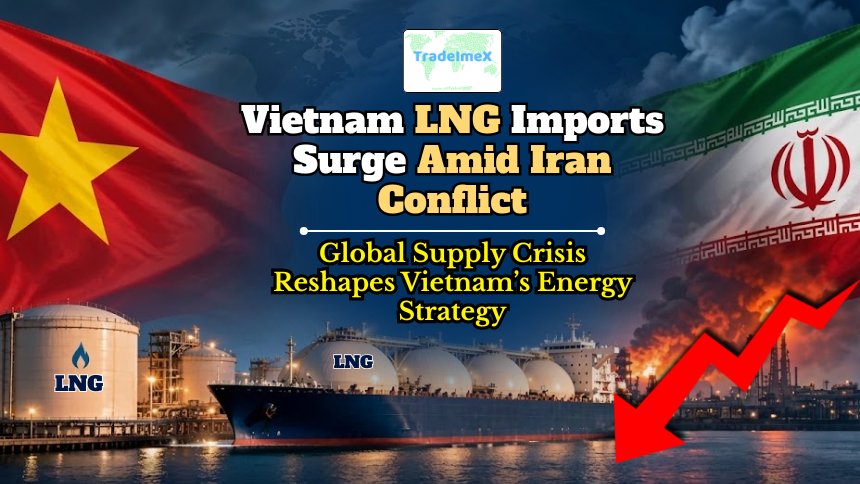
Vietnam LNG Imports Surge Amid Iran Conflict: Global Supply Crisis Reshapes Vietnam’s Energy Strategy
Vietnam’s LNG imports surge amid the Iran conflict as global supply tightens. Rising prices & shortages are reshaping Vietnam’s energy strategy.

Introduction: A Shock That Changed the Rules
The global energy system has always been vulnerable to geopolitical disruptions, but the 2026 Iran conflict has exposed just how fragile that system really is. When tensions escalated into military confrontation and effectively shut down parts of the Strait of Hormuz, one of the world’s most critical energy chokepoints, the consequences rippled far beyond the Middle East. The Strait typically carries about one-fifth of global oil and a significant share of liquefied natural gas (LNG). Its disruption triggered a cascade of supply shortages, price spikes, and policy responses across Asia & beyond. According to the latest Vietnam import data and Vietnam customs import data of LNG, the total value of Vietnam LNG imports reached $2.15 billion in 2025, an average of $593.16/ton, a 5.4% increase from the previous year.
Vietnam imported more than 3.63 million tons of Liquefied Natural Gas (LNG) in 2025, according to the Vietnam LNG import data. Vietnam is the 40th largest LNG importer in the world, as per the global trade data. Due to the impact of the war in Iran on global supplies, Vietnam is importing more LNG at higher prices. The all-time high for crude oil as of April 30 is 1.1%, down from 2% the day before. A significant portion of the world's LNG and oil commerce passes via the Strait of Hormuz, which is now closed due to the ongoing conflict in Iran. Vietnam's LNG imports and energy prices have increased as a result.
Although the likelihood of oil reaching an all-time high has somewhat decreased, supply interruptions still keep the market on alert. For Vietnam, a rapidly growing economy with rising energy demand and heavy reliance on imported fuels, the crisis has been very transformative. LNG imports have surged not just as a stopgap, but as part of a broader recalibration of national energy strategy. This blog examines how the Iran conflict has reshaped global LNG markets & forced Vietnam to rethink its energy future.
The Global LNG Shock: Supply Disruption Meets Surging Demand
The Iran conflict has created what many analysts now describe as a structural energy shock, not a temporary disruption.
-
The closure of key shipping routes stranded LNG exports and reduced available supply.
-
Qatar, one of the world’s largest LNG exporters, declared force majeure on shipments amid the crisis.
-
LNG prices surged dramatically, rising over 80% during peak disruptions.
-
The International Energy Agency now expects tight LNG markets to persist until at least 2027.
At the same time, demand has increased:
-
Countries cut off from Middle Eastern supply turned to alternative LNG sources, including the United States and Africa.
-
Shipping routes became longer and more complex, increasing costs and tightening vessel availability.
-
Several Asian economies, already dependent on imports, faced urgent supply gaps.
This combination of restricted supply and rising demand created a classic energy squeeze. But unlike previous crises, this one has exposed deeper structural issues in global energy dependence.
Vietnam’s Energy Profile: High Growth, High Vulnerability
Vietnam’s economic success over the past two decades has come with a cost: rapidly rising energy consumption. Key characteristics of Vietnam’s energy system:
-
Heavy import dependence: Around 87% of its oil imports come from the Middle East.
-
Limited domestic reserves: Declining domestic oil production has increased reliance on imports.
-
Fast-growing electricity demand driven by manufacturing, urbanization, and digital infrastructure.
This structure leaves Vietnam particularly exposed to global shocks.
When the Iran conflict disrupted the supply:
-
Gasoline prices rose by around 30%, diesel by 40%.
-
Fuel shortages became a real risk, prompting conservation measures.
-
The government moved quickly to remove fuel import tariffs to stabilize supply.
In short, Vietnam entered the crisis with high exposure and limited buffers, making rapid adaptation unavoidable & increasing dependence on Vietnam LNG import markets.
Vietnam LNG Imports by Country: Where Does Vietnam Import LNG From?
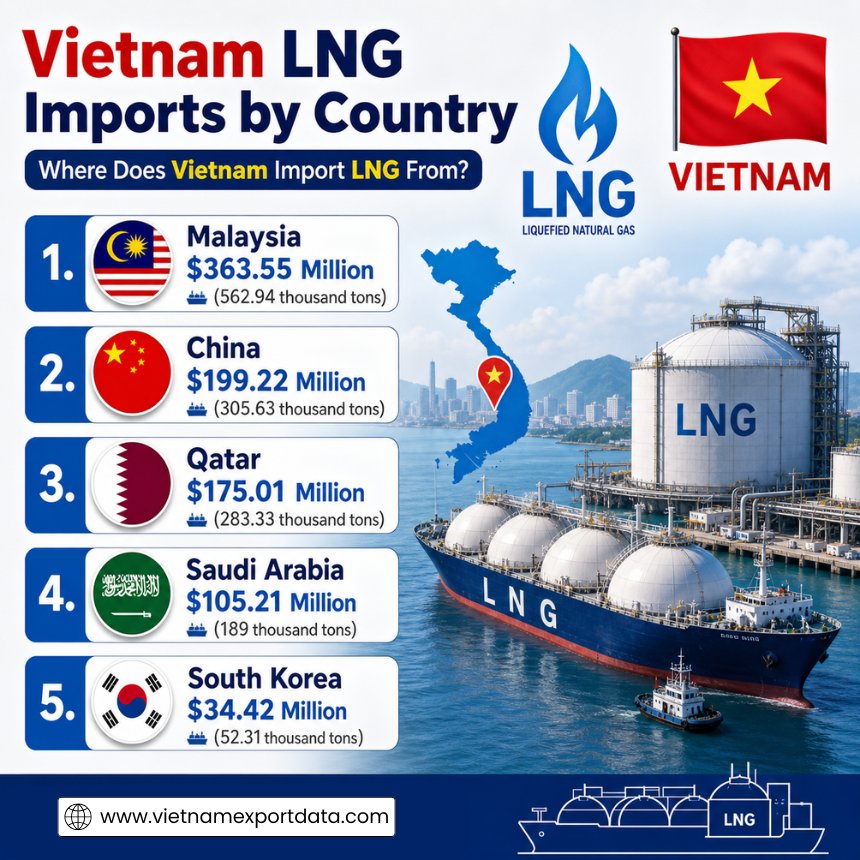
Vietnam's liquefied natural gas (LNG) imports come from diverse sources. The country primarily imports LNG mainly from Malaysia, China, and Qatar, as per the customs data on Vietnam LNG imports by country for 2025. Vietnam's strategic partnerships with these key LNG exporters play a vital role in meeting the country's growing energy demands.
As Vietnam continues to expand its energy infrastructure and embrace cleaner sources of fuel, its reliance on LNG imports from these countries underscores the importance of international trade relationships in the energy sector. The top 10 LNG supplier countries to Vietnam, as per the Vietnam LNG shipment data for 2025, include:
1. Malaysia: $363.55 million (562.94 thousand tons)
Malaysia is the leading exporter of LNG to Vietnam. With a total import value of $363.55 million and 562.94 thousand tons of LNG, Malaysia plays a significant role in meeting Vietnam's growing energy needs, as per the customs data on Vietnam LNG imports from Malaysia. The strategic geographic location of Malaysia makes it an ideal supplier of LNG to Vietnam, ensuring a steady supply of this crucial energy source. Malaysia's proximity to Vietnam, as well as its large reserves of natural gas, make it a strategic partner for Vietnam in meeting its energy needs.
2. China: $199.22 million (305.63 thousand tons)
China is another key player in Vietnam's LNG imports. With an import value of $199.22 million and 305.63 thousand tons of LNG, China offers a valuable contribution to Vietnam's energy security. The strong trade relationship between Vietnam and China has facilitated the smooth flow of LNG between the two countries, ensuring a stable supply chain.
3. Qatar: $175.01 million (283.33 thousand tons)
Qatar is a global leader in LNG production, and Vietnam has been quick to tap into this valuable resource. With an import value of $175.01 million and 283.33 thousand tons of LNG, Qatar has become a reliable partner in meeting Vietnam's energy demands, as per the data on Vietnam LNG imports from Qatar by HS code. The high-quality LNG from Qatar ensures that Vietnam has access to clean and efficient energy sources.
4. Saudi Arabia: $105.21 million (189 thousand tons)
Saudi Arabia is another important player in Vietnam's LNG imports. With an import value of $105.21 million and 189 thousand tons of LNG, Saudi Arabia provides a critical source of energy to Vietnam. The close cooperation between the two countries has strengthened the energy partnership, ensuring a steady supply of LNG to meet Vietnam's growing needs.
5. South Korea: $34.42 million (52.31 thousand tons)
South Korea is a key supplier of LNG to Vietnam, with an import value of $34.42 million and 52.31 thousand tons of LNG. The advanced technology and infrastructure of South Korea make it an attractive partner for Vietnam in meeting its energy requirements. The partnership between Vietnam & South Korea highlights the importance of international cooperation in ensuring energy security.
LNG as a Strategic Pivot
Why LNG Matters
Liquefied natural gas has long been viewed as a “bridge fuel” in Vietnam’s energy transition:
-
Cleaner than coal
-
Flexible for power generation
-
Compatible with industrial demand
Vietnam has invested in LNG infrastructure, including the Thị Vải LNG terminal, which received a shipment of 63,000 tons (87 million cubic meters) early in 2026. But the Iran conflict has accelerated LNG’s importance beyond initial expectations.
Surge in LNG Imports
As the oil supply became unstable, Vietnam increased LNG imports to:
-
Stabilize electricity generation
-
Replace disrupted fuel supplies
-
Avoid industrial slowdowns
However, this surge comes with complications:
-
LNG prices are volatile and rising
-
Supply chains are strained
-
Competition from other Asian buyers is intense
The result is a paradox: LNG is both a solution and a vulnerability.

Supply Chain Breakdown: The Shipment Crisis
One of the most overlooked impacts of the Iran conflict is trade disruption.
-
LNG and LPG shipments have been delayed or canceled due to unsafe shipping routes.
-
Companies issued force majeure notices on deliveries.
-
Global tanker availability has tightened as routes lengthen and demand rises.
Even when LNG is available, getting it to Vietnam is more difficult and expensive.
This has several implications:
-
Higher landed costs for LNG
-
Uncertainty in delivery schedules
-
Increased need for storage capacity
These trade challenges reinforce the urgency of diversifying supply sources and infrastructure.
Regional Competition: Asia’s Energy Scramble
Vietnam is not alone in facing LNG shortages.
Across Asia:
-
Countries are competing for limited LNG cargoes
-
Many are reverting to coal as a fallback energy source
-
Governments are implementing emergency measures to secure supply
This regional competition has intensified price pressures and reduced availability.
For Vietnam, this means:
-
Paying higher premiums for LNG
-
Facing potential supply gaps
-
Accelerating policy responses
Policy Response: Short-Term Crisis Management
Vietnam’s immediate response to the crisis has been pragmatic and multi-layered.
1. Fiscal Measures
-
Removal of fuel import tariffs to reduce costs
-
Use of stabilization funds to cushion price shocks
2. Supply Diversification
-
Seeking alternative suppliers outside the Middle East
-
Strengthening diplomatic ties with energy-exporting countries
3. Demand Management
-
Encouraging reduced fuel consumption
-
Promoting work-from-home policies during shortages
These measures aim to stabilize the situation in the short term, but they do not address deeper structural issues.
Long-Term Strategic Shifts
The real impact of the crisis lies in how it is reshaping Vietnam’s long-term energy strategy.
1. Diversification Beyond LNG
Vietnam is accelerating efforts to reduce reliance on imported fossil fuels:
-
Expansion of renewable energy (solar, wind)
-
Increased focus on biofuels like E10 gasoline
2. Nuclear Energy Revival
The crisis has revived interest in nuclear power:
-
Plans for projects like the Ninh Thuan 1 nuclear plant
-
Collaboration with international partners
3. Strategic Reserves
Vietnam is likely to:
-
Expand national oil and gas reserves
-
Improve storage infrastructure for LNG
4. Energy Security as Policy Priority
Energy is no longer just an economic issue; it is now a national security priority.
The LNG Dilemma: Bridge Fuel or Risky Bet?
The crisis has exposed a fundamental tension in Vietnam’s energy strategy.
Advantages of LNG:
-
Lower emissions than coal
-
Flexible and scalable
-
Supports industrial growth
Risks:
-
Exposure to global price volatility
-
Dependence on fragile supply chains
-
Competition with larger buyers
The Iran conflict has raised a critical question: Is LNG a reliable bridge fuel, or a risky dependency? Evidence suggests it is both.
Global Energy Realignment: A New Order Emerges
The Iran conflict is not just a regional crisis; it is reshaping the global energy order.
Key trends include:
-
Shift of energy power toward the Americas and non-Middle Eastern producers
-
Increased investment in LNG infrastructure and shipping
-
Acceleration of renewable energy adoption worldwide
At the same time, the world is entering what analysts call an “age of energy shocks”, characterized by frequent disruptions and volatility. For countries like Vietnam, adaptability will be key.
Economic Implications for Vietnam
The energy crisis has broader economic consequences:
1. Inflationary Pressure
-
Rising fuel costs increase transportation and production expenses
-
Consumer prices are likely to rise
2. Industrial Impact
-
Energy-intensive industries face higher costs
-
Supply uncertainty may disrupt manufacturing output
3. Currency and Financial Stability
-
Higher import bills put pressure on the Vietnamese dong
-
Increased volatility in financial markets
Environmental Trade-offs
Ironically, the LNG shortage has led to increased coal use in Vietnam and across Asia.
-
Coal-fired power generation is rising to fill the gap
-
This risks reversing progress on emissions reduction
This highlights a key challenge: Energy security and climate goals are often in tension during crises.
What Comes Next?
Looking ahead, several scenarios could shape Vietnam’s energy future:
Scenario 1: Prolonged Conflict
-
Continued supply disruptions
-
Sustained high LNG prices
-
Accelerated shift to renewables and nuclear
Scenario 2: Partial Stabilization
-
Gradual recovery of LNG supply
-
Continued diversification efforts
Scenario 3: Structural Transformation
-
Reduced reliance on fossil fuels
-
Greater investment in domestic energy sources
Regardless of the scenario, one thing is clear: Vietnam’s energy strategy will not return to its pre-crisis state.
Conclusion: Crisis as Catalyst
The surge in Vietnam’s LNG imports is not just a response to a temporary disruption; it is part of a broader transformation.
The Iran conflict has exposed:
-
The fragility of global energy supply chains
-
The risks of overdependence on specific regions
-
The need for diversified, resilient energy systems
For Vietnam, the crisis is both a challenge and an opportunity. In the short term, LNG imports are helping to stabilize the economy. But in the long term, the country is likely to pursue a more balanced energy mix, one that includes renewables, nuclear power, and improved energy efficiency. The global supply crisis has forced Vietnam to rethink its approach. And in doing so, it may emerge stronger, more resilient, and better prepared for the uncertain energy landscape ahead.
Note For Our Readers
We hope you found this blog on Vietnam’s LNG import surge amid the Iran conflict, shifting global supply dynamics, and the country’s evolving energy strategy useful in understanding how geopolitical disruptions are reshaping energy markets. With rising fuel costs, tighter LNG supply, and increasing pressure to balance energy security with sustainability, staying informed with accurate, data-driven insights is essential for policymakers, businesses, and investors alike.
If you’re looking for deeper insights, customized Vietnam export-import data, or want to explore live Vietnam LNG import data by country, HS code, or shipment trends, feel free to connect with VietnamExportdata. We provide comprehensive & up-to-date trade intelligence to support your analysis & decision-making. For exclusive access or tailored data solutions & Vietnam LNG importers & buyers database, contact us at [email protected] and move forward with clarity and confidence.
Share
What's Your Reaction?
 Like
1
Like
1
 Dislike
0
Dislike
0
 Love
0
Love
0
 Funny
0
Funny
0
 Angry
0
Angry
0
 Sad
0
Sad
0
 Wow
0
Wow
0