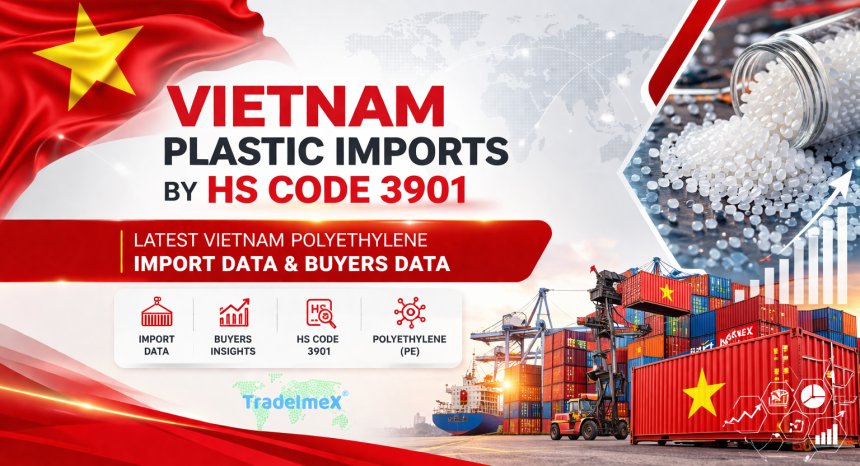
Vietnam Plastic Imports by HS Code 3901: Latest Vietnam Polyethylene Import Data & Buyers Data
Explore Vietnam polyethylene imports under HS Code 3901 with latest data, top supplier countries, key buyers, & detailed Vietnam plastic import insights.

Vietnam has emerged as one of Asia’s fastest-growing plastic manufacturing hubs, driven by exports in packaging, electronics, textiles, and consumer goods. At the center of this growth lies polyethylene (PE), classified under HS Code 3901, which is one of the most widely imported plastic raw materials in the country. If you look at Vietnam’s manufacturing growth over the last decade, one thing becomes obvious very quickly. The country doesn’t just export finished goods. It imports a massive amount of raw materials to make them. And polyethylene sits right at the center of that system. According to the latest Vietnam import data and Vietnam customs import data of Polyethylene, the total value of Vietnam polyethylene imports reached $3.48 billion in 2024, a 14% increase from the previous year.
Between January and August 2025, Vietnam's total imports of polyethene (PE) reached over $666 million, a 9% increase from the same period in 2024, according to Vietnam plastic import data under HS code 3901. Despite price fluctuations, the industry is driven by strong demand for consumer goods and packaging. Vietnam is the 5th largest Polyethylene importer worldwide, according to global trade data & Vietnam customs data. Vietnam is one of Southeast Asia’s fastest-growing manufacturing hubs, creating strong demand for plastic raw materials and attracting numerous Polyethylene importers in Vietnam. Many Vietnam Polyethylene importers source polyethylene from global suppliers to support the packaging, construction, automotive, and consumer goods industries.
Under HS Code 3901, polyethylene is one of Vietnam’s most heavily traded plastic inputs. It quietly powers everything from packaging and electronics to construction materials. But the interesting part isn’t just the scale. It’s how the import patterns are changing. Let’s walk through what the latest 2024–25 data actually tells us.
Why Polyethylene Matters So Much in Vietnam
Polyethylene is not some niche industrial chemical. It’s everywhere. Businesses looking to identify active buyers and analyze market trends can leverage Vietnam import data by HS code 3901, which covers polymers of ethylene in primary forms. This trade data provides valuable insights into import volumes, supplier countries, pricing trends, and key importing companies operating in Vietnam’s plastics sector.
Think about:
-
Plastic packaging for exports
-
Stretch films used in trade
-
Bottles, containers, pipes
-
Insulation materials in electronics
Vietnam produces all of these at scale. But it doesn’t produce enough polyethylene domestically. So it imports a lot. That’s why HS Code 3901 is a good lens to understand Vietnam’s broader industrial activity. When PE imports go up, it usually means manufacturing is expanding, as per the Vietnam Plastics Association report.
Vietnam Polyethylene Imports by Country: Where Does Vietnam Import Polyethylene From?
 Vietnam's imports of polyethene are a significant part of its trade. In acquiring Vietnam Polyethylene Imports by Country, it is notable that the country sources its polyethylene predominantly from a variety of regions worldwide. The main contributors to Vietnam's plastic imports under HS code 3901 include countries such as Saudi Arabia, South Korea, the USA, and Thailand. These nations play crucial roles in supplying Vietnam with the necessary polyethylene materials to meet its industrial and commercial demands. The top 10 polyethylene supplier countries to Vietnam, as per the Vietnam shipment data for 2025, include:
1. Saudi Arabia: $853.37 million (24.5%)
Saudi Arabia is the top supplier of polyethylene to Vietnam, accounting for a substantial 24.5% of the country's total imports. The Kingdom has a robust petrochemical industry and produces a large quantity of polyethylene for export. Vietnam benefits from Saudi Arabia's quality products and competitive pricing, making it a preferred source for polyethylene imports.
2. South Korea: $707.40 million (20.3%)
South Korea is another major supplier of polyethylene to Vietnam, capturing a significant market share of 20.3%, as per the data on Vietnam imports from South Korea by HS code 3901. The country's advanced manufacturing capabilities and proximity to Vietnam make it a convenient source for polyethylene imports. South Korean polyethylene products are known for their high quality and are widely used in various industries in Vietnam.
3. USA: $389.80 million (11.2%)
The United States is a key player in the global polyethylene market and a significant supplier to Vietnam. Despite the geographical distance, the USA still manages to hold an 11.2% market share in Vietnam's polyethylene imports. American polyethylene products are valued for their innovation and technology, attracting Vietnamese buyers looking for premium quality.
4. Thailand: $243.45 million (7%)
Thailand is a close neighbor to Vietnam and a crucial source of polyethylene imports for the country, as per the customs data on Vietnam polyethylene imports from Thailand by HS code. With a 7% market share, Thailand provides Vietnam with a diverse range of polyethylene products to cater to different industry needs. Proximity and trade agreements between the two countries make Thailand an attractive option for Vietnamese businesses.
5. Taiwan: $207.26 million (5.9%)
Taiwan is a leading producer of polyethylene and a significant supplier to Vietnam, holding a 5.9% market share. Taiwanese polyethylene products are known for their reliability and consistency, making them a popular choice among Vietnamese importers. The strong trade relations between Taiwan and Vietnam further facilitate polyethylene trade between the two countries.
6. China: $192.34 million (5.5%)
China is one of the largest producers of polyethylene in the world and a key supplier to Vietnam. Despite competition from other countries, China manages to capture a 5.5% market share in Vietnam's polyethylene imports. Chinese polyethylene products are competitively priced, making them a cost-effective option for Vietnamese buyers.
7. United Arab Emirates: $123.93 million (3.6%)
The United Arab Emirates is a growing player in the polyethylene market and a source of imports for Vietnam. With a 3.6% market share, the UAE offers a range of polyethylene products to meet Vietnam's demand. Growing trade relations between the two countries have boosted polyethylene imports from the UAE into Vietnam.
8. Kuwait: $109.07 million (3.1%)
Kuwait is a significant supplier of polyethylene to Vietnam, holding a 3.1% market share in the country's imports. Kuwaiti polyethylene products are valued for their purity and quality, making them a preferred choice in various industries in Vietnam. The strategic location of Kuwait and trade agreements contribute to the smooth flow of polyethylene imports into Vietnam.
9. Malaysia: $97.45 million (2.8%)
Malaysia is a key player in the polyethylene market and a notable supplier to Vietnam. With a 2.8% market share, Malaysia offers a diverse range of polyethylene products to cater to different industry needs in Vietnam. The quality and competitive pricing of Malaysian polyethylene make it a popular choice among Vietnamese importers.
10. Singapore: $91.82 million (2.6%)
Singapore is a significant source of polyethylene imports for Vietnam, holding a 2.6% market share in the country's total imports. Singaporean polyethylene products are known for their efficiency and reliability, making them a preferred choice for Vietnam's growing industries. Strong trade relations and market advantages further drive polyethylene imports from Singapore to Vietnam.
Vietnam Polyethylene Buyers Database & Shipment Records
Companies like Hyosung Vina Chemicals Co., Ltd, are the top importers of polyethylene in Vietnam. The leading polyethylene buyers in Vietnam, according to the Vietnam plastic buyers database & polyethylene importers data for 2025, include:
1. Hyosung Vina Chemicals Co., Ltd
-
Approx. Import Value in 2025: $220M
-
Top Import Types: HDPE, LLDPE
-
Top Import Sources: South Korea, USA, Saudi Arabia
2. SCG Chemicals Vietnam Co., Ltd
-
Approx. Import Value in 2025: $190M
-
Top Import Types: HDPE, LLDPE, LDPE
-
Top Import Sources: Thailand, the USA, the Middle East
3. Lotte Chemical Vietnam Co., Ltd
-
Approx. Import Value in 2025: $170M
-
Top Import Types: HDPE, LDPE
-
Top Import Sources: South Korea, USA
4. TPC Vina Plastic & Chemicals Corp
-
Approx. Import Value in 2025: $140M
-
Top Import Types: HDPE, industrial PE resins
-
Top Import Sources: Taiwan, Saudi Arabia
5. Duy Tan Plastics Manufacturing Corp
-
Approx. Import Value in 2025: $120M
-
Top Import Types: HDPE, LDPE
-
Top Import Sources: USA, Singapore, Thailand
6. Binh Minh Plastics JSC
-
Approx. Import Value in 2025: $110M
-
Top Import Types: HDPE (pipes), PE compounds
-
Top Import Sources: Saudi Arabia, UAE, USA
7. An Phat Bioplastics JSC
-
Approx. Import Value in 2025: $100M
-
Top Import Types: LLDPE, biodegradable blends
-
Top Import Sources: South Korea, Europe, USA
8. Dong Nai Plastic JSC
-
Approx. Import Value in 2025: $60M
-
Top Import Types: HDPE, LDPE
-
Top Import Sources: Thailand, Saudi Arabia
9. Tan Tien Plastic Packaging JSC
-
Approx. Import Value in 2025: $50M
-
Top Import Types: LLDPE, LDPE (films)
-
Top Import Sources: Singapore, Malaysia, USA
10. Minh Hung Plastic Co., Ltd
-
Approx. Import Value in 2025: $40M
-
Top Import Types: HDPE, recycled polyethylene
-
Top Import Sources: China, Thailand
Vietnam Polyethylene Import Data for the Last 10 Years
|
Year of Imports |
Total Import Value ($) |
Total Import Quantity (Tons) |
|
2015 |
$1.78 billion |
1.30 million tons |
|
2016 |
$1.92 billion |
1.49 million tons |
|
2017 |
$2.22 billion |
1.69 million tons |
|
2018 |
$2.63 billion |
1.66 million tons |
|
2019 |
$2.64 billion |
1.94 million tons |
|
2020 |
$2.39 billion |
1.96 million tons |
|
2021 |
$3.44 billion |
1.85 million tons |
|
2022 |
$3.79 billion |
1.92 million tons |
|
2023 |
$3.04 billion |
1.96 million tons |
|
2024 |
$3.48 billion |
2.23 million tons |
|
2025 |
$3.15 billion |
2.21 million tons |
The Scale: How Much Vietnam Is Importing
Let’s start with the numbers. Vietnam imported roughly $3.4 billion worth of polyethylene in 2024-25, and that momentum has carried into 2026. The shipment-level data shows steady growth, not a one-off spike.
What stands out more is volume activity:
-
Tens of thousands of shipments recorded under HS 3901
-
Thousands of active suppliers globally
-
Hundreds of buyers within Vietnam
Even in just one segment like HDPE, imports jumped sharply in the latest cycle. That tells you demand is not just stable, it’s accelerating in certain sectors. This isn’t random growth. It’s tied directly to how Vietnam’s economy is evolving.
What Types of Polyethylene Are Driving Demand
Not all polyethylene is used the same way. Vietnam’s import mix gives you a clear picture of where demand is coming from.
LDPE and LLDPE: The Packaging Engine
A big chunk of imports falls into LDPE and LLDPE.
These are used in:
-
Flexible packaging
-
Plastic films
-
Bags and wraps
Now think about Vietnam’s export profile. Electronics, garments, food products. All of these need packaging. That’s why LDPE alone takes a massive share of import value. If exports grow, this segment grows with it.
HDPE: Infrastructure and Industrial Growth
HDPE tells a slightly different story.
It’s used in:
-
Pipes
-
Industrial containers
-
Construction materials
The strong growth in HDPE imports, especially the double-digit jump recently, points to infrastructure and industrial expansion. It’s less about exports and more about internal development. So when you see HDPE rising faster than usual, it usually means domestic investment is picking up.
What This Tells You
Vietnamese importers are not locked into rigid supply chains. They actively switch and diversify based on:
-
Price
-
availability
-
geopolitical conditions
That flexibility is one reason the import market stays competitive.
Buyer Landscape: Who’s Actually Importing
This is where raw data becomes useful. There isn’t just a handful of big buyers controlling everything. Instead, you see a broad and fragmented buyer base.
Roughly speaking:
-
A few large manufacturers import consistently in high volumes
-
A long tail of mid-sized and smaller buyers imports more selectively
These buyers include:
-
Packaging companies
-
Plastic product manufacturers
-
Industrial processors
-
Trading firms
What separates top buyers from the rest is not just volume. It’s consistency. The most active importers tend to:
-
Import frequently (not just in bulk once or twice)
-
Work with multiple suppliers
-
Adjust sourcing strategies quickly
If you’re trying to enter this market, those are the companies that matter most.
A Pattern That Keeps Showing Up: Growth with Competition
One thing the 2024–25 data makes clear is this: The market is growing, but it’s not getting easier. There are now:
-
More buyers than before
-
More suppliers are competing for those buyers
-
More countries entering the supply chain
So even though demand is rising, competition is rising just as fast. That changes how deals happen.
What HS Code 3901 Import Trends Say About Vietnam’s Economy
If you step back and look at the bigger picture, polyethylene imports tell a story beyond plastics.
1. Manufacturing Is Still Expanding
The steady increase in shipments shows that factories are still running and scaling up. This isn’t a slowdown phase.
2. Export Dependency Is Still High
Packaging-related polyethylene demand remains strong. That means Vietnam is still heavily tied to export markets.
3. Supply Chains Are Becoming More Flexible
Importers are no longer relying on fixed partners. They’re actively optimizing sourcing, sometimes switching countries based on short-term advantages.
Challenges That Are Starting to Show
It’s not all smooth growth.
Price Volatility
Polyethylene prices are closely tied to oil. That creates uncertainty for importers, especially those working on tight margins.
Environmental Pressure
Vietnam, like many countries, is facing pressure to reduce plastic usage. This doesn’t kill demand overnight, but it does push companies toward:
-
recycling
-
alternative materials
-
efficiency improvements
Global Disruptions
Import costs and geopolitical issues still affect supply chains. Importers have to constantly adapt.
Where the Opportunities Are
If you’re an exporter or trader, Vietnam is still a strong opportunity. But the approach matters.
What works:
-
Targeting buyers with a consistent import history
-
Offering stable pricing instead of chasing short-term spikes
-
Building relationships rather than one-off deals
What doesn’t work as well anymore:
-
Competing only on price without reliability
-
Treating the market as low-competition
-
Ignoring buyer-specific needs
The market rewards suppliers who can stay consistent.
What to Watch Going Forward
The next phase of Vietnam’s polyethylene imports will likely be shaped by a few things:
-
Continued manufacturing growth
-
Gradual shift toward sustainable materials
-
More data-driven sourcing decisions by buyers
Demand isn’t going away. But it will become more selective.
Conclusion and Final Thoughts
In conclusion, Vietnam’s imports under HS Code 3901 (polyethylene) highlight a dynamic and fast-growing market driven by manufacturing expansion and global trade integration. If you strip away all the data points, the core story is simple. Vietnam imports a huge amount of polyethylene because it makes a huge number of things. And it’s still making more every year. HS Code 3901 isn’t just a trade category. It’s a signal of how active the country’s industrial engine really is. And right now, that engine is still running strong.
Note For Our Readers
We hope this breakdown of Vietnam’s polyethylene imports under HS Code 3901 gave you a clear and practical view of how the market is actually moving in 2024–25. Beyond the numbers, the real takeaway is how closely plastic imports are tied to Vietnam’s manufacturing growth, export demand, and shifting global supply chains. For traders, suppliers, and analysts, this kind of data is not just informative; it helps you make better decisions about where the market is heading next. Access the latest Vietnam export-import data on our platform.
If you want to go further, you can explore detailed Vietnam plastic import data by country or HS code, track monthly shipment activity, or identify active polyethylene buyers and their sourcing patterns using Vietnam trade intelligence tools. For deeper insights, including a verified Vietnam polyethylene buyers & importers database, supplier tracking, and customized market reports tailored to your business needs, feel free to reach out to us at [email protected] today.
Share
What's Your Reaction?
 Like
0
Like
0
 Dislike
0
Dislike
0
 Love
0
Love
0
 Funny
0
Funny
0
 Angry
0
Angry
0
 Sad
0
Sad
0
 Wow
0
Wow
0