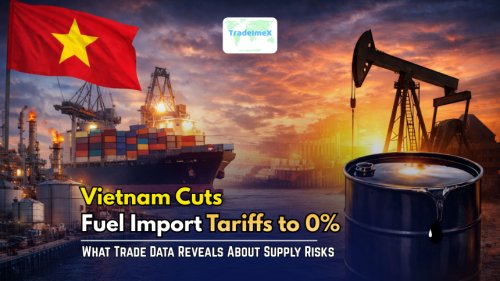
Vietnam Cuts Fuel Import Tariffs to 0%: What Trade Data Reveals About Supply Risks
Vietnam cuts fuel import tariffs to 0% to secure supply amid global energy disruptions. Explore Vietnam fuel import data, top supplier countries, & energy supply risks.


Vietnam has taken an unusually aggressive step in energy policy: cutting import tariffs on several fuel products to 0%, a move aimed at stabilizing supply amid global disruptions. The policy, announced in early March 2026, temporarily removes import duties on key fuels, including gasoline, diesel, jet fuel, and petrochemical feedstocks. The measure will remain in effect until April 30, 2026, though it may be extended if energy markets remain volatile. According to the latest Vietnam import data and Vietnam customs import data of fuel, the total value of Vietnam fuel imports reached $6.8 billion in 2025, a 2% increase from the previous year.
At first glance, the decision is a short-term response to surging global oil prices and geopolitical tensions. But trade data suggests a deeper issue: Vietnam’s structural dependence on imported refined fuels and fragile supply chains. When those supply chains face shocks, even small disruptions can trigger price spikes & shortages. Vietnam is the 24th largest fuel importer in the world, according to global trade data.
This article examines the policy change in detail, using trade data and energy market trends to understand what Vietnam’s tariff cut reveals about supply risks, regional trade flows, and long-term energy security.
The Policy: Why Vietnam Slashed Fuel Tariffs
Vietnam’s Ministry of Finance proposed reducing Most Favored Nation (MFN) import tariffs on key petroleum products to zero to stabilize domestic supply and prices. The changes include:
-
Unleaded gasoline: tariff reduced from 10% to 0%
-
Gasoline blending components (naphtha, reformate): 10% to 0%
-
Diesel, fuel oil, jet fuel, kerosene: 7% to 0%
-
Petrochemical feedstocks (xylene, condensate, p-xylene): 2–3% to 0%
The policy was introduced as global energy markets tightened following geopolitical tensions in the Middle East. In particular, disruptions affecting oil flows through the Strait of Hormuz, a critical shipping route carrying about 20 million barrels of crude oil per day, have threatened supplies across Asia. Oil prices reacted quickly. Brent and WTI crude surged above $100 per barrel, with prices jumping around 15–20% in a single trading session.
For an import-dependent economy like Vietnam, these shocks quickly translate into higher domestic prices. In fact, the government recently reported that gasoline prices rose 7.66% in a single adjustment, despite interventions from the national fuel stabilization fund. Removing tariffs, therefore, acts as an emergency lever to lower import costs and allow fuel distributors to source supplies from a broader set of markets.
Vietnam’s Energy Structure: A Net Importer of Refined Fuel
To understand why the tariff cut on fuel imports 0% was necessary, it is important to look at Vietnam’s energy trade structure. Although Vietnam produces crude oil domestically, it imports a large share of refined petroleum products, including gasoline and diesel. Domestic refining capacity is limited and concentrated mainly in two large refineries:
-
Nghi Son Refinery
-
Dung Quat Refinery
When these refineries operate below capacity or face maintenance disruptions, the country must rely heavily on imports.
In fact, trade estimates suggest:
-
Vietnam imports millions of tons of refined petroleum annually.
-
Imports surged 43% in early 2026 due to tightening supply conditions.
This surge has already widened Vietnam’s trade deficit in energy commodities, illustrating how volatile global oil markets can quickly impact the country’s trade balance.
Vietnam Fuel Imports by Country: Where Does Vietnam Import Fuel From?

Vietnam's fuel imports originate from several countries, with key sources including South Korea, Singapore, Malaysia, and China. These nations play a significant role in supplying Vietnam's fuel demand, ensuring a steady flow of resources to support the country's energy needs. South Korea is the largest supplier of fuel to Vietnam, as per the data on Vietnam fuel imports from South Korea by HS code. The top 10 fuel supplier countries to Vietnam, as per the customs data on Vietnam fuel imports by country & Vietnam shipment data for 2025, include:
1. South Korea: $2.63 billion (41.7%)
2. Singapore: $980.58 million (15.6%)
3. China: $900.92 million (14.3%)
4. Malaysia: $779.84 million (12.4%)
5. Thailand: $643.76 million (10.2%)
6. Brunei Darussalam: $175.11 million (2.8%)
7. Japan: $26.59 million (0.4%)
8. Taiwan: $25.98 million (0.4%)
9. United Arab Emirates: $25.28 million (0.4%)
10. USA: $21.45 million (0.3%)
Vietnam Fuel Import Data For the Last 10 Years

|
Year of Imports |
Total Fuel Import Value ($) |
Total Import Quantity (tons) |
|
2015 |
$4.38 billion |
8.12 million tons |
|
2016 |
$4.31 billion |
10.02 million tons |
|
2017 |
$5.57 billion |
10.55 million tons |
|
2018 |
$6.44 billion |
4.54 million tons |
|
2019 |
$5.01 billion |
8.47 million tons |
|
2020 |
$3.06 billion |
7.86 million tons |
|
2021 |
$4.16 billion |
7.16 million tons |
|
2022 |
$7.68 billion |
4.11 million tons |
|
2023 |
$7.26 billion |
3.50 million tons |
|
2024 |
$6.30 billion |
3.04 million tons |
|
2025 |
$6.80 billion |
9.90 million tons |

Where Vietnam Gets Its Fuel: Trade Flow Patterns
Trade data reveal that Vietnam’s fuel supply chain is highly concentrated geographically. Most petroleum imports come from:
-
ASEAN countries (particularly Singapore, Malaysia, and Thailand)
-
South Korea
These suppliers dominate Vietnam’s fuel imports largely because regional trade agreements already provide preferential tariffs at near-zero rates. This means the new policy does not primarily benefit these traditional suppliers. Instead, it opens the door to imports from non-FTA markets, which previously faced higher MFN tariffs.
Potential alternative suppliers include:
-
Middle Eastern exporters
-
China
-
India
-
Japan
-
the United States
Without the tariff cut, Vietnamese fuel importers would face a significant cost disadvantage when sourcing from these countries.
Trade Data Shows Vietnam Fuel Imports Surging in Early 2026
Recent trade statistics reinforce why Vietnam moved quickly to eliminate fuel import tariffs. Data from the country’s customs authorities shows a sharp surge in petroleum imports in the first two months of 2026, signaling growing concern about supply security. According to official Vietnam customs data, Vietnam imported 2.18 million tons of petroleum products worth more than $1.44 billion between January and February 2026. That represents a 43% increase in volume and a 31.4% rise in value compared with the same period in 2025. The scale of the increase is notable for several reasons.
First, the surge reflects pre-emptive stockpiling by fuel wholesalers and distributors. As geopolitical tensions escalated in the Middle East and oil prices became more volatile, Vietnamese energy companies accelerated imports to secure supply for the domestic market.
Second, the growth highlights the country’s reliance on imported refined fuels. Despite operating two major refineries, Vietnam still imports a significant portion of gasoline, diesel, and other petroleum products needed to support economic growth.
A Diverging Trend Between Crude and Refined Fuel
Interestingly, trade data shows a contrasting trend between refined petroleum products and crude oil imports. While refined fuel imports surged sharply, crude oil imports declined during the same period. Vietnam imported about 2.16 million tons of crude oil worth roughly $1.08 billion, representing a 10% drop in volume and a 25% decline in value year-on-year.
This divergence reveals a shift in the structure of Vietnam’s energy trade. Instead of importing crude oil for domestic refining, the country increasingly relies on imported finished fuels. This shift can occur for several reasons:
-
Domestic refineries operating near capacity
-
Maintenance schedules affecting production
-
Higher efficiency or lower cost of importing refined fuels from regional hubs
-
Short-term supply disruptions affecting refinery feedstock
As a result, Vietnam’s fuel supply chain is becoming more dependent on international refined fuel markets, which are often more volatile than crude oil markets.
Falling Energy Exports Signal Domestic Prioritization
Another signal from the trade data is a decline in Vietnam’s energy exports. In the first two months of 2026, the country exported about $200.3 million worth of crude oil and nearly $55 million in petroleum products, both of which were significantly lower than the previous year. Crude exports dropped 16.7%, while refined petroleum exports fell by 62.3%.
This drop suggests that Vietnam is prioritizing domestic fuel supply over export revenue. When energy markets become unstable, governments often encourage producers and distributors to retain supplies for domestic use rather than export them abroad. Vietnam appears to be following this pattern as it seeks to prevent potential shortages.
The Longer-Term Trend: Rising Import Dependence
The surge in early-year imports also fits into a broader trend. In 2025, Vietnam imported around 9.9 million tons of petroleum products worth about $6.8 billion, reflecting the country’s growing reliance on imported energy to sustain economic expansion.
Vietnam’s manufacturing sector, trade networks, and rapidly expanding transportation system all require large quantities of fuel. As the government pursues double-digit economic growth targets, energy demand is expected to rise further. That demand growth makes the country increasingly vulnerable to global supply disruptions.
What the Import Surge Signals About Policy
When viewed alongside the tariff cut, the import data paints a clear picture of government strategy. The sequence of events looks like this:
-
Global oil markets become volatile due to geopolitical tensions.
-
Vietnamese energy companies increase imports sharply to secure supply.
-
The government cuts import tariffs to reduce costs and widen sourcing options.
In other words, the tariff cut is not an isolated policy move. It is part of a broader response to rapidly rising import demand and growing supply risks. If tensions in global energy markets persist, Vietnam may continue to rely heavily on imports to stabilize domestic fuel supplies.
The Documentation Problem: Why Tariffs Matter More Than They Seem
Another key issue revealed by trade data is the certificate-of-origin requirement tied to preferential tariff rates. Under many free trade agreements, importers must provide a Certificate of Origin (C/O) to prove that goods were produced in partner countries to qualify for zero tariffs. However, during periods of supply disruption:
-
Cargoes may be rerouted
-
Documentation may be unavailable
-
Spot market purchases may lack C/O certification
In these cases, the standard MFN tariff applies, which could add up to 10% to fuel import costs. Lowering the MFN rate to zero, therefore, allows companies to buy fuel on the global spot market without worrying about documentation constraints. In practical terms, this greatly increases flexibility during supply shocks.
The Geopolitical Trigger: Energy Markets in Crisis
Vietnam’s tariff cut cannot be separated from current geopolitical events. The global energy market has been destabilized by escalating conflict involving the United States, Israel, and Iran. The tensions threaten the stability of the Persian Gulf energy corridor, which is responsible for roughly one-fifth of global oil supply flows.
Several immediate consequences have emerged:
-
Shipping risks around the Strait of Hormuz
-
Reduced refinery exports across Asia
-
Higher insurance costs for tankers
-
Oil price spikes above $100 per barrel
These disruptions have already forced governments to adopt emergency measures. In Vietnam’s case, officials even encouraged companies to allow employees to work from home to reduce fuel consumption during the crisis. This highlights how quickly supply shocks can ripple through the broader economy.
Domestic Supply Risks: More Than Just Imports
Trade data also reveals structural vulnerabilities inside Vietnam’s domestic fuel system.
1. Limited Refining Capacity
Vietnam’s refining infrastructure struggles to meet national demand. When either major refinery experiences maintenance issues or financial disputes, the country must rapidly increase imports. In the past, supply disruptions at the Nghi Son refinery alone have forced emergency imports to prevent shortages.
2. Demand Growth
Vietnam’s fuel demand has been rising steadily due to:
-
Rapid industrialization
-
Growing transport demand
-
Expanding manufacturing exports
This makes the energy system more sensitive to external shocks.
3. Inventory Constraints
Unlike larger economies with large strategic reserves, Vietnam’s petroleum storage capacity is relatively limited. This reduces the government’s ability to buffer supply disruptions. Together, these factors create a system where even short-term trade disruptions can cause domestic shortages.
Inflation Risks: Why the Government Is Acting Quickly
Fuel prices are one of the most sensitive inflation drivers in Vietnam’s economy.
Higher energy costs affect:
-
transportation
-
manufacturing
-
agriculture
-
consumer goods
When oil prices spike globally, Vietnamese authorities typically intervene using several tools:
-
Fuel price stabilization funds
-
Adjustments to environmental taxes
-
Temporary tariff reductions
The current zero-tariff policy is therefore part of a broader toolkit designed to prevent inflation from spiraling out of control. Without these measures, analysts estimate domestic fuel prices could rise sharply, especially if oil remains above $100 per barrel.
Fiscal Trade-Off: Revenue Loss vs Economic Stability
Removing tariffs does come with a fiscal cost. Estimates suggest the tariff cut could reduce government revenue by more than 1 trillion Vietnamese dong (around $40 million). However, policymakers see this as a worthwhile trade-off.
The reasoning is straightforward:
-
Higher fuel prices could slow economic growth.
-
Inflation could increase household costs.
-
Supply shortages could disrupt manufacturing.
In contrast, the revenue loss from tariffs is relatively small compared with the potential economic damage from a fuel shortage.
Vietnam Fuel Trade Data Signals a Bigger Problem
Although the tariff cut is a short-term measure, trade patterns reveal bigger structural risks. Three key vulnerabilities stand out.
1. Import Dependence
Vietnam’s reliance on imported refined fuels makes it vulnerable to global market volatility. Even small disruptions in regional supply chains can quickly create shortages.
2. Supplier Concentration
Heavy reliance on ASEAN and South Korea means supply could tighten if regional refineries reduce exports. Diversifying supply sources is therefore critical.
3. Infrastructure Gaps
Limited domestic refining capacity leaves the country exposed during global energy crises. Expanding refining capacity or strategic reserves could reduce this risk in the long run.
Could the Zero Tariff Become Permanent?
For now, the tariff cut is temporary, scheduled to expire at the end of April 2026. But if global energy volatility continues, policymakers may consider extending the policy. Longer-term options include:
-
Permanent tariff adjustments
-
Expanded fuel storage reserves
-
Investments in refinery upgrades
-
Accelerated transition to alternative fuels
Vietnam has already explored alternative energy pathways, including ethanol-blended fuels and renewable energy expansion. However, the country’s transport and industrial sectors still depend heavily on petroleum.
What This Means for Global Energy Trade
Vietnam’s policy shift also highlights broader trends in global energy markets. Several emerging economies across Asia face similar challenges:
-
heavy dependence on imported fuel
-
limited domestic refining capacity
-
exposure to geopolitical disruptions
As a result, policies like tariff reductions, strategic reserves, and supplier diversification are becoming more common. In Vietnam’s case, the fuel tariff cut may signal to global suppliers that the country is actively seeking alternative import sources. This could reshape regional fuel trade flows if disruptions persist.
Conclusion and Bottom Line
In conclusion, Vietnam’s decision to cut fuel import tariffs to zero is more than just a temporary tax adjustment. It reflects a deeper reality revealed by fuel trade data: the country’s energy system remains vulnerable to global supply shocks.
Several factors are driving this vulnerability:
-
heavy reliance on imported refined fuels
-
concentrated supplier networks
-
limited domestic refining capacity
-
geopolitical risks affecting oil transport routes
The zero-tariff policy gives importers more flexibility and helps stabilize domestic prices in the short term. But it does not eliminate the structural risks embedded in Vietnam’s energy trade. In many ways, the move underscores a broader lesson for emerging economies: energy security is not just about price, it is about supply resilience. For Vietnam, strengthening that resilience will likely require long-term investments in refining capacity, diversified supply chains, and alternative energy sources. Until then, tariff cuts may remain a critical emergency tool whenever global energy markets become unstable.
Note For Our Readers
We hope you found this data-driven analysis on Vietnam’s fuel import tariff cuts and the underlying trade trends useful and informative. Understanding how policy decisions connect with real import-export data helps businesses, analysts, and energy market participants identify supply risks, price movements, and emerging trade opportunities.
Looking to expand your market insights or evaluate fuel trade dynamics more closely? Access the latest Vietnam export-import data or search live data on Vietnam fuel imports by HS code, supplier country, or port of entry, visit VietnamExportdata. For customized trade reports, verified Vietnamese fuel importers databases, buyer details, or deeper market intelligence, contact us at info@tradeimex.in today.
Share
What's Your Reaction?
 Like
0
Like
0
 Dislike
0
Dislike
0
 Love
0
Love
0
 Funny
0
Funny
0
 Angry
0
Angry
0
 Sad
0
Sad
0
 Wow
0
Wow
0