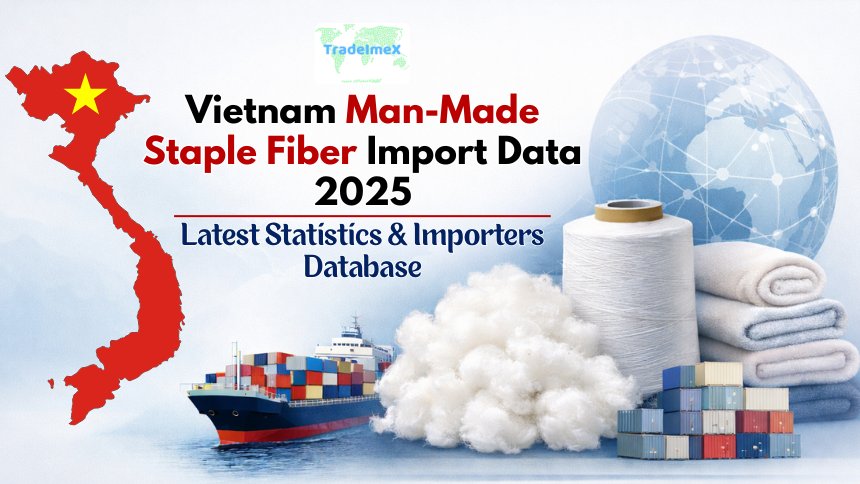
Vietnam Man-Made Staple Fiber Import Data 2025: Latest Statistics & Importers Database
Explore Vietnam Man-Made Staple Fiber Import Data 2025, with top supplier countries, HS code 55 insights, polyester trends, & Vietnam importers database.

Introduction
Vietnam is one of the fastest-growing textile and apparel manufacturing hubs in Asia. Over the past decade, the country’s export-oriented garment and textile sector has experienced explosive growth, driven by foreign direct investment, regional trade agreements (such as the CPTPP and EVFTA), and rising global demand for apparel and fabrics. However, Vietnam’s domestic production of raw textile materials, especially man-made staple fibers (MMSF) such as polyester and other synthetic fibers, has not kept pace with the demand from its downstream textile industry. According to the latest Vietnam import data and Vietnam customs import data of man-made staple fiber, the total value of Vietnam man-made staple fiber imports reached $2.49 billion in 2024-25, a 7% increase from the previous year.
Vietnam is the largest man-made staple fiber importer in the world, according to global trade data and Vietnam customs data. As a result, Vietnam has become a significant importer of man-made staple fibers, relying on global producers to supply inputs for yarn, fabric, and garment production. This blog provides a detailed, data-backed look at how much and what types of MMSF Vietnam imported in 2024-25, where these imports came from, the countries that import Vietnamese synthetic fiber products, and a snapshot of the major importers in Vietnam’s fiber ecosystem.
Defining Man-Made Staple Fiber (MMSF)
In global trade terminology, man-made staple fibers classified under HS code 55, refer to fibers such as polyester, viscose, acrylic, nylon, and other synthetic fibers that are cut to a specified length (staple form) and used as feedstock in spinning mills to produce yarns and fabrics. Common HS (Harmonized System) codes related to MMSF include:
-
55032010 – Polyester staple fibers (not carded/combed)
-
55049000 – Other man-made staple fibers, not carded/combed
-
551011 – Yarn with ≥85% artificial staple fiber
-
Other related textile inputs involve synthetic staple fibers.
Vietnam’s imports in these categories are a critical economic indicator for the textile sector.
Vietnam’s Total Import Value of Man-Made Staple Fibers
According to United Nations COMTRADE data and the latest import statistics, Vietnam’s total imports of man-made staple fibers in 2025, worth over $2.60 billion, measured in value from all sources, show significant activity across several segments: synthetic fibers, yarn, woven fabric, and sewing threads. While exact national totals for all MMSF categories are not consolidated in one public dataset, the available data highlight important trends. However, the most striking trend in 2024-25 is Vietnam’s increased reliance on imported fiber feedstock, particularly polyester, because local fiber production is limited compared to demand.
Vietnam Man-Made Staple Fiber Imports by Country
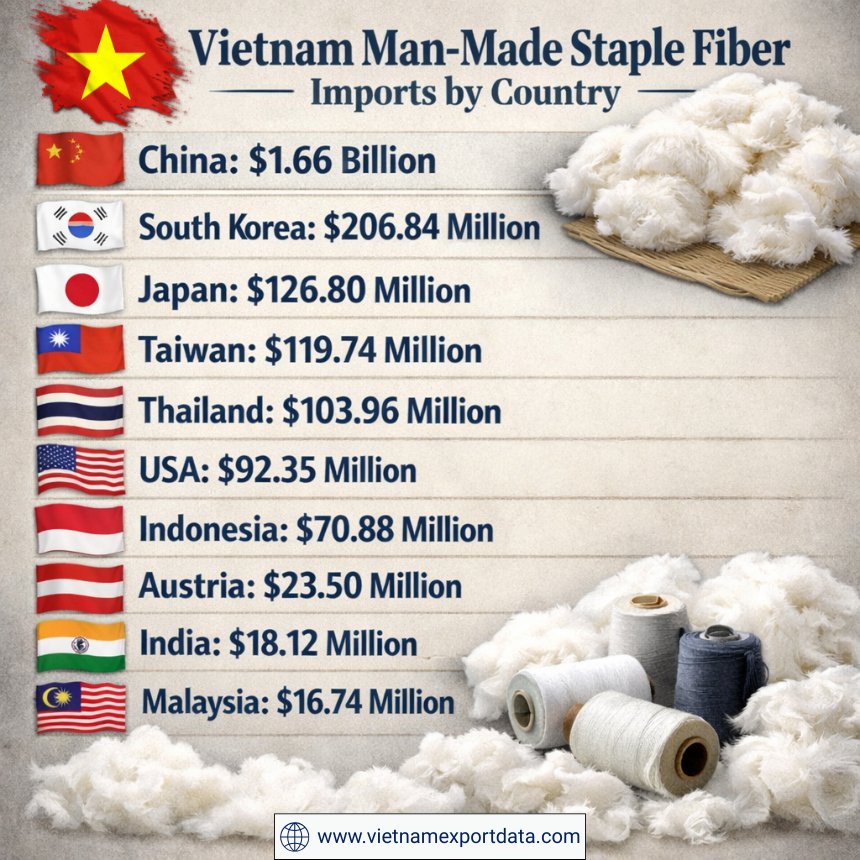
In recent years, Vietnam has experienced a significant rise in man-made staple fiber imports by country. As an emerging market, Vietnam has established itself as a key player in the global textile industry, attracting attention from various countries worldwide. The increase in imports of man-made staple fibers reflects the country's growing demand for raw materials to support its thriving textile and garment manufacturing sectors. The top 10 suppliers of man-made staple fibers to Vietnam, as per the Vietnam man-made staple fiber imports by country and Vietnam shipment data for 2025, include:
1. China: $1.66 billion (66.6%)
Unsurprisingly, China tops the list as the largest exporter of man-made staple fibers to Vietnam, accounting for a whopping 66.6% of the total imports, as per the data on Vietnam man-made staple fiber imports from China by HS code. With its massive production capacity and competitive pricing, Chinese manufacturers have established a strong presence in the Vietnamese market.
2. South Korea: $206.84 million (8.3%)
South Korea occupies the second spot with a market share of 8.3%, providing Vietnam with a diverse range of high-quality man-made staple fibers. Korean suppliers are known for their technological innovation and premium products, making them a preferred choice for many Vietnamese textile companies, as per the data on Vietnam man-made fiber imports from South Korea.
3. Japan: $126.80 million (5.1%)
Japanese man-made staple fibers are valued for their superior quality and advanced manufacturing processes. With a market share of 5.1%, Japan remains a key supplier to Vietnam's textile industry, catering to the demand for specialty fibers and niche products.
4. Taiwan: $119.74 million (4.8%)
Taiwanese suppliers hold a 4.8% market share in Vietnam's man-made staple fiber imports, offering a mix of traditional fibers and cutting-edge materials. The Taiwanese textile industry is known for its flexibility and reliability, meeting the varied requirements of Vietnamese manufacturers.
5. Thailand: $103.96 million (4.2%)
Thailand's share of Vietnam's man-made staple fiber imports stands at 4.2%, with Thai manufacturers delivering cost-effective solutions and prompt delivery to their Vietnamese counterparts. The proximity between the two countries also contributes to the smooth flow of trade in textile materials.
6. USA: $92.35 million (3.7%)
The USA holds a 3.7% market share in Vietnam's man-made staple fiber imports, supplying a range of innovative fibers and eco-friendly options. American manufacturers are known for their sustainability efforts and adherence to stringent quality standards, making them a preferred choice for environmentally conscious Vietnamese companies.
7. Indonesia: $70.88 million (2.8%)
Indonesia's contribution to Vietnam's man-made staple fiber imports is significant, accounting for 2.8% of the total market share. Indonesian suppliers offer a mix of synthetic and natural fibers, catering to the diverse needs of Vietnam's textile industry.
8. Austria: $23.50 million (0.9%)
Austria holds a modest 0.9% market share in Vietnam's man-made staple fiber imports, providing specialty fibers and value-added solutions to the local manufacturers. Austrian suppliers are known for their focus on innovation and customization, adding unique elements to Vietnam's textile products.
9. India: $18.12 million (0.7%)
Despite its relatively small market share of 0.7%, India plays a significant role in Vietnam's man-made staple fiber imports, offering a wide range of fibers at competitive prices. Indian manufacturers cater to both mass-market and premium segments, meeting the diverse requirements of Vietnamese customers.
10. Malaysia: $16.74 million (0.7%)
Rounding up the list is Malaysia, with a 0.7% market share in Vietnam's man-made staple fiber imports. Malaysian suppliers focus on quality and reliability, delivering consistent performance and on-time shipments to their Vietnamese partners.
Vietnam Man-Made Staple Fiber Importers Database & Shipment Records
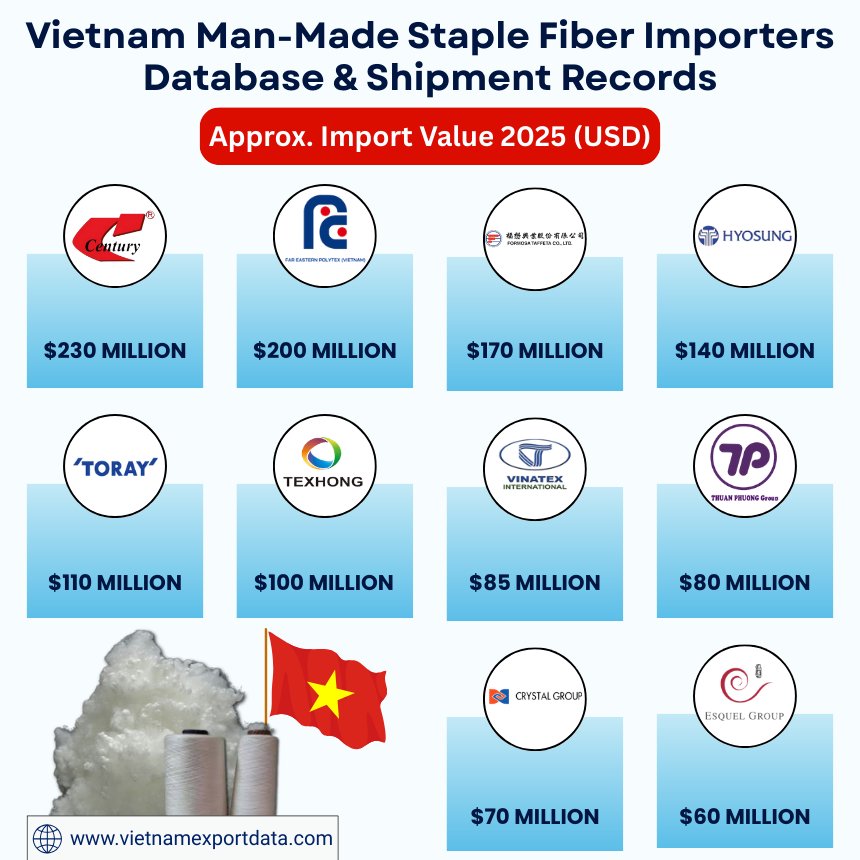
For businesses seeking reliable information on Vietnam Man-Made Staple Fiber Importers, accessing the database and shipment records can provide valuable insights. The Vietnam Man-Made Staple Fiber Importers Database & Shipment Records provide a comprehensive view of the market, enabling companies to identify potential partners, track competitors, and make informed decisions. The leading man-made staple fiber importers & buyers in Vietnam, according to the Vietnam importers database for 2025, include:
|
Rank |
Company Name |
Approx. Import Value 2025 (USD) |
Top Import Types |
Top Import Sources |
|
1 |
$230 million |
Polyester Staple Fiber (PSF), Hollow Conjugated Fiber |
China, South Korea |
|
|
2 |
Far Eastern Polytex (Vietnam) Ltd. |
$200 million |
Virgin PSF, Recycled PSF |
Taiwan, China |
|
3 |
Formosa Taffeta Vietnam Co., Ltd. |
$170 million |
Polyester Fiber, Functional Fibers |
Taiwan, China |
|
4 |
Hyosung Dong Nai Co., Ltd. |
$140 million |
Polyester & Blended Staple Fiber |
South Korea, China |
|
5 |
Toray International Vietnam Co., Ltd. |
$110 million |
High-performance Synthetic Staple Fiber |
Japan, Thailand |
|
6 |
Texhong Vietnam Textile Co., Ltd. |
$100 million |
Polyester & Viscose Staple Fiber |
China, Indonesia |
|
7 |
Vinatex International Import Export JSC |
$85 million |
PSF, Regenerated Fibers |
China, India |
|
8 |
Thuan Phuong Textile & Garment Investment Co., Ltd. |
$80 million |
Polyester Fiber Chips & PSF |
Taiwan, China |
|
9 |
Crystal Martin Vietnam Co., Ltd. |
$70 million |
Polyester & Blended Staple Fiber |
China, South Korea |
|
10 |
Esquel Garment Manufacturing Vietnam Co., Ltd. |
$60 million |
Cotton-Polyester Blended Staple Fiber |
China, Thailand |
Key Insights from 2025 Import Patterns
1. Polyester Staple Fiber Dominates
Over 65% of total MMSF imports in Vietnam in 2025 are estimated to be polyester-based fibers, including virgin PSF, recycled PSF (rPSF), and hollow conjugated fiber.
2. China Remains the Primary Supplier
Approximately 55–60% of Vietnam’s MMSF imports originate from China due to:
-
Competitive pricing
-
Short transit times
-
Large production capacity
3. Growing Share of Recycled Fiber
Imports of recycled polyester staple fiber (rPSF) have grown by an estimated 18–22% year-on-year in 2025, reflecting sustainability commitments from export-oriented manufacturers.
4. Industrial Zones Drive Import Activity
Most fiber imports are concentrated in:
-
Dong Nai
-
Binh Duong
-
Long An
-
Quang Ngai
-
Hai Phong
These provinces house spinning mills and fabric production plants that depend on steady raw material supply.
Vietnam Man-Made Staple Fiber Import Data For the Last 10 Years
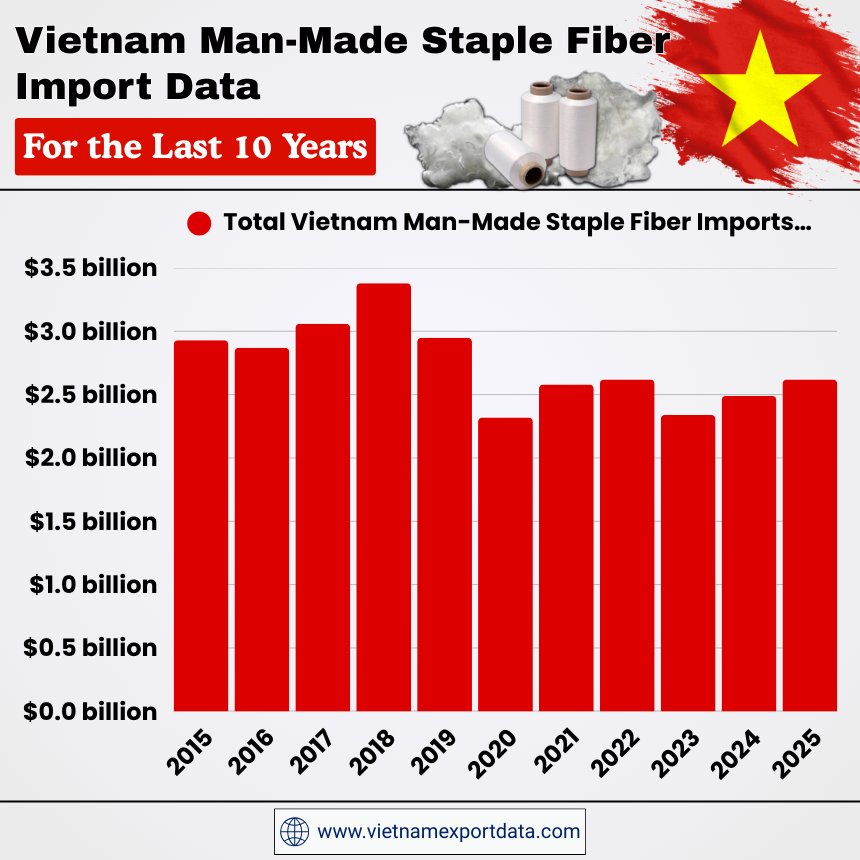
|
Year of Imports |
Total Vietnam Man-Made Staple Fiber Imports ($) |
|
2015 |
$2.93 billion |
|
2016 |
$2.87 billion |
|
2017 |
$3.06 billion |
|
2018 |
$3.38 billion |
|
2019 |
$2.95 billion |
|
2020 |
$2.32 billion |
|
2021 |
$2.58 billion |
|
2022 |
$2.62 billion |
|
2023 |
$2.34 billion |
|
2024 |
$2.49 billion |
|
2025 |
$2.62 billion |
Key Fiber Categories & Import Figures of Vietnam
Below are some of the major MMSF categories with available import data and the trending importers:
1. Synthetic Staple Fibres & Yarn
Vietnam’s imports of synthetic staple fibers and related yarns are dominated by key Asian suppliers. The latest data provides insight into product flows that likely continued into 2024:
-
Single yarn with ≥85% artificial staple fiber (HS 551011): Total imports reached US$21.2M, totaling 5.14 million kg in 2024.
-
Main suppliers to Vietnam in 2024 were Indonesia (US$10.7M), China (US$6.6M), and Thailand (US$1.7M).
2. Polyester Staple Fibres (HS 55032010)
Customs data extracts show detailed shipment records under HS 55032010 (polyester staple fibers), reflecting imports into Vietnam in 2024:
-
Multiple shipments sourced mainly from China and South Korea, including polyester staple fibers of varying lengths and denier grades (e.g., 2.5D, 4D, etc.).
-
Port destinations included industrial parks and major trade hubs such as Quang Ngai Industrial Park and Trang Bang Industrial Park, indicating robust supply chain activity.
3. Regenerated & Other Staple Fibres (HS 55049000)
Imports under HS 55049000 (uncombed man-made staple fibres) also showed:
-
Significant shipments from Austria, Taiwan, and China in 2024, including modal fiber from European producers and regenerated fibers from Asian producers.
-
Large quantities (tens of thousands of kilograms per shipment) and values in the six-figure USD range demonstrate that Vietnam’s textile trade is not only focused on polyester but also other fiber types.
Vietnam’s Fiber Imports Under HS Code 55: Market Drivers
1. Rapid Growth in Textile Manufacturing
Vietnam’s textile and apparel exports have grown steadily, which drives demand for fiber imports. Local fiber production cannot match demand, particularly for polyester, leading to increased imports.
2. Competitive Global Supply Chain Position
Vietnam’s trade agreements and manufacturing competitiveness make it a hub for yarn, fabric, and garment manufacturing, increasing reliance on imported staple fibers.
3. Shifts in Raw Material Sourcing
Global dynamics, such as fluctuations in polyester prices, regional supply imbalances, and trade conditions, influence Vietnam’s sourcing decisions. For example, export disruptions, rising transport costs, and changing trade policies have affected import patterns.
4. Growing Domestic Textile Market
Even with strong exports, the domestic apparel market continues to grow, adding more pressure on importer demand for fiber feedstocks.
Vietnam’s Export Markets for MMSF Products (2024)
While this blog focuses on imports into Vietnam, it is worth understanding where Vietnam exports man-made fiber products, as these flows can indicate both competitiveness and opportunity, based on the Vietnam export data.
1. European Union
Vietnam’s exports to the EU for MMSF products totalled around US$63.9M in 2024, largely in unprocessed synthetic staple fibers and yarn.
2. United States
The U.S. accounted for US$82.7M of imports from Vietnam in MMSF categories, showing demand for Vietnamese yarn, staple fibers, and related inputs.
3. India & Other Asian Markets
India imported roughly US$8.56M worth of man-made staple fibers from Vietnam, a sign of intra-Asian trade gains.
Importers & Buyers Database Snapshot
Accessing a comprehensive, verified importer database is an important asset for businesses globally. However, selected customs records and industry guides give insight into actual importers operating within Vietnam’s fiber import ecosystem:
1. Industrial Park & Enterprise Importers
Customs records show imports going to:
-
Quang Ngai Industrial Parks — a major textile production hub that receives large fiber shipments.
-
Trang Bang Industrial Park Headquarters — another trade and production node handling sizable fiber imports.
-
Ninh Binh & Duc Hoa Headquarters — additional regional import locations for staple fiber inputs.
These entries typically represent textile manufacturers, fabric producers, and traders that source raw fibers directly from overseas suppliers.
2. Industrial & Yarn Producers
Vietnam’s polyester fiber importers often include:
-
Large textile manufacturers producing yarn and fabric
-
Spinning mills sourcing staple fibers in bulk
-
Regional trading companies facilitating imports from China and Korea
-
Import-export intermediaries serving domestic textile demand
Industry directories, e.g., from market research reports, estimate that over 400 importers in Vietnam are actively involved in polyester fiber imports, with cumulative values in the hundreds of millions of USD annually.
Trend Analysis: 2025 vs 2026 (Preview)
Industry outlooks and trade data trends suggest:
-
Vietnam’s total polyester staple fiber imports grew by around 5% year-on-year in 2025 compared to 2024 levels, supported by stronger textile export demand.
-
The 2026 import figures are expected to continue rising, driven by sustained garment production growth and increasing global capacity requirements.
Challenges & Strategic Considerations
While Vietnam’s textile industry is thriving, several challenges impact staple fiber imports:
1. Supply Chain Volatility
Fluctuations in polyester and raw material prices can impact profitability for Vietnamese manufacturers reliant on imports.
2. Currency Fluctuations
Exchange rate changes may affect import costs, especially for transactions involving USD or Euro-priced fiber shipments.
3. Trade Policy Changes
Tariffs, trade agreements, and sustainability standards (e.g., carbon footprint concerns for synthetic fibers) could alter import preferences.
4. Sustainability & Regulatory Pressures
With increasing global emphasis on sustainability, Vietnam’s reliance on synthetic polyesters raises environmental concerns. This could accelerate imports of recycled or eco-friendly fibers.
Conclusion and Final Thoughts
In conclusion, Vietnam’s man-made staple fiber import landscape is characterized by:
-
Strong demand driven by textile and fabric production growth.
-
Dominant sourcing from China, Korea, and Southeast Asian neighbors.
-
Significant import values in key industrial hubs.
-
A growing importers network exceeding hundreds of companies.
-
Portfolio diversification into specialized fibers, including modal and regenerated staple fibers.
Despite local production limits, Vietnam’s import ecosystem has matured, integrating into global textile supply chains while offering opportunities for suppliers worldwide.
To access the latest Vietnam trade data, or to search live data on Vietnam man-made fiber imports by country, visit VietnamExportdata. Contact us at info@tradeimex.in for customized trade reports, a verified Vietnam man-made staple fiber importers database & market insights.
Share
What's Your Reaction?
 Like
0
Like
0
 Dislike
0
Dislike
0
 Love
0
Love
0
 Funny
0
Funny
0
 Angry
0
Angry
0
 Sad
0
Sad
0
 Wow
0
Wow
0