Vietnam Shrimp Export Data 2025: Shrimp Exports Achieve Biggest Growth in Three Years
Vietnam shrimp exports surged by over 22% in 2025, the strongest growth in three years. Explore Vietnam shrimp export data, key markets, & export trends driving this performance.


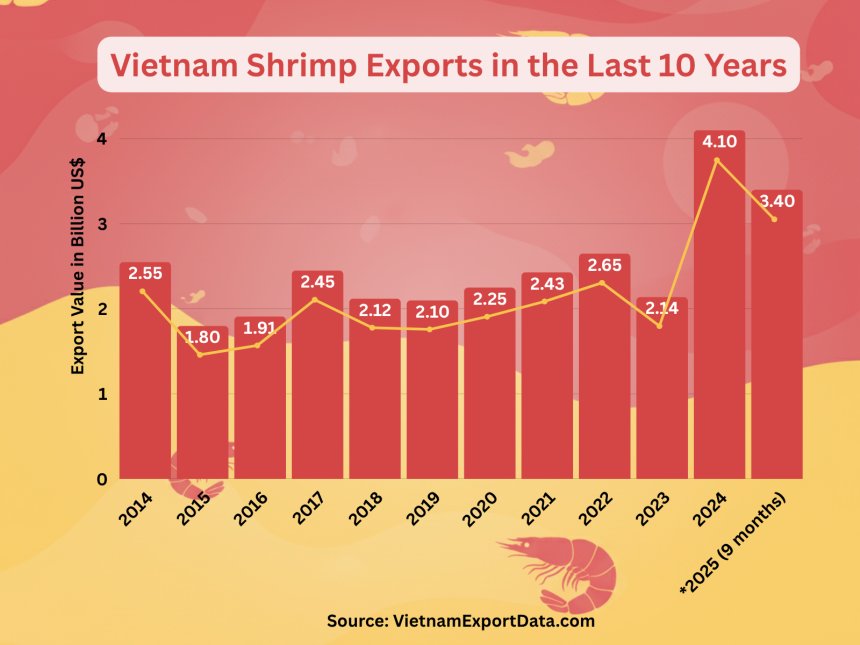
Vietnam’s shrimp industry is closing 2025 on an impressive high note. After several years of market volatility, global inflation, and fluctuating demand, the country’s shrimp exports have rebounded sharply, marking their strongest growth in three years. This surge is not only a reflection of improved global demand but also of Vietnam’s strategic investments in farming efficiency, product diversification, and international market expansion. According to the latest Vietnam export data and Vietnam customs export data of shrimp, the total value of Vietnam shrimp exports reached $4.10 billion in 2024, a 15% increase from the previous year. According to Vietnam shrimp export data, Vietnam exported shrimps worth $3.4 billion in the first 9 months of 2025.
Vietnam is the world's 2nd largest exporter of shrimp, accounting for 13-14% of global export value. Along with India and Ecuador, the nation is a major shrimp supplier, but it lags behind China in exports, according to global trade data and Vietnam customs data. This in-depth analysis dives into the data, market dynamics, policy drivers, challenges, and outlook of Vietnam’s shrimp export performance in 2025, explaining how and why the country achieved this major turnaround.
Vietnam Shrimp Export Overview in 2025
Export Value and Growth
In 2025, Vietnam’s shrimp exports are estimated to reach around 4.2 billion USD, representing a 20–22% increase compared to 2024, the fastest pace since 2021. This growth marks the industry’s strongest rebound since the COVID-era downturn and the subsequent two years of sluggish recovery.
The first nine months of 2025 alone generated approximately 3.4 billion USD in shrimp export value, up more than 22% year-on-year. In January 2025, the country already posted a 13% increase compared to the same month of the previous year, signaling the start of a bullish trend.
By the end of the first four months, total shrimp export revenue hit about 1.27 billion USD, up 30% compared to 2024’s early performance. Shrimp accounted for roughly 35% of Vietnam’s total seafood exports, making it the single largest contributor to the country’s fisheries export turnover.
Production and Volume Growth
Production data from Vietnam’s Ministry of Agriculture and Rural Development showed that shrimp output in the first half of 2025 rose steadily:
-
Whiteleg shrimp (vannamei): around 367,000 tons, up roughly 7.3% from the same period in 2024.
-
Black tiger shrimp: around 125,000 tons, up 3.5–4% year-on-year.
For comparison, the country’s shrimp output growth in 2024 had hovered around 2–3%, indicating a much stronger expansion this year. Export volumes in late 2024 already showed momentum, with a roughly 18% year-on-year rise in the third quarter, a trend that continued into 2025.
Contribution to Seafood Exports
Shrimp remains the backbone of Vietnam’s seafood export industry, typically representing 35-40% of total seafood export revenue. With the national seafood export target for 2025 projected at 11 billion USD, shrimp alone is expected to contribute 4.0–4.3 billion USD, reaffirming its central role in Vietnam’s aquaculture economy.
The Big Headline: Vietnam’s Strongest Shrimp Export Growth in Three Years
A recent report from Vietnam’s Ministry of Agriculture and Rural Development and Vietnam Association of Seafood Exporters and Producers confirms that Vietnamese shrimp exports have achieved their largest expansion in three years.
According to the Vietnam customs data, Vietnam exported 3.4 billion USD worth of shrimp in the first nine months of 2025, marking a 22% year-on-year increase, the fastest rate since 2021. The growth reflects a strong recovery in global demand, particularly from China, Japan, and the European Union, where importers increased orders amid improving consumer spending and reduced inflation.
Key Highlights
-
China & Hong Kong: Exports surged by about 65% to US$966 million, making up nearly 30% of total shrimp exports.
-
United States: Shipments increased around 4% to US$587 million, though exporters remain cautious due to potential anti-dumping tariffs.
-
European Union: Exports grew by roughly 21%, reaching US$434 million.
-
CPTPP Markets: Exports rose by about 34% to US$941 million. Japan alone accounted for US$426 million, driven by demand for convenient, high-quality, and sustainably processed seafood.
Outlook & Risks
-
Short-term slowdown possible due to inventory build-up in major destinations like China and Hong Kong, which could affect late-2025 and early-2026 performance.
-
U.S. market uncertainty persists because of trade investigations and tariff risks, but Vietnam may benefit as other suppliers like Indonesia and Ecuador face constraints.
-
Competitive edge maintained thanks to Vietnam’s strong processing capacity, sustainable farming initiatives, and favorable trade deals such as the EVFTA and CPTPP.
Why 2025 Marks the Strongest Growth in Three Years
Vietnam’s strongest shrimp export growth in the last 3 years is backed by the numbers. Between 2022 and 2024, Vietnam’s shrimp exports fluctuated due to declining global demand, oversupply from major producers like Ecuador and India, and weak consumer spending in key markets.
-
2022: Shrimp exports fell by over 10% due to post-pandemic market contractions.
-
2023: The decline slowed, but exports remained nearly flat, around 3.5 billion USD.
-
2024: Early recovery began, with modest 5–7% growth.
-
2025: A full rebound, with 20–22% growth in value and nearly 15% in export volume, the largest improvement since 2021.
This rebound is being driven by multiple interconnected factors, from improved farming conditions and government policy support to revived demand in Asia, the U.S., and Europe.
Vietnam Shrimp Exports by Country: Where Does Vietnam Export Shrimp?
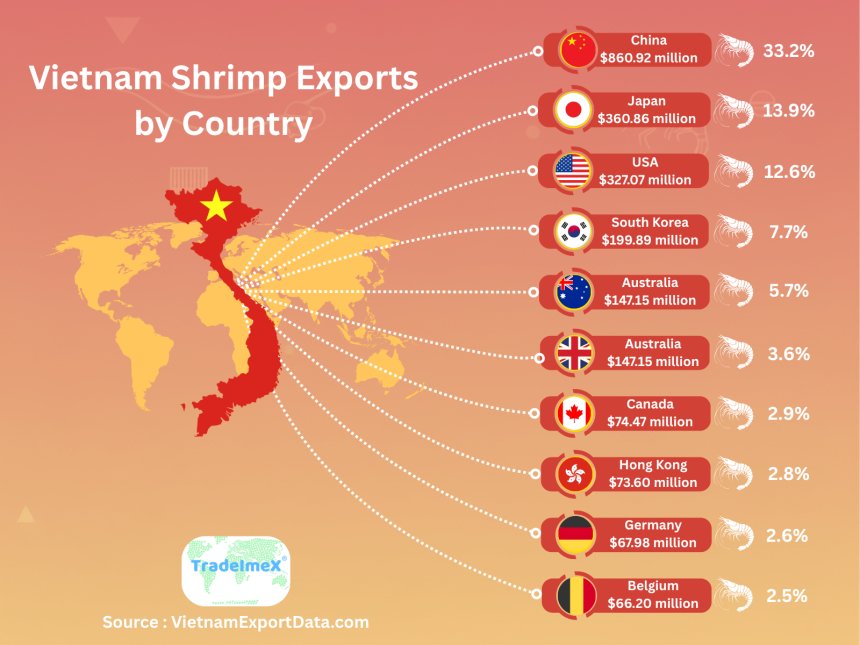
Vietnam's shrimp industry has shown remarkable growth in recent years, positioning the country as one of the top shrimp exporters globally. The major destinations for Vietnam's shrimp exports include the United States, Japan, the European Union, China, and South Korea. These countries have been key partners in importing Vietnam's high-quality shrimp products, contributing significantly to the country's economy. The top 10 export destinations for Vietnam shrimp exports by country, as per the Vietnam shipment data for 2024-25, include:
1. China: $860.92 million (33.2%)
China is the largest importer of Vietnamese shrimp, accounting for over a third of Vietnam's shrimp exports, as per the customs data on Vietnam shrimp exports to China by HS code. The demand for seafood in China has been growing rapidly in recent years, and Vietnamese shrimp has become a popular choice for Chinese consumers.
2. Japan: $360.86 million (13.9%)
Japan is another major market for Vietnamese shrimp. Japanese consumers are known for their high standards when it comes to seafood, and Vietnamese shrimp has gained a reputation for its quality and taste in the Japanese market, as per the data on Vietnam shrimp exports to Japan.
3. USA: $327.07 million (12.6%)
The United States is one of the largest importers of shrimp in the world, and Vietnam is a key supplier of shrimp to the US market. Vietnamese shrimp is popular among American consumers due to its affordability and availability.
4. South Korea: $199.89 million (7.7%)
South Korea is a relatively new market for Vietnamese shrimp, but it has quickly become one of the top importers of Vietnamese shrimp. The growing demand for seafood in South Korea has created opportunities for Vietnamese shrimp exporters.
5. Australia: $147.15 million (5.7%)
Australia is another important market for Vietnamese shrimp. Australian consumers value the quality of Vietnamese seafood, and Vietnamese shrimp is in high demand in Australia.
6. United Kingdom: $92.42 million (3.6%)
The United Kingdom is a key market for Vietnamese shrimp in Europe. Vietnamese shrimp is prized for its freshness and taste in the UK market, and it has become a popular choice among British consumers.
7. Canada: $74.47 million (2.9%)
Canada is a growing market for Vietnamese shrimp, with demand for seafood increasing among Canadian consumers. Vietnamese shrimp has gained a strong foothold in the Canadian market due to its quality and value.
8. Hong Kong: $73.60 million (2.8%)
Hong Kong is an important market for Vietnamese shrimp in Asia. Vietnamese shrimp is highly sought after in Hong Kong due to its quality and freshness, making it a popular choice among Hong Kong consumers.
9. Germany: $67.98 million (2.6%)
Germany is a key market for Vietnamese shrimp in Europe. German consumers appreciate the quality and sustainability of Vietnamese shrimp, making it a preferred choice in the German market.
10. Belgium: $66.20 million (2.5%)
Belgium is a relatively small market for Vietnamese shrimp, but it is an important one. Belgian consumers value the premium quality of Vietnamese shrimp, and it has carved out a niche for itself in the Belgian market.
Vietnam Shrimp Exports in the Last 10 Years: Historical Vietnam Shrimp Export Data
|
Year of Exports |
Vietnam Shrimp Export Value ($) |
|
2014 |
$2.55 billion |
|
2015 |
$1.80 billion |
|
2016 |
$1.91 billion |
|
2017 |
$2.45 billion |
|
2018 |
$2.12 billion |
|
2019 |
$2.10 billion |
|
2020 |
$2.25 billion |
|
2021 |
$2.43 billion |
|
2022 |
$2.65 billion |
|
2023 |
$2.14 billion |
|
2024 |
$4.10 billion |
|
2025 (first 9 months) |
$3.4 billion |
Major Growth Drivers Behind Vietnam Shrimp Exports
1. Rebound in Global Demand
2025 saw a significant rise in global shrimp consumption, led by a resurgence in Asian markets and easing inflation in developed economies.
-
China and Hong Kong have been the biggest demand engines, with imports of Vietnamese shrimp up more than 70% year-on-year in the first eight months. Economic reopening, improved trade at border crossings, and rising seafood consumption have made China the largest market for Vietnamese shrimp, accounting for nearly 30% of total export value.
-
The European Union also rebounded, posting double-digit growth as consumer confidence improved and food service sectors fully recovered post-pandemic.
-
Japan recorded around 20% growth, maintaining its position as a stable, high-value buyer.
-
The United States showed moderate but steady growth of about 10–12%, recovering from inventory backlogs and soft consumption in 2023–24.
2. Increased Production Capacity and Efficiency
Vietnamese shrimp farms have scaled up production capacity while maintaining improved efficiency. Intensive and semi-intensive farming systems, especially in the Mekong Delta provinces of Soc Trang, Ca Mau, and Bac Lieu, now dominate the landscape. These regions have invested heavily in:
-
Modern pond systems with liners and aeration.
-
Digital water-quality monitoring systems.
-
Disease control and biosecurity upgrades.
-
High-quality broodstock and improved feed efficiency.
This combination has enabled stable yields even in the face of rising input costs.
3. Product Diversification and Value-Added Exports
The industry is also shifting toward value-added shrimp products, including peeled, cooked, seasoned, and ready-to-eat shrimp. These higher-margin categories now account for over 40% of total shrimp export value, compared to around 30% in 2020.
Vietnam’s processing facilities are increasingly compliant with advanced food safety certifications (ASC, BAP, GlobalGAP, HACCP), enabling exporters to access high-end markets like the EU, Japan, and South Korea. The emphasis on processed products has not only increased profitability but also helped Vietnam stand out against low-cost suppliers like India and Ecuador.
4. Market Diversification and Trade Advantages
Vietnam’s shrimp sector benefits from an extensive network of free trade agreements (FTAs), such as:
-
The Comprehensive and Progressive Agreement for Trans-Pacific Partnership (CPTPP),
-
And the UK-Vietnam Free Trade Agreement (UKVFTA).
These trade deals have significantly lowered tariffs for Vietnamese shrimp, giving the country an advantage over competitors who face higher import duties. Exporters have also diversified toward new markets such as Australia, the Middle East, and Canada, reducing dependence on the U.S. and China.
Top 5 Shrimp Varieties Exported by Vietnam in 2024
-
Whiteleg Shrimp (Litopenaeus vannamei)
-
Export Value: 2.9 billion USD
-
Share: Around 70% of the total shrimp export value.
-
Notes: Main export type; popular for frozen and processed products to the U.S., China, Japan, and the EU.
-
Black Tiger Shrimp (Penaeus monodon)
-
Export Value: 450 million USD
-
Share: Around 12–14% of the total shrimp export value.
-
Notes: Considered a premium shrimp; exported mainly to Japan, EU, and high-end Asian markets.
-
Sea Tiger Shrimp and Native Marine Shrimp Varieties
-
Export Value: 200 million USD
-
Share: About 5% of the shrimp export value.
-
Notes: Smaller volume but higher value per kilogram, mostly sold to Japan & South Korea.
-
Processed and Value-Added Shrimp Products (mixed species)
-
Export Value: 150 million USD
-
Share: Roughly 4% of total shrimp exports.
-
Notes: Includes cooked, seasoned, and ready-to-eat shrimp; mainly for EU and U.S. retail markets.
-
Lobster and Specialty Shrimp (green and spiny varieties)
-
Export Value: 100 million USD
-
Share: Around 3% of total shrimp-related exports.
-
Notes: Primarily shipped live to China and Hong Kong; a fast-growing segment.
Summary
-
Total Shrimp Export Value (2024): 4.1 billion USD
-
The top 2 varieties (Whiteleg + Black Tiger) together make up over 80% of total export earnings.
-
The shift toward value-added and specialty products continued in 2024, setting the stage for the strong growth recorded in 2025.
Market Breakdown: Who Is Buying Vietnam’s Shrimp?
China and Hong Kong
China has overtaken the U.S. as Vietnam’s top shrimp buyer in 2025, accounting for nearly 1.2 billion USD in imports. Demand for live and frozen shrimp, particularly whiteleg shrimp and lobsters, has surged, as per the Vietnam frozen shrimp export data by HS code. Chinese consumption has shifted toward high-quality imported seafood, driven by the growth of premium dining and e-commerce seafood platforms.
United States
The U.S. remains a vital market, contributing around 750–800 million USD in shrimp imports from Vietnam this year. While growth is slower compared to China, Vietnamese shrimp has gained a reputation for consistent quality, which has helped maintain a strong market share despite fierce price competition from Ecuador.
Japan
Exports to Japan in 2025 are estimated at over 600 million USD, up around 20%. Japan’s demand leans toward cooked and peeled shrimp, where Vietnam holds a comparative advantage due to its strong processing infrastructure and quality assurance systems.
European Union
The EU has shown renewed appetite for Vietnamese shrimp, with exports likely to surpass 550 million USD, a 30–35% rise year-on-year. Markets such as the Netherlands, Germany, and Belgium have driven this recovery, especially through food service and retail chains emphasizing sustainability and traceability.
South Korea, Australia, and Emerging Markets
South Korea imported roughly 400 million USD worth of shrimp from Vietnam in 2025, while Australia and the Middle East collectively accounted for over 300 million USD. These emerging markets are increasingly important as Vietnamese exporters seek stability beyond traditional destinations.
Vietnam Shrimp Export Pricing and Profit Margins
Despite the significant growth in volume and value, export prices have seen only mild increases, averaging around 1–2% higher than in 2024. The average export price for Vietnamese shrimp in 2025 stands between 8.5–9.2 USD per kilogram, depending on size and processing level.
Profit margins remain under pressure from:
-
High feed and energy costs.
-
Price competition from Ecuador and India.
-
Expensive compliance and export costs for value-added products.
However, Vietnam’s strategic move toward processed shrimp has cushioned exporters from raw shrimp price volatility, allowing for more stable returns.
Structural and Regional Trends in Production
Regional Hubs
Vietnam’s shrimp production is concentrated in the Mekong Delta, which accounts for over 85% of national output. Key provinces include:
-
Ca Mau: The country’s shrimp capital, known for large-scale intensive farming.
-
Soc Trang: A leader in whiteleg shrimp production and processing.
-
Bac Lieu: A pioneer in eco-shrimp and sustainable aquaculture.
-
Kien Giang and Ben Tre: Emerging hubs for semi-intensive farms.
These provinces are integrating technology-driven aquaculture and expanding water treatment and disease prevention infrastructure.
Species Composition
Whiteleg shrimp dominate Vietnam’s shrimp exports, accounting for roughly 80–85% of total volume, while black tiger shrimp account for around 10–12%. Specialty species such as lobsters and native shrimp varieties contribute the rest, mainly to the Chinese and Japanese markets.
Policy Support and Government Targets
The Vietnamese government and the Vietnam Association of Seafood Exporters and Producers (VASEP) have set an ambitious goal for the shrimp industry:
-
Export revenue of 5 billion USD by 2030, with a strong focus on sustainability and digital transformation.
Policy support includes:
-
Expansion of high-tech shrimp farming zones.
-
Subsidies and low-interest loans for aquaculture infrastructure.
-
Incentives for certified farms and exporters.
-
Enhanced disease surveillance and early warning systems.
-
Trade promotion and market access programs.
The government’s strategy emphasizes moving from “quantity-driven” growth to “quality-driven and value-added” growth, ensuring the sector’s resilience against global price swings.
Key Challenges for 2025 and Beyond
Despite strong performance, several challenges loom over the industry:
1. Disease and Environmental Risks
Vietnam’s shrimp farms face continued risks from bacterial and viral diseases such as EMS (Early Mortality Syndrome). Climate change also brings higher salinity, unpredictable rainfall, and rising sea levels, all affecting pond ecosystems.
2. Rising Input Costs
Shrimp feed accounts for 50–60% of production costs, and prices have increased by roughly 10% in 2025. Electricity, fuel, and labor costs are also trending upward, cutting into farm margins despite export growth.
3. Global Competition
Ecuador remains the world’s largest shrimp exporter, benefiting from lower production costs and higher yields. India and Indonesia also pose strong competition. To stay competitive, Vietnam must rely on quality, processing, and branding rather than raw output.
4. Trade and Regulatory Barriers
Stringent food safety and sustainability regulations, especially in the EU and the US, could create compliance challenges for smaller exporters. Maintaining full traceability from farm to export is becoming a baseline expectation in global markets.
Outlook: The Road Ahead for Vietnam’s Shrimp Industry
Short-Term (2025–2026)
Vietnam’s shrimp exports are on track to surpass 4.2 billion USD by the end of 2025 and could reach 4.5 billion USD in 2026 if favorable trends continue. China will likely remain the biggest buyer, but the U.S., EU, and Japan will drive value through demand for high-end processed shrimp.
The focus will be on:
-
Boosting processing and packaging innovation.
-
Expanding sustainability certification coverage.
-
Strengthening cold-chain supply and export infrastructure.
Medium to Long-Term (2026–2030)
The sector’s long-term goal is sustainable growth with higher profit margins, rather than volume-driven expansion. Future success will depend on:
-
Greater adoption of automation and IoT in farming.
-
Improved broodstock genetics and disease resistance.
-
A stronger brand identity for Vietnamese shrimp in global markets.
-
Green aquaculture practices to meet ESG (environmental, social, and governance) standards.
If managed well, Vietnam could position itself not only as a top shrimp exporter but as a global leader in sustainable and high-quality aquaculture.
Conclusion and Final Thoughts
The year 2025 has become a defining milestone for Vietnam’s shrimp industry. After three years of uneven performance, the sector has staged a powerful comeback, expanding export value by over 20%, increasing production efficiency, and broadening its global footprint. The customs data from 2025 confirm that Vietnam’s shrimp exports have achieved their biggest growth in three years, signaling a full recovery and a promising new phase for the industry. Exports rose 22% in value, production climbed steadily, and markets in China, Japan, and the EU reignited demand for high-quality Vietnamese shrimp.
With strong momentum in China, Japan, and the EU, combined with growing demand for processed and sustainable seafood, Vietnam’s shrimp exporters are entering a new phase of competitiveness. However, sustaining this growth will require continuous investment in quality, technology, and sustainability. Disease risks, rising costs, and global competition will remain ongoing tests. Yet, the data from 2025 show that Vietnam’s shrimp industry is stronger, smarter, and more adaptive than ever, well on its way to achieving long-term global leadership.
We hope that you liked our insightful and data-driven blog report on Vietnam shrimp exports 2025. For the latest Vietnam import-export data, or to search live data on Vietnam shrimp exports by country, visit VietnamExportdata. Contact us at info@tradeimex.in for customized trade reports, market insights, and a verified database of the top shrimp exporters & suppliers in Vietnam, as per your business needs.
Share
What's Your Reaction?
 Like
0
Like
0
 Dislike
0
Dislike
0
 Love
0
Love
0
 Funny
0
Funny
0
 Angry
0
Angry
0
 Sad
0
Sad
0
 Wow
0
Wow
0