
Vietnam Banana Export Data 2025: Vietnam Targets US$1 Billion Banana Export Goal
Explore Vietnam Banana Export Data 2025, key markets, growth trends, & how Vietnam plans to achieve its ambitious US$1 billion banana export target.


Vietnam’s banana industry is undergoing a quiet but significant transformation. Once viewed as a secondary crop mainly for domestic consumption or informal cross-border trade, bananas have now become one of Vietnam’s most strategic fruit exports. With production expanding, export markets diversifying, & government support strengthening, Vietnam has set a clear and ambitious objective: to turn bananas into a US$1 billion export commodity. According to the latest Vietnam export data and Vietnam customs export data of bananas, the total value of Vietnam banana exports reached a record $369.19 million in 2024, a 19% increase from the previous year.
Vietnam is the 9th largest banana exporter in the world, as per the global trade data. As of 2025, this goal is challenging but realistic. Vietnam already ranks among the world’s leading banana exporters, and the sector is benefiting from strong global demand, regional trade advantages, and improving agricultural practices. This article provides a comprehensive, data-driven analysis of Vietnam’s banana export performance, production landscape, key markets, challenges, and the roadmap toward the billion-dollar milestone.
Overview of Vietnam’s Banana Industry in 2024–25
Vietnam is one of Southeast Asia’s major banana producers, with bananas grown across a wide range of ecological zones. From the Mekong Delta and Central Highlands to the Red River Delta, banana cultivation has spread steadily over the last decade.
Key Industry Metrics (2024–25)
-
Total banana production: Approximately 2.7–2.9 million metric tons per year
-
Cultivation area: Around 160,000–165,000 hectares
-
Export value (2024): Roughly US$370–380 million
-
Global export ranking: Among the top 10 banana-exporting countries
-
Share of global banana exports: About 2.5 percent
Bananas are currently Vietnam’s fourth-largest fruit export, following durian, dragon fruit, and coconut. While durian has captured most headlines due to explosive growth in China, bananas offer something different: scale, consistency, and long-term stability.
Unlike seasonal fruits, bananas can be harvested year-round, making them ideal for sustained export programs and long-term contracts with overseas buyers.
Vietnam Banana Exports by Country: Where Does Vietnam Export Bananas?
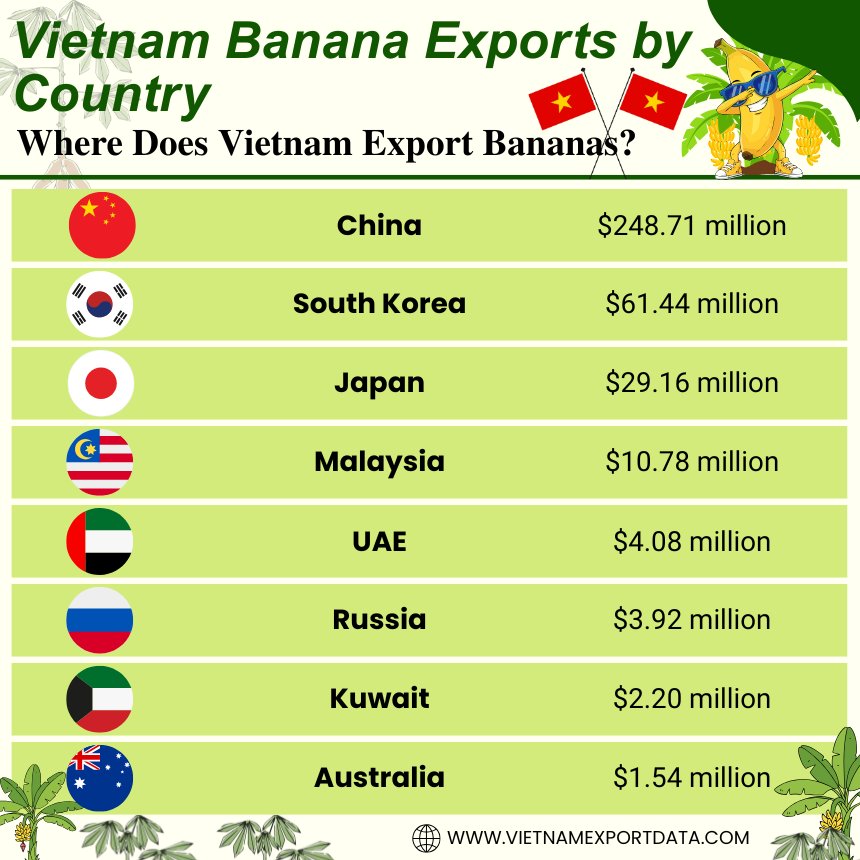
Vietnam is a key player in the global banana export market, with its bananas being shipped to various countries worldwide. Some significant destinations for Vietnam's banana exports include China, Japan, South Korea, Russia, & the United Arab Emirates. These countries have established trade relationships with Vietnam, making it a prominent supplier of high-quality bananas in the international market. The top 10 export destinations for Vietnam's banana exports, as per the data on Vietnam banana exports by country and Vietnam shipment data for 2024-25, include:
1. China: $248.71 million (67.4%)
China is the largest importer of Vietnamese bananas, accounting for a significant portion of Vietnam's total banana exports. The demand for Vietnamese bananas in China has been steadily increasing due to their superior quality and competitive pricing. Vietnamese banana farmers have been able to take advantage of this growing demand to expand their operations and increase production to meet the needs of the Chinese market.
2. South Korea: $61.44 million (16.6%)
South Korea is another key market for Vietnamese banana exports. The South Korean consumer base values the high quality and freshness of Vietnamese bananas, making them a popular choice in the country. Vietnamese banana exporters have established strong relationships with South Korean buyers, allowing them to maintain a steady flow of banana exports to this market.
3. Japan: $29.16 million (7.9%)
Japan is known for its strict quality standards when it comes to agricultural products, and Vietnamese bananas have been able to meet these standards consistently. The Japanese market appreciates the taste and texture of Vietnamese bananas, leading to a steady demand for these fruits. Vietnam has been able to carve out a niche for itself in the Japanese market, despite facing competition from other banana-producing countries.
4. Malaysia: $10.78 million (2.9%)
Malaysia is a relatively small but important market for Vietnamese banana exports. The proximity of Malaysia to Vietnam makes it an attractive destination for banana shipments, as it allows for quick and cost-effective transportation. Vietnamese exporters have been able to capitalize on this geographical advantage to establish a strong presence in the Malaysian market.
5. United Arab Emirates: $4.08 million (1.1%)
The United Arab Emirates (UAE) is a growing market for Vietnamese bananas, with increasing demand from consumers in the region. The UAE's affluent population values premium quality produce, making Vietnamese bananas a popular choice. Vietnamese exporters have been able to tap into this demand by supplying fresh and high-quality bananas to the UAE market.
6. Russia: $3.92 million (1.1%)
Russia is another emerging market for Vietnamese banana exports, with a growing demand for tropical fruits in the country, as per the customs data on Vietnam banana exports to Russia by HS code. Vietnamese bananas have gained popularity in Russia due to their unique flavor and nutritional benefits. Vietnamese exporters have been working to expand their presence in the Russian market and establish long-term partnerships with key buyers.
7. Kuwait: $2.20 million (0.6%)
Kuwait is a small but lucrative market for Vietnamese banana exports, with a niche consumer base that values premium quality produce, as per the data on Vietnam banana exports to Kuwait. Vietnamese bananas have gained traction in Kuwait due to their superior taste and freshness. Vietnamese exporters have been able to leverage this demand to increase their shipments to Kuwait and establish a foothold in the market.
8. Australia: $1.54 million (0.4%)
Australia is a relatively small market for Vietnamese banana exports, but it plays an important role in diversifying Vietnam's export destinations. Australian consumers appreciate the quality and taste of Vietnamese bananas, making them a sought-after product in the country. Vietnamese exporters have been working to expand their presence in the Australian market and explore new growth opportunities.
9. Cambodia: $1.43 million (0.4%)
Cambodia is a neighboring country to Vietnam and serves as a key market for Vietnamese banana exports. The proximity between the two countries allows for easy transportation of bananas, making Cambodia an attractive destination for Vietnamese exporters. Cambodian consumers have shown a preference for Vietnamese bananas, creating a steady demand for these fruits in the market.
10. Singapore: $1.13 million (0.3%)
Singapore is a strategic market for Vietnamese banana exports, with a well-developed infrastructure for importing fresh produce. Vietnamese bananas are prized in Singapore for their quality and taste, making them a popular choice among consumers. Vietnamese exporters have been able to capitalize on this demand by establishing strong distribution channels and partnerships in the Singaporean market.
Vietnam Banana Exports in the Last 10 Years: Historical Vietnam Banana Export Data
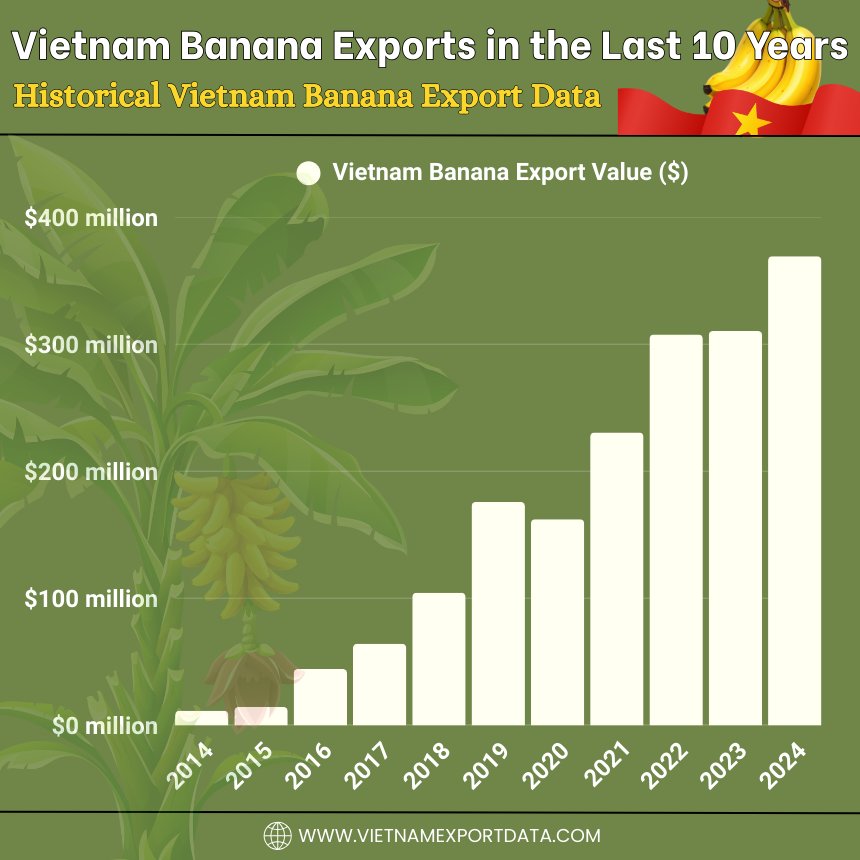
|
Year of Exports |
Vietnam Banana Export Value ($) |
|
2014 |
$11.31 million |
|
2015 |
$14.42 million |
|
2016 |
$44.31 million |
|
2017 |
$64.15 million |
|
2018 |
$104.33 million |
|
2019 |
$175.85 million |
|
2020 |
$162.18 million |
|
2021 |
$230.57 million |
|
2022 |
$307.64 million |
|
2023 |
$310.36 million |
|
2024 |
$369.19 million |
Vietnam Banana Export Performance: Trends and Growth
Export Value Growth
Vietnam’s banana exports have grown steadily over the past five years. While exact figures vary slightly by source, the trend is clear:
-
2019–2020: Banana export value below US$300 million
-
2021–2022: Recovery and stabilization after pandemic disruptions
-
2023: Export value crossed US$350 million
-
2024: Export earnings reached approximately US$372–378 million
This growth has been driven not by price inflation alone, but by higher export volumes, better quality control, and expanding market access.
Export Volume vs Value
Vietnam’s banana export model is still volume-driven, especially in nearby Asian markets. Average export prices remain lower than those of premium suppliers such as Ecuador or Costa Rica, but Vietnam compensates with:
-
Lower export costs to Asia
-
Faster delivery times
-
Competitive pricing
-
Increasing quality consistency
To reach the US$1 billion target, Vietnam must move beyond volume growth and focus more heavily on value per ton, branding, and premium market segments.
Major Export Markets for Vietnamese Bananas
China: The Cornerstone Market
China is by far Vietnam’s largest banana export destination and remains the backbone of the industry.
Key points:
-
Vietnam has become China’s leading banana supplier, surpassing traditional exporters.
-
Short transport distance allows for fresher fruit and lower costs.
-
Official export protocols have reduced reliance on informal border trade.
-
Demand remains strong due to China’s large population and limited domestic banana production in colder regions.
However, heavy dependence on China also creates concentration risk. Price fluctuations, policy changes, or border disruptions can significantly impact Vietnamese exporters.
Japan: A High-Value Growth Market
Japan represents one of the most promising premium markets for Vietnamese bananas.
Characteristics of the Japanese market:
-
Extremely strict quality, safety, and traceability standards
-
Preference for consistent size, appearance, and taste
-
Higher average prices compared to regional markets
Vietnamese banana exports to Japan have increased rapidly due to:
-
Improved compliance with Japanese food safety requirements
-
Gradual tariff reductions under trade agreements
-
Investments in clean cultivation and post-harvest handling
Although volumes are smaller than in China, export value per ton is significantly higher, making Japan critical for future revenue growth.
South Korea and East Asia
South Korea has emerged as another stable and growing market. Consumers value bananas as an everyday fruit, and Vietnamese suppliers benefit from:
-
Geographic proximity
-
Trade agreements
-
Competitive pricing
Other East Asian markets such as Taiwan and Hong Kong also import Vietnamese bananas, often as part of diversified sourcing strategies.
Emerging Markets: Middle East, EU, and the US
Vietnam is gradually expanding banana exports beyond Asia:
-
Middle East: Growing demand for affordable fresh fruit and year-round supply
-
European Union: Opportunities exist, but competition is intense, and compliance costs are high
-
United States: Still a small market for Vietnamese bananas, but long-term potential exists if branding and trade improve
Penetration into these markets is essential if Vietnam is to reach the US$1 billion target, as Asian markets alone may not be sufficient.
Production Landscape and Farming Structure
Geographic Distribution
Banana production is spread across multiple regions:
-
Mekong Delta: Large plantations, favorable climate, high productivity
-
Central Highlands: Expanding commercial farms, suitable for export-grade bananas
-
Northern provinces: Smaller farms, often focused on domestic and regional trade
This geographic diversity allows Vietnam to:
-
Reduce weather-related risks
-
Supply bananas year-round
-
Stagger harvest cycles
Farming Models
Vietnam’s banana sector includes:
-
Large agribusiness plantations with export contracts
-
Medium-scale commercial farms
-
Smallholder farmers supplying local traders
While large farms dominate exports to Japan and premium markets, smallholders still account for a significant share of total production. This creates challenges in quality control and traceability.
Government Strategy: The US$1 Billion Vision
Vietnam’s government has officially identified bananas as a strategic fruit crop under national agricultural development plans.
Production Targets
By 2030:
-
Banana cultivation area is expected to reach 165,000–175,000 hectares
-
Annual output could exceed 3 million metric tons
-
Export-oriented production zones will be expanded
Key Policy Objectives
To reach the Vietnam banana export US$1 billion goal, policy priorities include:
-
Developing standardized growing regions linked to exporters
-
Promoting certified production and traceability systems
-
Encouraging private investment in large-scale banana farming
-
Supporting research into disease-resistant varieties
Government support is not only financial but also institutional, particularly in negotiating market access and export protocols.
Disease Risk and Production Challenges
Panama Disease (Fusarium Wilt)
One of the biggest threats to Vietnam’s banana industry is Panama disease, a soil-borne fungal infection that has devastated banana plantations worldwide.
Impact in Vietnam:
-
Significant losses in previous years, especially in Cavendish varieties
-
Long-term soil contamination makes the affected land unusable for bananas
-
Increased production costs for disease management
Addressing this risk is essential for long-term export growth. Research into resistant varieties and improved farm management practices is ongoing.
Fragmented Supply Chains
Many banana farms operate independently, leading to:
-
Inconsistent quality
-
Limited bargaining power
-
Difficulty meeting strict export standards
Without stronger linkages between farmers, exporters, and processors, Vietnam risks losing competitiveness in high-value markets.
Post-Harvest Losses
Post-harvest handling remains a weak point:
-
Inadequate cold storage
-
Limited ripening facilities
-
Quality degradation during transport
Losses reduce exportable volumes and increase costs, particularly for long-distance shipments.
Global Banana Market Context
Global Demand Trends
Bananas are among the most consumed fruits worldwide due to:
-
Affordability
-
Nutritional value
-
Year-round availability
Global banana exports are valued at over US$15 billion annually, with steady growth expected over the next decade.
Vietnam’s Competitive Advantages
Vietnam’s strengths include:
-
Proximity to fast-growing Asian markets
-
Lower production and labor costs
-
Expanding cultivated area
-
Government support for export agriculture
However, Vietnam faces strong competition from:
-
Ecuador (global export leader)
-
Philippines (as per the Philippines banana export statistics)
-
Costa Rica
-
Guatemala
These countries often benefit from stronger branding and established trade networks.
Value Addition: The Missing Link
To reach US$1 billion, Vietnam must focus on value addition, not just fresh banana exports.
Processed Banana Products
Opportunities include:
-
Dried banana chips
-
Banana puree and paste
-
Banana flour for food processing
-
Baby food and health products
Processed products offer:
-
Higher margins
-
Longer shelf life
-
Reduced dependence on the fresh fruit trade
Branding and Marketing
Currently, most Vietnamese bananas are sold as generic products. Developing a recognizable national or regional brand could significantly increase export value, especially in premium markets.
What It Will Take for Vietnam to Reach US$1 Billion in Banana Exports
Reaching US$1 billion in banana exports will require:
-
Export value growth of nearly three times the current levels
-
Expansion into high-value markets
-
Higher average export prices
-
Stronger disease management
-
Integrated supply chains
-
Development of processed banana exports
This is not achievable through production expansion alone. Efficiency, quality, and value creation must lead the next growth phase.
Outlook for 2025 and Beyond
In the short term, Vietnam’s banana exports are expected to:
-
Continue steady growth
-
Remain heavily Asia-focused
-
Gradually increase shipments to premium markets
In the medium term (2026–2030), success will depend on:
-
How well Vietnam manages disease risks
-
Whether exporters can build strong brands
-
The pace of infrastructure upgrades
Conclusion: A Realistic but Demanding Goal
In conclusion, Vietnam’s ambition to achieve US$1 billion in banana exports reflects both confidence and necessity. Bananas offer a rare combination of scale, stability, and global demand that few agricultural products can match. Vietnam has already built a strong foundation through rising production, growing export volumes, and strategic market positioning. However, moving from hundreds of millions to one billion dollars will require structural changes, not just incremental growth.
If Vietnam succeeds in upgrading quality, diversifying markets, and capturing more value per ton, bananas could become one of the country’s most reliable and profitable agricultural exports in the decade ahead.
We hope that you liked our data-driven & insightful blog report on Vietnam banana export data. For the latest Vietnam import-export data, or to search live data on Vietnam banana exports by country, visit VietnamExportdata. Contact us at info@tradeimex.in for customized trade reports, market insights, and a verified database of the top banana exporters & suppliers in Vietnam, as per your requirement.
Share
What's Your Reaction?
 Like
0
Like
0
 Dislike
0
Dislike
0
 Love
0
Love
0
 Funny
0
Funny
0
 Angry
0
Angry
0
 Sad
0
Sad
0
 Wow
0
Wow
0