Vietnam Semiconductor Industry Boom: Vietnam Semiconductor Manufacturing & Export Data Insights 2025
Explore Vietnam's semiconductor industry growth with manufacturing trends, export data insights, key markets, and supply chain developments in 2025.


Vietnam’s rise in the global semiconductor ecosystem is no longer a side story. By 2025, it will have become one of the most closely watched manufacturing destinations in Asia, driven by export growth, geopolitical shifts, and aggressive foreign investment. According to the latest Vietnam export data and Vietnam customs export data of semiconductors, the total value of Vietnam semiconductor exports reached $6.37 billion in 2024-25, a 26% decline from the previous year.
Vietnam is the 8th largest semiconductor exporter worldwide, according to global trade data and Vietnam customs data. While countries like Taiwan and South Korea dominate chip fabrication, Vietnam is carving out a different but strategically important role. It is becoming a hub for assembly, testing, electronics manufacturing, & increasingly, design and R&D. This article breaks down the data behind Vietnam’s semiconductor boom, focusing on manufacturing trends, export performance, supply chain dynamics, and future outlook.
Market Overview: A Fast-Growing Semiconductor Ecosystem
Vietnam’s semiconductor industry is still in a developing stage, but its growth rate is among the fastest in Southeast Asia.
-
Estimated market size (2025): $7.5–$8 billion
-
Projected market size (2030): $15–$18 billion
-
CAGR: 9%–11%
Broader estimates that include the electronics ecosystem push the opportunity size above $30 billion by 2027. This growth is tied closely to Vietnam’s electronics manufacturing boom. The country is not yet a leader in wafer fabrication, but it is rapidly strengthening its position in:
-
Chip packaging and testing
-
Electronics assembly
-
Component manufacturing
-
Embedded chip usage in exports
In short, Vietnam is growing as a downstream semiconductor powerhouse, which is where much of the volume and employment lies.
Manufacturing Landscape: Where Vietnam Actually Competes
Vietnam’s semiconductor strength lies in the OSAT segment (Outsourced Semiconductor Assembly and Testing).
Why OSAT Matters
OSAT is the stage where:
-
Chips are packaged
-
Tested for defects
-
Prepared for integration into devices
This segment is less capital-intensive than fabrication but still critical to the global supply chain.
Key Manufacturing Investments
Major global players have already built large-scale facilities:
-
Intel operates one of its largest assembly and test plants in Vietnam.
-
Amkor Technology invested billions into advanced packaging facilities.
-
Hana Micron and other Korean firms are expanding aggressively.
These facilities are concentrated in industrial hubs like:
-
Ho Chi Minh City
-
Bac Ninh
-
Thai Nguyen
Manufacturing Growth Data
-
Electronics and semiconductor manufacturing growth: 9–10% annually.
-
High-tech manufacturing accounts for a rising share of industrial output.
-
Vietnam’s manufacturing PMI has remained expansionary in most quarters post-2023.
Vietnam’s advantage is clear:
-
Labor costs are 30–50% lower than in China in many cases.
-
Strong trade access to global shipping routes.
-
Established electronics ecosystem led by multinational firms.
Vietnam Semiconductor Exports by Country: Where Does Vietnam Export Semiconductors?
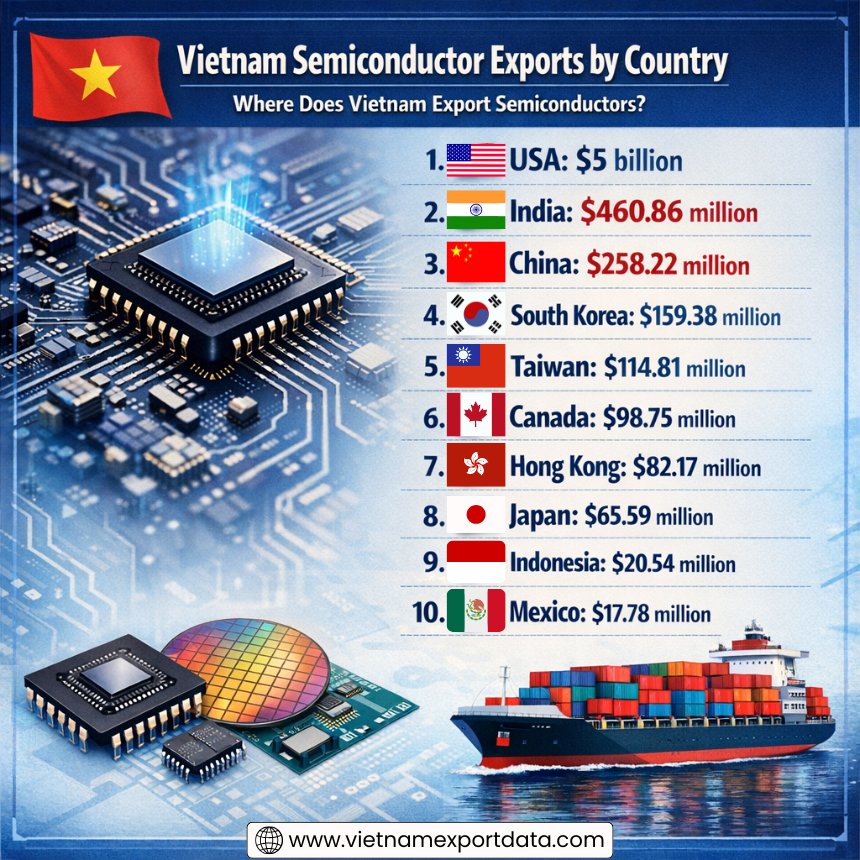
Vietnam has steadily increased its semiconductor exports to various countries over recent years. The top destinations for Vietnam's semiconductor exports include the United States, India, China, and South Korea. These countries have been key partners for Vietnam in the semiconductor industry, with the United States being the largest importer of Vietnamese semiconductors. The top 10 export destinations for Vietnam's semiconductor exports by country, as per the Vietnam shipment data by HS code 8541 for 2025, include:
1. USA: $5 billion (78.6%)
The United States is the largest market for Vietnam's semiconductor exports, accounting for a whopping 78.6% of total exports, as per the data on Vietnam semiconductor exports to the USA. The strong demand for advanced electronic products in the US has created vast opportunities for Vietnamese semiconductor manufacturers to supply a wide range of semiconductor components.
2. India: $460.86 million (7.2%)
India is another significant market for Vietnam's semiconductor exports, accounting for 7.2% of total exports. The rapid growth of the electronics industry in India has fueled the demand for semiconductors, & Vietnamese manufacturers have been quick to capitalize on this opportunity.
3. China: $258.22 million (4.1%)
China is a key player in the global semiconductor market, and Vietnam has been able to leverage its proximity to China to export $258.22 million worth of semiconductors to the country. The strong demand for electronic products in China has created a lucrative market for Vietnamese semiconductor manufacturers.
4. South Korea: $159.38 million (2.5%)
South Korea is renowned for its advanced technology & high-quality electronic products, making it an attractive market for Vietnam's semiconductor exports, as per the data on Vietnam semiconductor exports to South Korea by HS code. Vietnamese manufacturers have been able to establish strong partnerships with South Korean companies, allowing them to tap into this lucrative market.
5. Taiwan: $114.81 million (1.8%)
Taiwan is a major player in the global semiconductor industry, and Vietnam has been able to export $114.81 million worth of semiconductors to the country. The strong trade ties between Vietnam and Taiwan have paved the way for increased cooperation in the semiconductor sector.
6. Canada: $98.75 million (1.5%)
Canada may not be as prominent as some of the other markets on this list, but it still represents an important destination for Vietnam's semiconductor exports. With a growing demand for electronic products in Canada, Vietnamese manufacturers have been able to establish a foothold in this market.
7. Hong Kong: $82.17 million (1.3%)
Hong Kong serves as a key trading hub in Southeast Asia, making it an important market for Vietnam's semiconductor exports. The strategic location of Hong Kong has enabled Vietnamese manufacturers to reach a wider audience and expand their presence in the global semiconductor market.
8. Japan: $65.59 million (1%)
Japan is known for its high-tech electronics industry, and Vietnam has been able to export $65.59 million worth of semiconductors to the country. The strong demand for cutting-edge semiconductor products in Japan has created opportunities for Vietnamese manufacturers to tap into this lucrative market.
9. Indonesia: $20.54 million (0.3%)
Indonesia may not be a major market for Vietnam's semiconductor exports, but it still represents a growing opportunity for Vietnamese manufacturers. With the growing demand for electronic products in Indonesia, Vietnam has strong potential to expand its presence in this market further.
10. Mexico: $17.78 million (0.3%)
Rounding out the list is Mexico, which represents a smaller but still significant market for Vietnam's semiconductor exports. The proximity of Mexico to the US market has created opportunities for Vietnamese manufacturers to supply semiconductor components to Mexican companies.
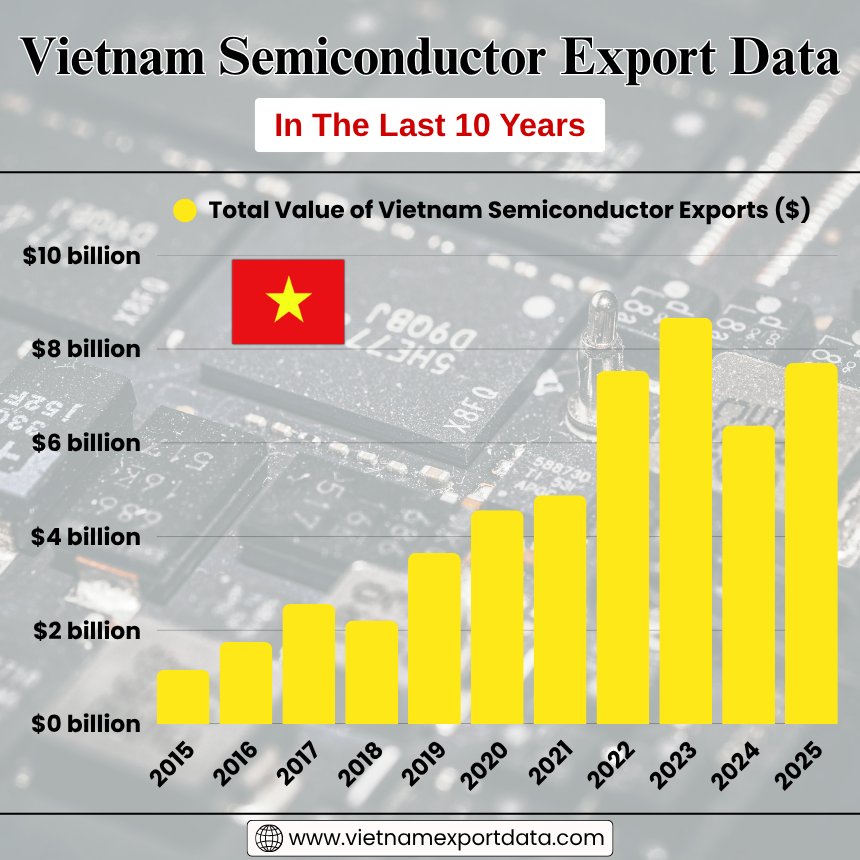
Vietnam Semiconductor Export Data in The Last 10 Years
|
Year of Exports |
Total Value of Vietnam Semiconductor Exports ($) |
|
2015 |
$1.16 billion |
|
2016 |
$1.75 billion |
|
2017 |
$2.56 billion |
|
2018 |
$2.21 billion |
|
2019 |
$3.65 billion |
|
2020 |
$4.56 billion |
|
2021 |
$4.88 billion |
|
2022 |
$7.53 billion |
|
2023 |
$8.67 billion |
|
2024 |
$6.37 billion |
|
2025 |
$7.70 billion |

Export Engine: The Real Driver of Semiconductor Demand
Vietnam’s semiconductor boom cannot be understood without looking at exports.
Electronics Export Performance
-
2024 electronics exports: $126 billion
-
2025 projection: $140–150 billion
-
Growth rate: 10–15% YoY
Electronics account for over one-third of Vietnam’s total exports, making it the country’s most important sector.
Key Export Categories
-
Smartphones and mobile devices
-
Computers and laptops
-
Electronic components
-
Telecom equipment
Component-Level Data
-
Electronic components exports: $70+ billion
-
Growth: 25–27% YoY
This is where semiconductors play a central role.
Every exported device contains:
-
Microprocessors
-
Memory chips
-
Sensors
-
Power management ICs
So as exports grow, semiconductor demand rises proportionally.
Trade Structure: A Hyper-Connected Economy
Vietnam’s trade model is one of the most open in the world.
2025 Trade Snapshot
-
Total trade: $900–930 billion
-
Exports: $470–480 billion
-
Imports: $450 billion
-
Trade surplus: $20–25 billion
Trade-to-GDP ratio exceeds 170%, indicating deep global integration.
Major Export Markets
-
United States (largest market)
-
European Union
-
China
-
South Korea
-
Japan
The United States alone accounts for over $150 billion in imports from Vietnam, a large share of which is electronics.
China+1 Strategy: Vietnam’s Biggest Tailwind
One of the most important structural drivers of Vietnam’s rise is the China+1 strategy.
What It Means
Global companies are diversifying manufacturing away from China due to:
-
Rising labor costs
-
Trade tensions
-
Supply chain disruptions
-
Regulatory uncertainty
Vietnam has emerged as a top alternative.
Evidence in Investment Trends
-
Manufacturing FDI consistently accounts for 60%–70% of total inflows
-
Annual FDI inflows exceed $25 billion
-
A large share goes into electronics and semiconductor-related industries
Real-World Impact
Companies like Samsung, Foxconn, and Intel have shifted large portions of their production to Vietnam. This is not a temporary shift. It is a structural rebalancing of global supply chains.
Role of Multinational Corporations
Vietnam’s semiconductor ecosystem is heavily driven by foreign players.
Key Contributors
-
Samsung: Dominates Vietnam smartphone exports
-
Intel: Major semiconductor assembly operations
-
Foxconn: Expanding electronics production
-
LG, Panasonic: Supporting component ecosystems
Economic Impact
-
Millions of jobs created directly and indirectly
-
Technology transfer into the local workforce
-
Integration into global value chains
However, this also creates a challenge:
Vietnam captures volume but not always high-value innovation.
Government Strategy: Building a Long-Term Semiconductor Hub
Vietnam’s government has made semiconductors a strategic priority.
Policy Goals
-
Develop a full semiconductor ecosystem by 2030
-
Move into chip design and R&D
-
Strengthen workforce capabilities
Key Initiatives
-
Tax incentives for high-tech investment
-
Industrial parks focused on electronics
-
Partnerships with global tech firms
-
Semiconductor education programs
Vietnam is also strengthening ties with major economies like the United States to support semiconductor development.
Talent Gap: The Biggest Constraint
Despite strong momentum, Vietnam faces a major bottleneck: skilled labor.
Current Situation
-
Demand for semiconductor engineers is rising rapidly
-
The supply of highly trained professionals is limited
-
Most expertise still resides within foreign firms
Estimated Needs
-
Tens of thousands of engineers are required by 2030
-
Expansion needed in:
-
Chip design
-
Materials science
-
Process engineering
Response
-
Universities expanding engineering programs
-
Industry partnerships for training
-
Overseas collaboration
If Vietnam solves this, it can move up the value chain. If not, growth may stall at assembly-level operations.
Structural Challenges
Vietnam’s growth story is strong, but not without risks.
1. Limited Domestic Ecosystem
-
Weak local supplier base
-
Heavy reliance on imported inputs
2. Low Value Capture
-
Most high-value design work happens abroad
-
Vietnam focuses on assembly and testing
3. External Demand Dependence
-
Electronics demand is cyclical
-
Global slowdowns directly impact exports
4. Trade Risks
-
Heavy reliance on the US market
-
Exposure to tariffs and policy shifts
5. Infrastructure Pressure
-
Rapid industrialization is straining trade and energy systems
High-Growth Opportunity Areas
Despite challenges, several segments offer strong upside.
Advanced Packaging
-
Increasing complexity of chips
-
Higher demand for advanced packaging solutions
-
Vietnam already has a strong base here
AI and Edge Devices
-
Growth in AI-powered electronics
-
Demand for specialized chips
Automotive Electronics
-
EV growth is driving semiconductor demand
-
Opportunity in sensors and power chips
Chip Design
-
Early-stage but high potential
-
Requires talent and ecosystem development
Outlook to 2030: What Comes Next
Based on current data and trends, Vietnam’s semiconductor sector is expected to:
-
Maintain 10% annual growth
-
Expand its role in global supply chains
-
Increase participation in higher-value activities
Likely Scenario
By 2030, Vietnam will:
-
Be a leading global OSAT hub
-
Expand into chip design services
-
Attract more advanced semiconductor investments
However, it is unlikely to compete directly with Taiwan or South Korea in fabrication within this timeframe.
A Crucial Year for Vietnam’s Semiconductor Industry
With years of groundwork already laid, 2026 marks a decisive turning point for Vietnam’s semiconductor industry as it transitions from policy planning to real execution. The country has moved beyond strategic discussions and is now actively building the legal, institutional, and industrial foundations required to become a key player in the global chip ecosystem.
A major driver of this shift is the introduction of new regulatory frameworks, particularly the Law on Digital Technology Industry, which came into effect in early 2026. This landmark legislation, considered one of the first of its kind globally, prioritizes semiconductors alongside emerging technologies like artificial intelligence and digital assets, creating a clear legal pathway for industry expansion.
Traditionally focused on assembly, packaging, and testing, the country is now pushing toward higher-value segments such as chip design & fabrication. This shift is supported by rising foreign investment, national development strategies, and the entry of domestic players into more advanced stages of production. Ambitious national targets further reinforce the momentum. Vietnam aims to generate over $25 billion in semiconductor revenue by 2030 while increasing domestic value addition, signaling its intent to move beyond a low-cost manufacturing hub to a technology-driven economy. However, this pivotal phase is not without challenges.
The industry still faces constraints, including shortages of skilled talent, limited R&D capacity, and infrastructure gaps. Overall, 2026 represents a transformative year, one where Vietnam’s semiconductor ambitions are no longer theoretical but are being actively realized through policy implementation, investment inflows, and deeper integration into global supply chains.
Final Take: A Strategic, Not Speculative Boom
Vietnam’s semiconductor growth is not hype. It is backed by:
-
Strong export data
-
Consistent FDI inflows
-
Global supply chain shifts
-
Government support
The key question is not whether Vietnam will grow. The real question is: Can Vietnam move from manufacturing to innovation? If it succeeds, it could become one of the most important semiconductor hubs in Asia. If it does not, it will remain a high-volume but low-value player.
Conclusion and Final Thoughts
In conclusion, Vietnam’s semiconductor industry in 2025 sits at a turning point. With the electronics exports crossing $140 billion, the total trade nearing $1 trillion, & strong manufacturing growth, the country has firmly established itself in the global tech supply chain.
What comes next depends on execution:
-
Building talent
-
Expanding local capabilities
-
Moving into higher-value segments
For businesses, investors, and policymakers, one thing is clear: Vietnam is no longer emerging. It has arrived as a leading semiconductor supplier.
Note For Our Readers
We hope you found this blog on Vietnam Semiconductor Industry Boom: Manufacturing & Export Data Insights 2025 useful and informative. If you’re looking to explore deeper insights, access detailed semiconductor trade flows, or analyze Vietnam’s electronics and chip-related import-export trends at a granular level, feel free to connect with us. We provide comprehensive and up-to-date Vietnam import-export trade databases, including shipment-level records, buyer-supplier data, & Vietnam semiconductor export data by country, to help you make well-informed business decisions.
Whether you are tracking semiconductor supply chains, identifying sourcing opportunities, or studying market entry strategies, our data solutions are designed to support you. For exclusive access, customized reports, or a tailored Vietnam semiconductor exporters database, reach out to us at info@tradeimex.in today.
Also Read:
Share
What's Your Reaction?
 Like
0
Like
0
 Dislike
0
Dislike
0
 Love
0
Love
0
 Funny
0
Funny
0
 Angry
0
Angry
0
 Sad
0
Sad
0
 Wow
0
Wow
0