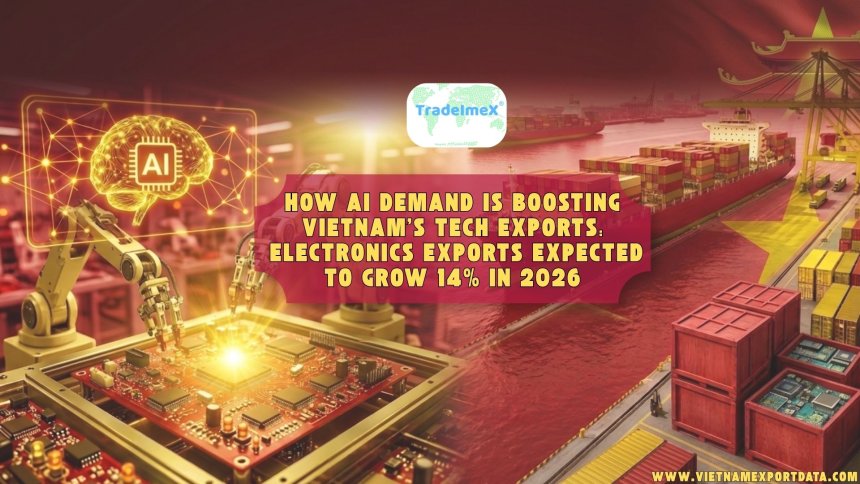
How AI Demand is Boosting Vietnam’s Tech Exports: Electronics Exports Expected to Grow 14% in 2026
Explore Vietnam tech exports with Vietnam electronics export data 2026. Discover key trends driving AI demand, shaping the country’s booming electronics industry.

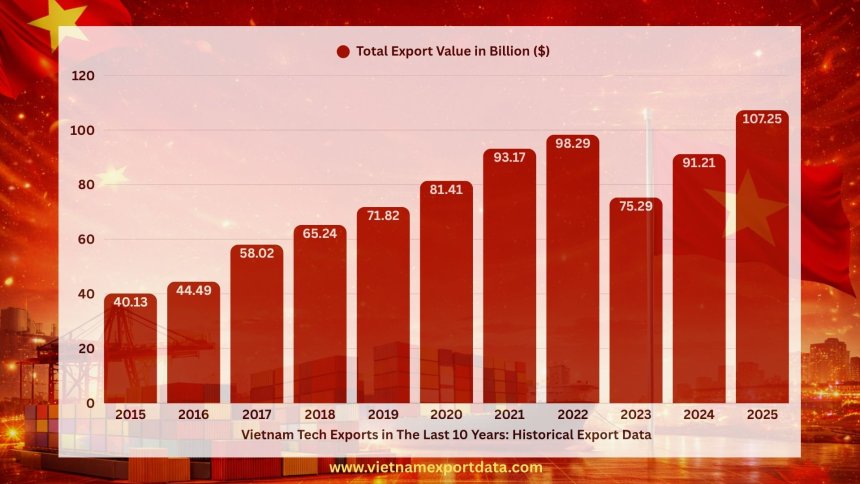
Vietnam is no longer just a low-cost manufacturing base. It is rapidly becoming one of Asia’s most important technology exporters. At the center of this transformation is a powerful global force: artificial intelligence (AI). As demand for AI systems accelerates worldwide, it is reshaping supply chains, driving semiconductor demand, and increasing the need for advanced electronics. Vietnam's tech exports increased dramatically in 2025, with computers, electronics, and parts totaling more than US$107 billion, or over 23% of all exports, according to the Vietnam export data. Vietnam, positioned at the intersection of global trade shifts and digital transformation, is benefiting directly from this surge.
Driven by the production of semiconductors and smartphones, high-tech products now account for more than 36% of total trade value, solidifying Vietnam's position as a major worldwide hub for technology and a crucial choice for supply chain diversification. Vietnam's tech sector is being significantly boosted by the growing demand for artificial intelligence (AI) and the global digital shift. Following a robust 2025, exports of electronics, computers, and components are predicted to continue growing at a high rate in 2026.
A major component of Vietnam's objective to raise overall export revenues by 8% to USD 513 billion in 2026 is electronics exports, which are fueled by investments in semiconductors and AI server infrastructure, according to Vietnam customs export data of electronics. By the end of 2026, Vietnam’s electronics exports are expected to grow strongly, with estimates suggesting double-digit expansion, around 14% in some projections, fuelled by AI-driven demand, supply chain diversification, and domestic technological advancement. This article breaks down the data, trends, and structural shifts behind Vietnam’s rising tech export story.
Vietnam’s Export Engine: A Strong Baseline
To understand the scale of the AI and tech opportunity, it helps to start with where Vietnam stands today. Vietnam recorded $475 billion in exports in 2025, marking a robust 17% year-on-year growth. Electronics led this expansion, contributing around $165 billion, making it the largest export category by far. Within this, computers, components, and consumer electronics accounted for a significant share. In fact:
-
Electronics made up roughly one-third of Vietnam’s exports.
-
Computer and component exports alone contributed over $100 billion.
-
The tech sector continues to grow faster than traditional industries such as textiles and agriculture.
Looking ahead, Vietnam aims to reach around $513 billion in exports by 2026, with continued reliance on high-tech sectors. The key shift is not just scale, but composition. Vietnam is moving from labor-intensive exports to technology-intensive, higher-value products. Vietnam is the 8th largest tech exporter in the world, according to global trade data & Vietnam customs data.
AI as a Global Demand Shock
The surge in AI adoption globally is not just a software story. It has deep hardware implications for High-technology exports from Vietnam.
AI systems require:
-
Advanced semiconductors
-
High-performance computing hardware
-
Data center infrastructure
-
Networking equipment
-
Smart devices and sensors
This has triggered a global demand wave across the electronics ecosystem. According to industry projections:
-
Global IT spending is expected to grow nearly 10% in 2026, with AI as a primary driver.
-
Demand for AI chips has intensified due to geopolitical competition, especially between the U.S. & China.
This demand is cascading across supply chains, and Vietnam is strategically positioned within them.
Vietnam's Export Growth Is Driven by AI Demand
-
AI Infrastructure Boom: According to early 2026 data, electronics exports increased by more than 40% in Q1 2026 due to demand for AI servers, cutting-edge devices, and semiconductor components.
-
Transition to High-Value Tech: With a spike in computer and electronic component exports to the United States in late 2025, Vietnam is transitioning from low-end assembly to higher-value tech products.
-
Important Investor Activity: Japanese producer Meiko Electronics is investing an additional $50 million to increase PCB output by April 2026, while major companies, including Apple, Samsung, LG, and Foxconn, have increased production.
-
Important AI Partnerships: In order to further integrate Vietnam into the global AI supply chain, partnerships with businesses such as NVIDIA are being constructed to construct AI data centers and research centers.
Projection for 2026
-
Strong Export rise: In 2026, exports are predicted to increase by 15% to 16%, with electronics expected to lead this rise.
-
Breaking Records: Following a record-breaking 2025, the government has set a goal to increase export revenue by about USD 38 billion in 2026, aiming for a total of over USD 500 billion, with high-tech products leading the way.
-
Targeting New Markets: Since the US accounts for more than 30% of Vietnam's overall export volume, there is a heavy focus on expanding export destinations, such as growing into the Middle East and bolstering trade with the US.
Strategic Motivators
-
Supply Chain Realignment: Vietnam has emerged as a top location for semiconductor assembly, evaluation, and packaging as multinational corporations move away from China (the "China+1" strategy).
-
4G/5G Coverage: It is anticipated that all provinces will have 4G and 5G coverage by 2025, enabling IoT devices and smart manufacturing.
-
Government Support: To strengthen its position in the global IT scene, Vietnam is promoting a "C = SET + 1" formula (Chips, Specialization, Electronics, Talent + 1 safe destination).
The emphasis on AI and high-tech manufacturing is anticipated to make 2026 a pivotal year for Vietnam's digital economy, despite possible obstacles including tighter technical barriers and carbon laws (CBAM).
Vietnam Tech Exports in The Last 10 Years: Historical Export Data
|
Year of Exports |
Vietnam Tech Exports Value ($) |
|
2015 |
$40.13 billion |
|
2016 |
$44.49 billion |
|
2017 |
$58.02 billion |
|
2018 |
$65.24 billion |
|
2019 |
$71.82 billion |
|
2020 |
$81.41 billion |
|
2021 |
$93.17 billion |
|
2022 |
$98.29 billion |
|
2023 |
$75.29 billion |
|
2024 |
$91.21 billion |
|
2025 |
$107.75 billion |

Why Vietnam Is Benefiting from AI-Driven Demand
1. Supply Chain Diversification Away from China
The “China+1” strategy has been in motion for years, but AI has accelerated it. Tech companies are diversifying production to reduce geopolitical risk and secure supply chains. Vietnam has emerged as one of the biggest beneficiaries.
Key advantages include:
-
Competitive labor costs
-
Political stability
-
Strong trade agreements (17 FTAs covering nearly 70 economies)
-
Proximity to existing Asian supply chains
As a result, global manufacturers are shifting assembly and production of electronics, especially AI-related hardware, to Vietnam.
2. Integration into Semiconductor and Electronics Value Chains
Vietnam is not yet a leading chip designer, but it plays a critical role in:
-
Assembly and testing
-
Consumer electronics manufacturing
-
Component production
As AI demand increases, semiconductor output globally, Vietnam benefits indirectly through:
-
Increased demand for downstream electronics
-
Expansion of production facilities
-
Higher export volumes of AI-enabled devices
HSBC analysts note that AI-driven chip demand is reshaping the semiconductor landscape, creating strong opportunities for electronics exporters like Vietnam. This includes Vietnam’s exports of tech products under HS codes 8542, 8471, & 8517.
3. Rapid Growth in Domestic Digital Infrastructure
Vietnam is not just exporting technology; it is also building it domestically as electronics lead Vietnam’s trade growth.
Recent developments include:
-
Nationwide expansion of 5G networks
-
Early exploration of 6G technologies
-
Investment in AI, cloud computing, and digital platforms
-
Digital penetration reaching over 84% of the population by 2025
These developments strengthen Vietnam’s position as both a producer and consumer of AI-driven technology. The government is also investing heavily:
-
Around $3.6 billion allocated to science and technology in 2026, prioritizing AI and digital infrastructure
This creates a virtuous cycle where domestic adoption supports export capability.
4. The “Make in Vietnam” Strategy
Vietnam is transitioning from an outsourcing model to innovation-led manufacturing. Major local companies are investing in:
-
AI platforms
-
Cloud infrastructure
-
Semiconductor capabilities
This shift is supported by policy frameworks such as:
-
Digital Technology Industry Law (effective 2026)
-
National AI and semiconductor development strategies
The goal is clear: move up the value chain. Instead of just assembling products, Vietnam aims to design, develop, and export higher-value technology.
Electronics Exports: Why 2026 Looks Strong
Several indicators suggest that electronics exports will remain the primary growth driver in 2026.
Strong Forecasts
-
Total exports are projected to grow 15–16% in 2026, driven by high-tech industries
-
Electronics is expected to lead this growth due to AI demand and global recovery
Market Demand Trends
Global demand for electronics is being driven by:
-
AI applications
-
Smart devices
-
Data center expansion
-
Automation technologies
Even Vietnam’s domestic consumer electronics market is expected to grow steadily, reaching $9.68 billion by 2033.
AI as a Demand Multiplier
AI doesn’t just create demand in one category. It multiplies demand across several layers:
|
AI Layer |
Hardware Demand Impact |
|
AI models |
GPUs, chips |
|
Cloud AI |
Servers, data centers |
|
Edge AI |
Smartphones, IoT devices |
|
Industrial AI |
Robotics, sensors |
Vietnam participates in many of these layers, especially in:
-
Smartphones
-
Consumer electronics
-
Assembly of computing devices
This is why electronics exports are expected to grow at a faster pace than the overall export sector.
Vietnam’s Role in the Global AI Supply Chain
Vietnam’s position can be understood across three tiers:
Tier 1: Assembly Hub
Vietnam is a major base for assembling:
-
Smartphones
-
Laptops
-
Consumer electronics
These products are increasingly AI-enabled, driving higher demand.
Tier 2: Component Manufacturing
Vietnam produces:
-
Electronic components
-
Circuit boards
-
Peripheral devices
These are essential for AI hardware systems.
Tier 3: Emerging Innovation Hub
With increasing investment in:
-
AI startups
-
Research institutions
-
Technology events like GITEX AI Vietnam
Vietnam is gradually moving into higher-value segments of the tech ecosystem.
Key Drivers Behind the 14% Growth Projection
The projected 14% growth in electronics exports in 2026 is driven by a combination of structural and cyclical factors:
1. AI-Led Global Investment Boom
Companies worldwide are investing heavily in AI infrastructure, boosting demand for electronics.
2. Trade Diversification
Vietnam is gaining market share, especially in the U.S., even amid tariff pressures.
3. Free Trade Agreements (FTAs)
Access to nearly 6 billion consumers through FTAs gives Vietnam a strong export advantage.
4. Infrastructure Investment
Large-scale infrastructure spending is supporting industrial expansion and exports.
5. Stable Economic Growth
Vietnam is expected to remain one of Asia’s fastest-growing economies, supporting industrial output and export capacity.
Risks and Challenges
Despite strong high-tech export growth prospects, several risks remain.
1. Dependence on Foreign Firms
Much of Vietnam’s electronics production is driven by multinational companies. This limits value capture.
2. Low Value-Added Segments
Vietnam still focuses heavily on assembly rather than design or core technology.
3. Trade Barriers
New regulations like:
-
U.S. tariffs
-
EU carbon border taxes
could impact export growth.
4. Supply Chain Vulnerabilities
Reliance on imported components exposes Vietnam to global disruptions.
What Needs to Happen Next
For Vietnam to sustain and expand its tech & electronics export growth, several steps are critical:
Move Up the Value Chain
Invest in:
-
Semiconductor design
-
AI software
-
Advanced manufacturing
Strengthen Domestic Firms
Support local companies to compete globally.
Invest in Talent
Develop a skilled workforce in:
-
AI engineering
-
Data science
-
Electronics design
Enhance R&D
Increase research spending and innovation capacity.
The Bigger Picture: Vietnam as a Tech Powerhouse
Vietnam’s economic rise is part of a broader shift in global manufacturing and technology. The country is transitioning from:
-
Low-cost production to High-tech manufacturing
-
Assembly hub to Innovation ecosystem
-
Export follower to Supply chain leader
AI is accelerating this transformation. With global demand for AI hardware continuing to rise, Vietnam is well-positioned to capture a growing share of the electronics market.
Conclusion and Final Thoughts
In conclusion, the intersection of AI demand and global supply chain shifts is creating a once-in-a-generation opportunity for Vietnam. Key takeaways include:
-
Electronics already dominate Vietnam’s exports, contributing over $165 billion annually.
-
AI is driving global demand for chips, devices, and infrastructure.
-
Vietnam is benefiting from supply chain diversification and strong trade networks.
-
Electronics exports are expected to grow around 14% in 2026, outpacing many other sectors.
-
Long-term tech success will depend on moving up the value chain and building domestic capabilities.
In simple terms, AI is not just a technology trend for Vietnam; it is an economic catalyst. If current momentum continues, Vietnam could emerge not just as a manufacturing hub but as a key player in the global AI economy.
Note For Our Readers
We hope you found this blog on How AI Demand is Boosting Vietnam’s Tech Exports: Electronics Exports Expected to Grow 14% in 2026 useful and insightful. If you’re looking to go beyond high-level trends and explore detailed data on Vietnam’s electronics exports by country, AI-driven supply chains, or semiconductor-linked trade flows, feel free to connect with VietnamExportdata.
We offer comprehensive and up-to-date Vietnam import-export databases, including shipment-level records, buyer-supplier insights, and country-wise electronics and technology export data. This helps businesses, analysts, and decision-makers gain clarity and act with confidence.
Whether you are tracking AI-driven electronics demand, identifying sourcing partners, analyzing global tech supply chains, or planning market entry into Vietnam, our data solutions are built to support your goals. For exclusive access, customized reports, or a tailored Vietnam electronics exporters database, contact us at info@tradeimex.in today.
Share
What's Your Reaction?
 Like
0
Like
0
 Dislike
0
Dislike
0
 Love
0
Love
0
 Funny
0
Funny
0
 Angry
0
Angry
0
 Sad
0
Sad
0
 Wow
0
Wow
0