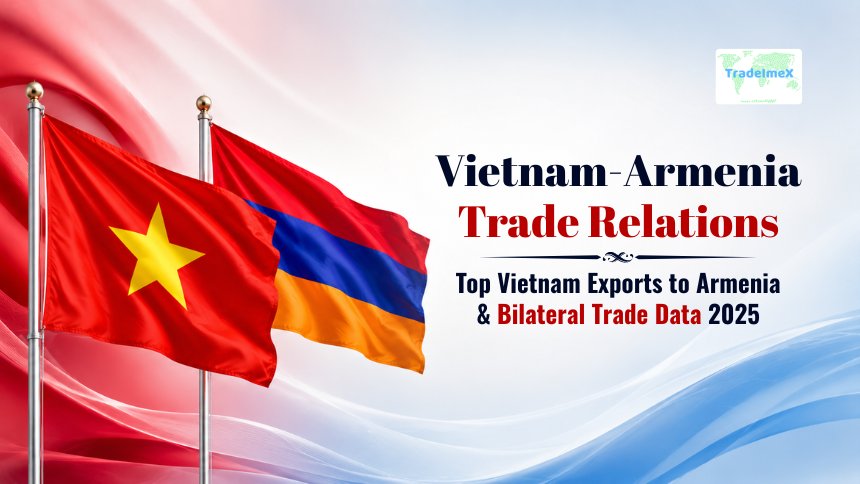
Vietnam-Armenia Trade Relations: Top Vietnam Exports to Armenia & Bilateral Trade Data 2025
Explore Vietnam-Armenia trade relations, including top Vietnam exports to Armenia, bilateral trade statistics 2025, market trends, & trade insights.

Vietnam and Armenia are steadily strengthening their economic and trade cooperation as both countries seek to diversify international partnerships, expand export opportunities, and improve connectivity with emerging markets. Although bilateral trade between Vietnam and Armenia remains relatively small compared to Vietnam’s trade with major global economies, trade volumes have shown gradual growth in recent years due to increasing diplomatic cooperation, regional trade integration, and rising demand for Asian manufactured products in the Caucasus region. According to the Vietnam export data and Armenia import data, the total value of Vietnam-Armenia trade reached around $95 million in 2025.
In 2026, Vietnam-Armenia trade relations will continue expanding across sectors such as electronics, machinery, textiles, consumer goods, agricultural products, pharma, and processed foods. Vietnam’s strong manufacturing base and Armenia’s strategic location between Europe and Asia are creating new opportunities for long-term bilateral trade growth. This blog explores Vietnam-Armenia trade relations in detail, including bilateral trade statistics, top Vietnam exports to Armenia, major imported products, trade trends, investment opportunities, and prospects for economic cooperation in 2025.
Overview of Vietnam-Armenia Trade Relations
Vietnam and Armenia maintain friendly diplomatic relations supported by economic cooperation agreements, trade discussions, and multilateral partnerships. Trade between the two countries has gradually increased over the last decade, although total trade value remains modest compared to larger regional trade corridors. According to recent trade estimates:
-
Total Vietnam-Armenia bilateral trade in 2025 exceeded over $95 million.
-
Bilateral trade growth is projected at around 11-14% annually.
-
Vietnam maintains a strong trade surplus with Armenia.
Vietnam exports to Armenia mainly include:
-
Electronics
-
Machinery
-
Textiles
-
Consumer goods
-
Agricultural products
Meanwhile, Armenia's exports to Vietnam include:
-
Alcoholic beverages
-
Metals
-
Minerals
-
Processed agricultural products
-
Chemicals
Economic cooperation has improved due to:
-
Eurasian Economic Union (EAEU) agreements
-
Growing Asia-Europe trade connectivity
-
Increased business networking
-
Expanding trade corridors
Vietnam’s Growing Role in Eurasian Trade
Vietnam became the first Southeast Asian country to sign a Free Trade Agreement (FTA) with the Eurasian Economic Union, which includes:
-
Armenia
-
Russia
-
Belarus
-
Kazakhstan
-
Kyrgyzstan
This agreement has significantly improved market access for Vietnamese exporters entering Armenia and other Eurasian markets. The Vietnam-EAEU FTA has reduced tariffs across several sectors, including:
-
Electronics
-
Garments
-
Agricultural products
-
Seafood
-
Processed foods
-
Machinery
As a result, Vietnamese exporters are increasingly targeting Armenia as:
-
A direct consumer market
-
A gateway into the Caucasus region
-
A regional distribution hub
Vietnam-Armenia Bilateral Trade Data 2025
Trade between Vietnam and Armenia has shown consistent growth despite global economic uncertainty.
Bilateral Trade Statistics 2025
-
Total bilateral trade: $95 million
-
Vietnam exports to Armenia: $72 million
-
Vietnam imports from Armenia: $23 million
-
Vietnam trade surplus: $49 million
Vietnam’s exports account for approximately:
-
75.8% of total bilateral trade
The main growth drivers include:
-
Consumer electronics demand
-
Expansion of textile imports
-
Rising machinery imports
-
Growth in processed food consumption
-
Increasing pharmaceutical trade
What Are the Top 10 Goods Vietnam Exports to Armenia?
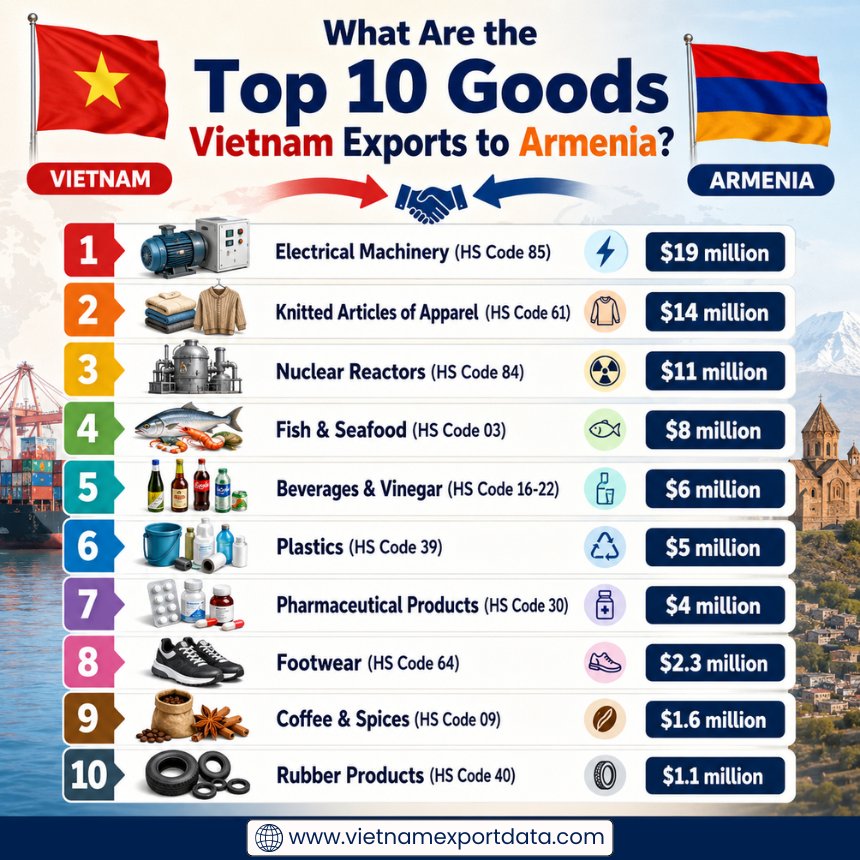
Vietnam exports a wide range of industrial and consumer products to Armenia. Manufactured goods dominate bilateral trade. Vietnam's top exports to Armenia encompass a diverse range of products, reflecting the strong trade relations between the two nations. Some of the key exports from Vietnam to Armenia include footwear, textiles, coffee, machinery, and electronic products. Vietnam's export sector has been steadily growing, with a focus on delivering quality products to meet the demands of the Armenian market. The top 10 Vietnamese exports to Armenia, as per the Vietnam shipment data for 2025, include:
1. Electrical Machinery & Equipment (HS Code 85): $19 million (26.4%)
One of the most significant exports from Vietnam to Armenia is electrical machinery and equipment, accounting for a substantial portion of the total export value, as per the customs data on Vietnam electronics exports to Armenia. With technological advancements driving global demand for such products, Vietnam has positioned itself as a key supplier to Armenia in this category.
2. Knitted Articles of Apparel (HS Code 61): $14 million (19.4%)
Vietnam's textile industry has been booming in recent years, as evidenced by the export of knitted apparel to Armenia. The quality and affordability of Vietnamese garments have made them popular in the Armenian market, leading to a substantial export value in this category.
3. Nuclear Reactors & Machinery (HS Code 84): $11 million (15.3%)
Vietnam's expertise in nuclear reactors and machinery has also contributed significantly to its exports to Armenia. As countries worldwide seek to diversify their energy sources, Vietnamese products in this category have found a niche in the Armenian market, driving export revenues.
4. Fish & Seafood (HS Code 03): $8 million (11.1%)
Vietnam's rich coastline and thriving fishing industry have paved the way for the export of fish and seafood to Armenia. With increasing demand for fresh and high-quality seafood products, Vietnamese exports in this category have seen steady growth, meeting the needs of Armenian consumers.
5. Beverages, Spirits, & Vinegar (HS Code 16-22): $6 million (8.3%)
Vietnam's beverages, spirits, and vinegar have also found a place in the Armenian market, with unique flavors and diverse products capturing the interest of consumers. These exports showcase the cultural richness of Vietnam and contribute to the country's trade relations with Armenia.
6. Plastics & Plastic Products (HS Code 39): $5 million (6.9%)
Plastics and plastic products from Vietnam have become integral to the manufacturing sector in Armenia, driving the export value in this category. The quality and variety of Vietnamese plastic products have made them essential imports for Armenian industries, fostering a strong trade partnership.
7. Pharmaceutical Products (HS Code 30): $4 million (5.6%)
Vietnam's pharmaceutical industry has seen rapid growth in recent years, and this is reflected in the export of pharmaceutical products to Armenia. With a focus on quality and innovation, Vietnamese pharmaceutical exports have gained popularity in the Armenian market, contributing significantly to the trade between the two countries.
8. Footwear (HS Code 64): $2.3 million (3.2%)
Vietnamese footwear has carved a niche for itself in the global market, including Armenia, where the export of footwear products has seen steady growth. The craftsmanship and quality of Vietnamese footwear have made them sought after in Armenia, driving the export value in this category.
9. Coffee, Tea & Spices (HS Code 09): $1.6 million (2.2%)
Vietnam's rich agricultural sector is well represented in the export of coffee, tea, and spices to Armenia. The unique flavors and aromas of Vietnamese products have garnered a dedicated consumer base in Armenia, contributing to the export revenues in this category.
10. Rubber & Rubber Products (HS Code 40): $1.1 million (1.5%)
Vietnamese rubber and rubber products have become essential imports for Armenian industries, driving the export value in this category, as per the data on Vietnam rubber exports to Armenia by HS code. With a focus on quality and durability, Vietnamese rubber products have found a strong foothold in the Armenian market, contributing to the bilateral trade relationship.
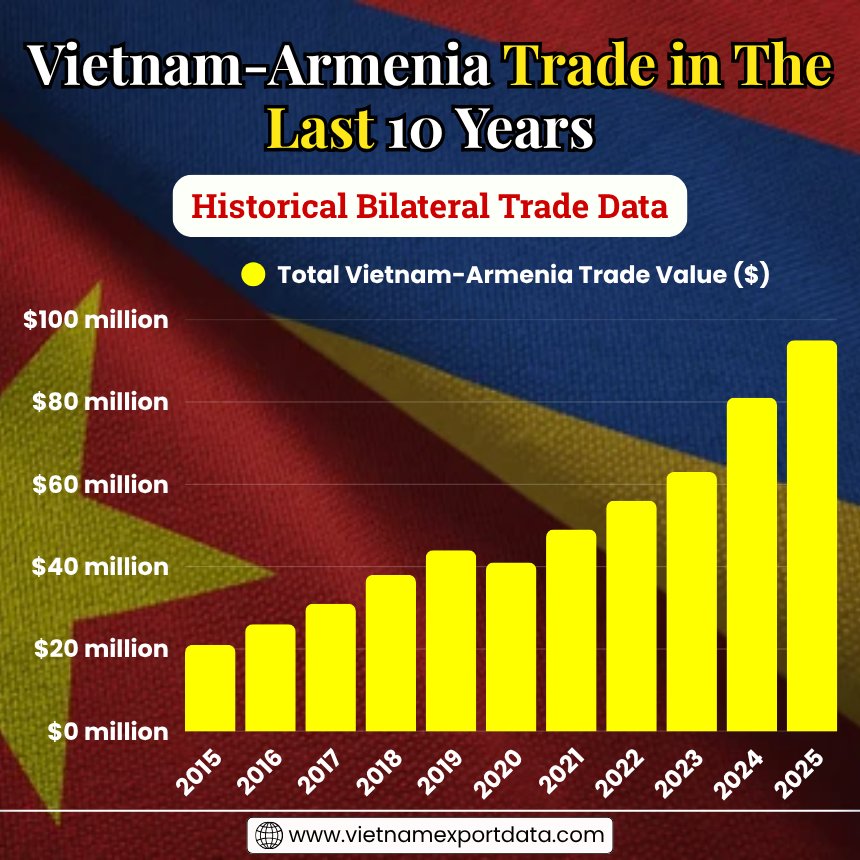
Vietnam-Armenia Trade in The Last 10 Years: Historical Bilateral Trade Data
|
Year of Trade |
Total Vietnam-Armenia Trade Value ($) |
|
2015 |
$21 million |
|
2016 |
$26 million |
|
2017 |
$31 million |
|
2018 |
$38 million |
|
2019 |
$44 million |
|
2020 |
$41 million |
|
2021 |
$49 million |
|
2022 |
$56 million |
|
2023 |
$63 million |
|
2024 |
$81 million |
|
2025 |
$95 million |

Vietnam Export Trends to Armenia
Vietnam’s exports to Armenia have steadily diversified over the past several years.
Vietnam Exports to Armenia (2018–2025)
-
2018: $38 million
-
2019: $44 million
-
2020: $41 million
-
2021: $49 million
-
2022: $56 million
-
2023: $63 million
-
2024: $68 million
-
2025: $72 million
The temporary slowdown in 2020 was mainly linked to global trade disruptions and pandemic-related trade challenges. However, exports recovered strongly afterward.
Armenia’s Main Exports to Vietnam
Although Armenia exports significantly less to Vietnam, several products maintain a stable demand.
Key Armenian Exports Include:
-
Brandy and alcoholic beverages
-
Copper products
-
Precious metals
-
Minerals
-
Processed agricultural goods
-
Chemicals
Armenian alcoholic beverages, especially brandy and wine, are among the country’s best-known international export products.
Key Drivers Supporting Vietnam-Armenia Trade Growth
1. Eurasian Economic Union Trade Benefits
The Vietnam-EAEU Free Trade Agreement continues to reduce tariff barriers and improve market access.
Vietnamese exporters benefit from:
-
Lower import duties
-
Simplified customs procedures
-
Better regulatory cooperation
This has improved competitiveness for Vietnamese products entering Armenia.
2. Supply Chain Diversification
Businesses globally are diversifying sourcing away from traditional suppliers. Armenian importers increasingly source products from Vietnam because of:
-
Cost competitiveness
-
Manufacturing reliability
-
Broad product availability
3. Growing Consumer Demand
Armenia’s urban consumers are increasingly purchasing:
-
Electronics
-
Fashion products
-
Packaged foods
-
Household goods
Vietnamese manufacturers are successfully targeting these consumer segments.
4. Expanding Trade Connectivity
Improved shipping routes and Eurasian trade corridors are helping facilitate bilateral trade. Regional trade integration between:
-
Asia
-
Russia
-
Caucasus countries
-
Europe
continues supporting trade growth.
Recent Developments Strengthening Vietnam-Armenia Economic Cooperation
Vietnam and Armenia are also actively working to deepen bilateral economic engagement through government-level cooperation and trade dialogue initiatives. During the 2nd session of the Joint Intergovernmental Commission on Economic, Scientific and Technical Cooperation held in Yerevan in May 2025, officials from both countries discussed expanding trade, investment, food processing, information technology, and light industry cooperation. Armenia’s Deputy Economy Minister Arman Khojoyan emphasized that Armenia’s current economic policy focuses heavily on:
-
Export diversification
-
Import diversification
-
Supply chain resilience
-
Expanding international economic partnerships
According to Armenian officials, closer economic ties with Vietnam could significantly support these goals, especially as both countries continue strengthening cooperation under the Vietnam-EAEU Free Trade Agreement framework. The discussions also highlighted opportunities for Armenia to expand exports of:
-
Armenian brandy
-
Wine
-
Processed agricultural goods
-
Food products
to the Vietnamese market under preferential trade conditions. Earlier Armenia-EAEU trade discussions had already identified zero-duty opportunities for Armenian wine, cognac, and tobacco exports to Vietnam following the EAEU-Vietnam free trade agreement.
Another important area of discussion was Armenia’s “Crossroads of Peace” initiative, which aims to improve regional transportation connectivity and economic integration across the South Caucasus. Armenian officials believe enhanced transport and trade infrastructure could strengthen trade routes connecting Vietnam with Eurasian and European markets. Political and parliamentary cooperation between the two countries is also expanding. In recent bilateral meetings, Vietnamese and Armenian leaders discussed strengthening collaboration in:
-
Trade
-
Science and technology
-
Tourism
-
Education
-
Investment
-
Manufacturing
According to Vietnamese and Armenian parliamentary officials, bilateral trade turnover in the first ten months of 2024 reached nearly $424 million, reflecting a strong year-on-year growth of approximately 28.9%. Vietnam also continues encouraging businesses to invest in Armenia, particularly in sectors such as:
-
Agriculture
-
Food processing
-
Textile manufacturing
-
Electronics
-
Industrial production
At the same time, Armenian companies are exploring investment opportunities in Vietnam’s rapidly expanding manufacturing sector.
These recent developments indicate that Vietnam-Armenia trade relations are gradually evolving from basic commodity trade into broader long-term economic cooperation focused on investment, industrial partnerships, regional connectivity, and supply chain diversification.
Investment Opportunities Between Vietnam and Armenia
Trade relations are also opening investment opportunities across multiple industries.
Key Potential Sectors Include:
-
Food processing
-
Textile manufacturing
-
Tourism
-
Technology services
-
Renewable energy
-
Pharmaceuticals
-
Agriculture
Vietnamese companies may increasingly explore Armenia as a regional operational base within Eurasian markets.
Challenges Facing Bilateral Trade
Despite positive growth trends, several challenges remain.
1. Limited Market Size
Armenia has a relatively small population and consumer market compared to larger Eurasian economies.
2. Shipment Costs
Transportation between Southeast Asia and the Caucasus region can remain costly and time-consuming.
3. Limited Business Awareness
Many businesses in both countries still have limited market knowledge regarding:
-
Regulations
-
Consumer preferences
-
Distribution networks
4. Currency & Economic Risks
Global inflation, currency fluctuations, and geopolitical uncertainty may affect bilateral trade expansion.
Future Outlook for Vietnam-Armenia Trade Relations
The future of Vietnam-Armenia trade relations appears positive as both countries continue strengthening economic partnerships.
Industry analysts expect:
-
Bilateral trade to exceed $120 million by 2030
-
Continued growth in electronics exports
-
Rising agricultural trade
-
Expansion of processed food exports
-
Increased trade cooperation
The Vietnam-EAEU trade framework is likely to remain the primary driver of future growth. Vietnam’s expanding role in global manufacturing and Armenia’s strategic location between Europe and Asia create strong long-term trade potential.
Conclusion and Final Thoughts
In conclusion, the Vietnam-Armenia trade relations are steadily developing in 2026 through growing bilateral trade, expanding export diversification, and stronger Eurasian economic integration. Vietnam currently dominates bilateral trade through exports of:
-
Electronics
-
Garments
-
Machinery
-
Agricultural products
-
Processed foods
Meanwhile, Armenia continues supplying niche exports, including beverages, metals, and minerals. The Vietnam-EAEU Free Trade Agreement, improving trade connectivity, and growing consumer demand are helping strengthen long-term economic cooperation between the two countries. As global trade patterns continue evolving and businesses seek diversified sourcing opportunities, Vietnam and Armenia are expected to deepen bilateral trade relations further in the coming years.
Note For Our Readers
We hope this blog on Vietnam-Armenia trade relations, bilateral trade data in 2025, and top Vietnam exports to Armenia helps you better understand the current trade landscape, export opportunities, sourcing trends, and Eurasian market dynamics.
If you’re looking for deeper market insights, customized Vietnam import-export data, or want to explore live Vietnam trade data by country, buyer, supplier, or HS code, feel free to connect with VietnamExportdata. We provide comprehensive and updated global trade databases designed to support market research, supplier sourcing, competitor analysis, buyer identification, and international business expansion. For exclusive access or customized trade data solutions, contact us at info@tradeimex.in and make smarter import-export decisions with confidence.
Share
What's Your Reaction?
 Like
1
Like
1
 Dislike
0
Dislike
0
 Love
0
Love
0
 Funny
0
Funny
0
 Angry
0
Angry
0
 Sad
0
Sad
0
 Wow
0
Wow
0