Vietnam Poised to Overtake Canada as Top Source of US Imports: Data-Driven Analysis of Growth in Vietnam Exports to US
Vietnam is set to overtake Canada as a top source of US imports. Explore data-driven insights on Vietnam exports to US, trade growth trends, & analysis.

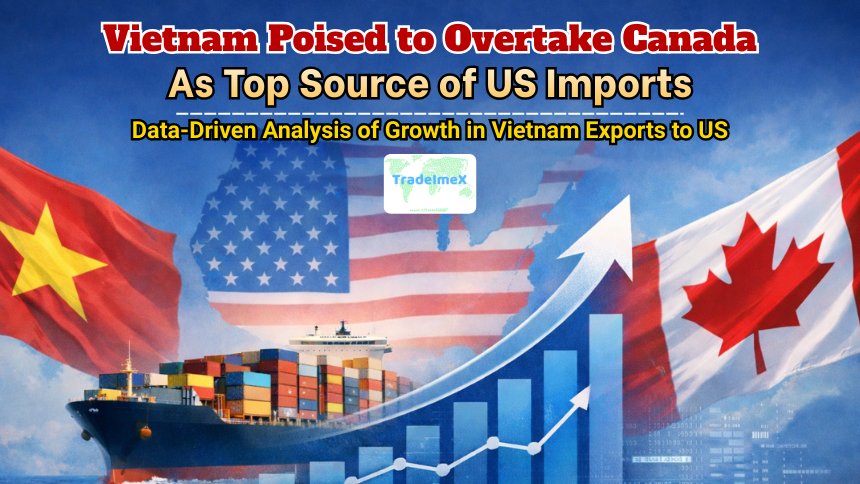
Global trade patterns are undergoing a major transformation. Over the last decade, the United States has gradually diversified its supply chains, reducing dependence on traditional manufacturing hubs while expanding imports from emerging economies. One of the most striking developments in this shift is the rapid rise of Vietnam as a key supplier to the U.S. market. According to the latest Vietnam export data and US import data, the total value of Vietnam exports to US reached $136.50 billion in 2024 and over $201 billion in 2025, a massive 41% increase from the previous year.
Recent trade data shows that Vietnam is rapidly climbing the ranks of America’s largest import partners. Vietnam is the 5th largest import partner of the US, as per the Vietnam customs data & global trade data. While Canada has historically been one of the United States’ top suppliers, the gap between Canadian exports to the U.S. and Vietnamese shipments is narrowing quickly. If current trends continue, Vietnam could soon rival or even surpass Canada in certain categories of U.S. imports.
This blog presents a detailed, data-driven analysis of Vietnam’s export growth to the United States, the structural factors driving this shift, and what it means for global supply chains.
Vietnam’s Export Boom: A Decade of Rapid Growth
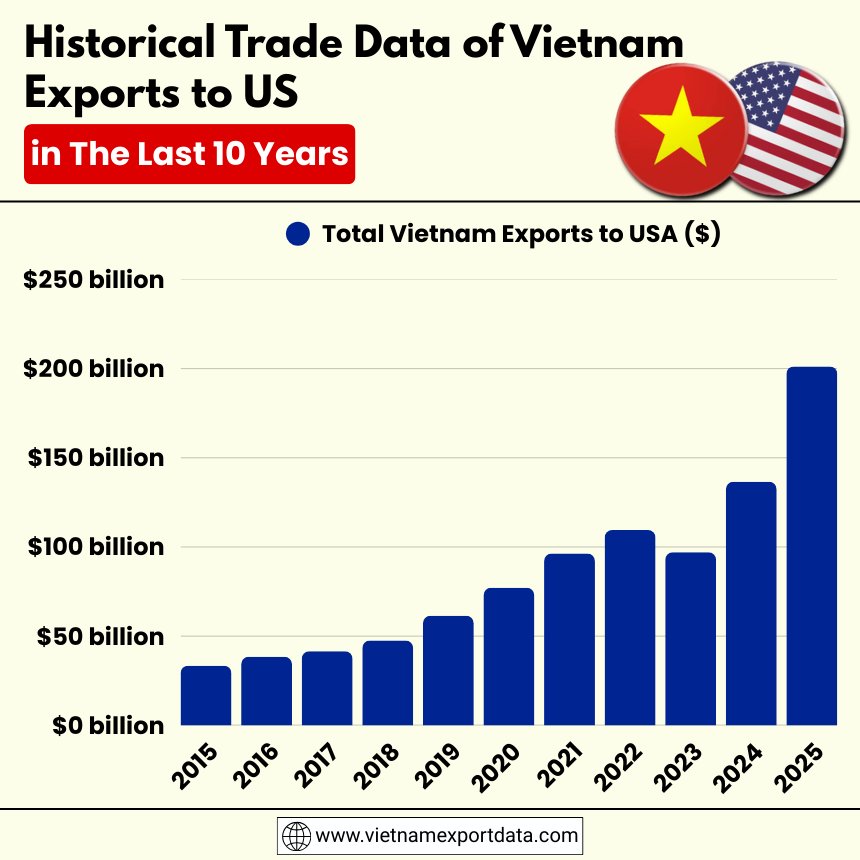
Vietnam’s rise in global trade has been remarkable. In 2017, U.S. imports from Vietnam were only $48.44 billion. By 2025, they had nearly quadrupled to $201.05 billion. This expansion reflects Vietnam’s transformation from a low-cost textile exporter to a diversified manufacturing hub producing electronics, machinery, furniture, and apparel. Today, the U.S. is Vietnam’s most important export market, as per the Vietnam-US trade data.
In fact, Vietnam’s exports to the United States account for around 30% of Vietnam’s GDP, the highest share among major U.S. trading partners. Such dependence highlights both the strength and vulnerability of Vietnam’s export-driven growth model.
Current Landscape of Vietnam as a Source of US Imports
The United States is the world’s largest importer of goods, with total imports reaching roughly $3.50 trillion in 2025.
America’s leading suppliers remain geographically and economically diverse. According to global trade data, the top exporters to the U.S. in 2025 include:
|
Rank |
Country |
U.S. Imports Value (2025) |
|
1 |
Mexico |
$538.97B |
|
2 |
Canada |
$392.99B |
|
3 |
China |
$327.49B |
|
4 |
Taiwan |
$205.03B |
|
5 |
Vietnam |
$201.25B |
|
6 |
Germany |
$159.17B |
Vietnam now ranks among the top 5 suppliers of goods to the United States, exporting $201.25 billion worth of products in 2025.
Although Canada still ships nearly three times as much to the U.S., Vietnam’s export growth rate has been significantly faster. If this trajectory continues over the next decade, Vietnam could challenge Canada’s position as one of America’s dominant import sources.
Vietnam's Top Exports to the US: What Vietnam Exports to USA?
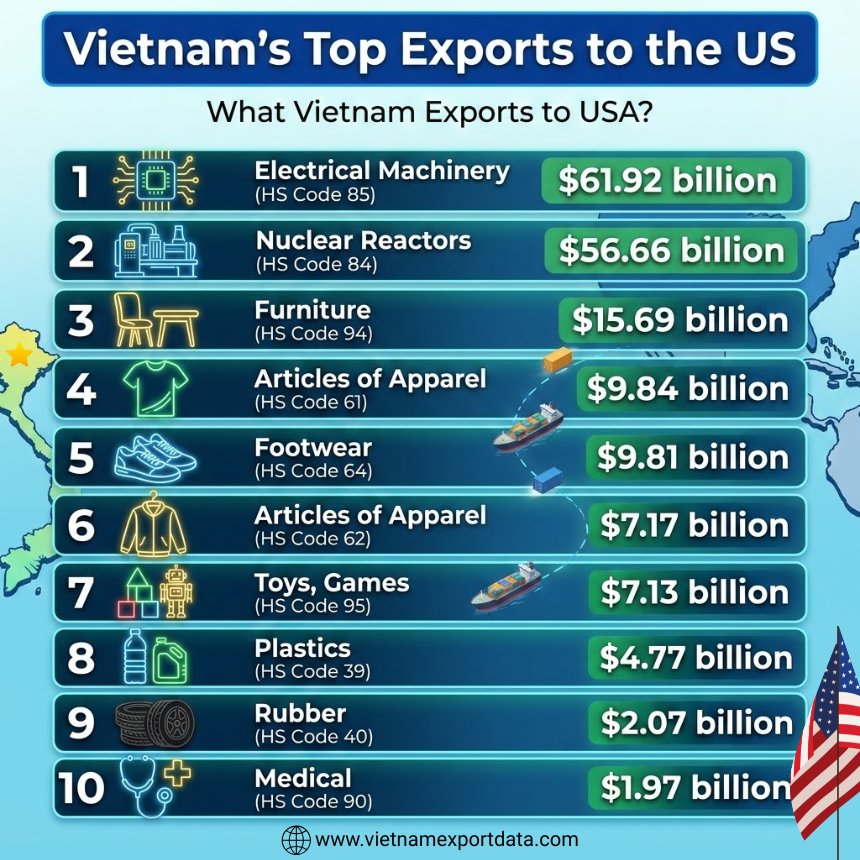
Vietnam's top exports to the US encompass a variety of products, reflecting the country's diverse economy and growing global trade presence. Key exports from Vietnam to the USA include apparel and footwear, electronics, furniture, seafood, and agricultural products like coffee, rice, and cashew nuts. These exports play a crucial role in strengthening the trade relationship between the two countries, highlighting Vietnam's importance as a key trading partner in the Asia Pacific region. The top 10 goods that Vietnam exports to the US, as per the Vietnam shipment data for 2025, include:
1. Electrical Machinery & Equipment (HS Code 85): $61.92 billion
One of Vietnam's top exports to the US is electrical machinery and equipment, reaching a staggering $61.92 billion, as per the data on Vietnam electronics exports to the US. This category includes items such as televisions, radios, and electrical transformers. Vietnam's skilled workforce and growing expertise in electronics manufacturing have made it a go-to destination for US importers seeking high-quality products at competitive prices.
2. Nuclear Reactors & Machinery (HS Code 84): $56.66 billion
Another significant export from Vietnam to the US is nuclear reactors and machinery, amounting to $56.66 billion. This category covers a wide range of products, including parts for nuclear reactors, machinery for industrial use, and mechanical appliances. Vietnam's strong infrastructure and commitment to technological advancements have positioned it as a reliable supplier of these goods to the US market.
3. Furniture, Bedding, & Mattresses (HS Code 94): $15.69 billion
Vietnam has also made a name for itself in the furniture industry, with exports totaling $15.69 billion, as per the data on Vietnam furniture exports to US by HS code. The country's rich tradition of craftsmanship and design, coupled with its cost-effective manufacturing processes, has enabled it to capture a significant share of the US furniture market. From stylish sofas to comfortable mattresses, Vietnamese furniture products are known for their quality and affordability.
4. Articles of Apparel, Knitted (HS Code 61): $9.84 billion
The apparel industry is another key export sector for Vietnam, with knitted articles accounting for $9.84 billion in exports to the US. Vietnamese manufacturers are renowned for their expertise in producing high-quality clothing items such as shirts, sweaters, and socks. The country's favorable trade agreements and efficient supply chains have further bolstered its position as a leading exporter of knitted apparel to the US.
5. Footwear (HS Code 64): $9.81 billion
Vietnam is also a major player in the footwear industry, exporting $9.81 billion worth of shoes to the US. With a skilled workforce and access to high-quality materials, Vietnamese shoe manufacturers have become preferred suppliers for US retailers and consumers alike. From running sneakers to stylish sandals, Vietnam offers a diverse range of footwear options that cater to different tastes and preferences.
6. Articles of Apparel, Not-Knitted (HS Code 62): $7.17 billion
In addition to knitted apparel, Vietnam also exports non-knitted clothing items worth $7.17 billion to the US. This category includes garments such as suits, dresses, and outerwear. Vietnamese fashion designers and manufacturers are known for their creativity and attention to detail, making their products stand out in the competitive US market.
7. Toys, Games, & Sports Requisites (HS Code 95): $7.13 billion
Vietnam's exports to the US also include toys, games, and sports requisites, amounting to $7.13 billion. The country's vibrant toy manufacturing sector produces a wide variety of products, from educational games to outdoor sports equipment. With a focus on safety, quality, and innovation, Vietnamese toy manufacturers have captured the imagination of children and parents in the US market.
8. Plastics & Articles Thereof (HS Code 39): $4.77 billion
Plastics and articles thereof are another significant export category for Vietnam, with exports reaching $4.77 billion. This category includes a wide range of plastic products, from packaging materials to household items. Vietnam's advanced manufacturing capabilities and commitment to sustainable practices have made it a preferred supplier of plastic goods to the US market.
9. Rubber & Articles Thereof (HS Code 40): $2.07 billion
Vietnam also exports rubber and articles thereof to the US market, worth $2.07 billion. This category includes items such as tires, hoses, and rubber gloves. With a focus on quality control and product innovation, Vietnamese rubber manufacturers have established a strong presence in the US market, catering to the diverse needs of industries such as automotive, construction, and healthcare.
10. Optical, Medical, Surgical Instruments (HS Code 90): $1.97 billion
Last but not least, Vietnam's exports to the US also include optical, medical, and surgical instruments, totaling $1.97 billion. Vietnamese manufacturers are renowned for their precision engineering and cutting-edge technology, producing a wide range of products, including eyewear, medical devices, and surgical tools. With a growing demand for healthcare products, Vietnam is poised to expand its presence in this lucrative market segment.
Vietnam’s exports to the United States are dominated by manufacturing sectors, particularly electronics and consumer goods. Electronics alone account for a substantial share of shipments. These sectors reflect Vietnam’s strategic shift from low-value production toward higher-value manufacturing integrated into global supply chains.
Historical Trade Data of Vietnam Exports to US in The Last 10 Years
|
Year of Exports |
Total Vietnam Exports to USA ($) |
|
2015 |
$33.47 billion |
|
2016 |
$38.47 billion |
|
2017 |
$41.54 billion |
|
2018 |
$47.58 billion |
|
2019 |
$61.40 billion |
|
2020 |
$77.07 billion |
|
2021 |
$96.32 billion |
|
2022 |
$109.45 billion |
|
2023 |
$97.07 billion |
|
2024 |
$136.50 billion |
|
2025 |
$201.25 billion |
Supply Chain Realignment: The “China Plus One” Strategy
One of the most important drivers behind Vietnam’s export growth is the restructuring of global supply chains. For decades, China dominated manufacturing exports to the United States. However, geopolitical tensions, tariffs, and rising labor costs have encouraged multinational corporations to diversify production.
This shift is widely known as the “China Plus One” strategy, where companies maintain operations in China but expand manufacturing in other Asian countries.
Vietnam has emerged as one of the biggest beneficiaries.
Major corporations manufacturing in Vietnam include:
-
Apple suppliers
-
Samsung Electronics
-
Foxconn
-
Intel
-
Nike
Foreign investment has played a critical role in expanding Vietnam’s manufacturing capacity. Large technology companies have relocated or expanded production in Vietnam to mitigate geopolitical risks and tariff exposure.
As a result, Vietnam has become a major node in global electronics and consumer goods supply chains.
AI, Technology, and the Surge in High-Tech Imports
Another major driver of Vietnam’s export boom is the growing demand for technology products. The rise of artificial intelligence infrastructure and digital hardware has increased imports of computers, electronics, and accessories into the United States. Recent economic analysis indicates that imports of computers increased 87%, while computer accessories rose 42% due to AI-driven business investment.
Much of this production involves supply chains running through Vietnam, where electronics assembly plants produce components for global brands. As technology demand continues to rise, Vietnam’s role in supplying high-tech products to the U.S. is expected to grow further.
Trade Imbalances and Rising U.S. Deficit with Vietnam
While Vietnam’s exports to the United States are booming, American exports to Vietnam remain relatively modest. This imbalance has created a rapidly expanding trade deficit.
In recent years, the U.S. trade deficit with Vietnam has grown dramatically and reached approximately $178 billion, nearly matching the deficit with China.
This imbalance reflects several structural factors:
-
Vietnam’s export-led development strategy
-
Limited Vietnamese imports of high-value U.S. goods
-
Strong demand for consumer goods in the U.S.
-
Global supply chain relocation from China
The deficit has also raised policy concerns in Washington, where some policymakers worry that trade imbalances could intensify political pressure for tariffs or renegotiated trade agreements.
Canada vs. Vietnam: Comparing Trade Structures
Although Vietnam’s export growth is impressive, Canada remains one of the United States’ largest trading partners.
Canada exported $392.99 billion worth of goods to the United States in 2025, far exceeding Vietnam’s total. However, the structure of Canadian exports differs significantly from that of Vietnam’s.
U.S. Imports from Vietnam vs. Canada (Last 5 Years)
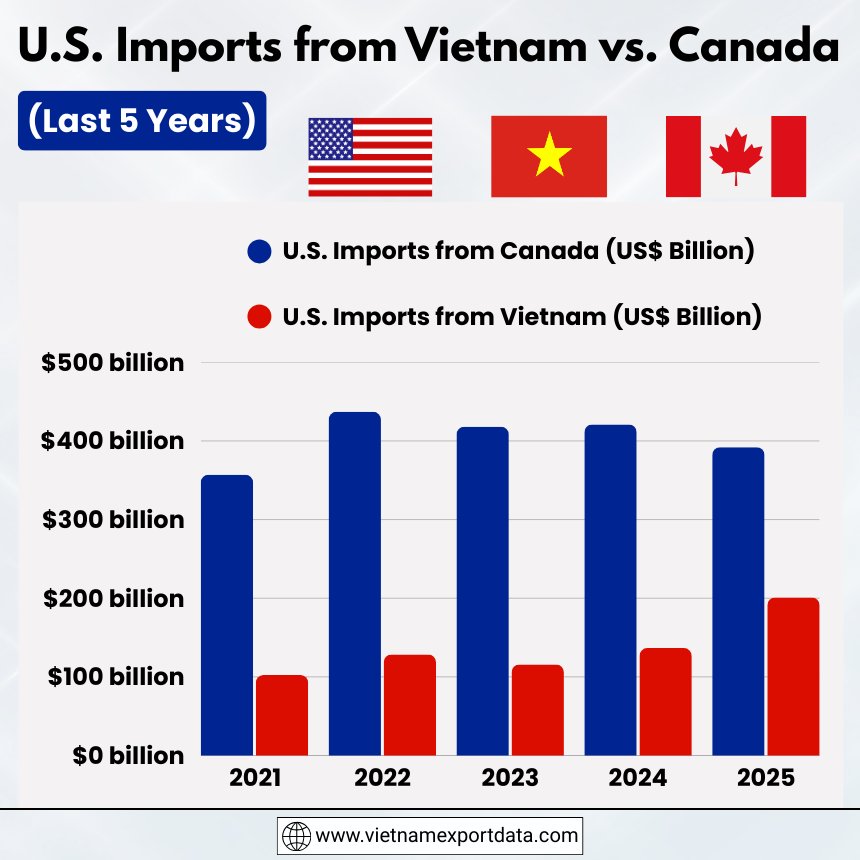
Below is a comparative overview of U.S. goods imports from Vietnam and Canada over the past five years. The data highlights how Vietnam has rapidly expanded its export presence in the U.S. market, while Canada remains a dominant but slower-growing supplier.
|
Year |
U.S. Imports from Canada (US$ Billion) |
U.S. Imports from Vietnam (US$ Billion) |
|
2021 |
$357 billion |
$102.39 billion |
|
2022 |
$437 billion |
$128.36 billion |
|
2023 |
$418 billion |
$115.8 billion |
|
2024 |
$421 billion |
$136.6 billion |
|
2025 |
$392 billion |
$201 billion |
Data Analysis: Vietnam vs. Canada in U.S. Import Market
1. Vietnam’s Imports to the U.S. Grew Faster Than Canada’s
The most striking pattern in the data is the growth rate difference between the two countries.
Between 2021 and 2025:
-
Vietnam exports to the U.S. increased from $102B to about $201B
-
Canada's exports increased from about $437B to around $392B
Growth Rate (2021–2025)
|
Country |
Growth |
|
Vietnam |
97% increase |
|
Canada |
10% decrease |
Vietnam’s export growth is nearly double Canada’s growth rate over the same period. This shows that while Canada remains a much larger supplier, Vietnam is expanding much faster.
Canada’s Main Exports to the U.S.
-
Energy (oil and gas)
-
Automobiles and auto parts
-
Industrial materials
-
Agricultural products
Vietnam’s Main Exports to the U.S.
-
Electronics
-
Consumer goods
-
Apparel and footwear
-
Furniture
In other words, Canada’s exports are largely resource and industrial goods, while Vietnam’s are manufactured consumer products. As U.S. demand for consumer electronics, furniture, and apparel continues to grow, Vietnam’s export share could expand faster than Canada’s.
Manufacturing Competitiveness: Why Vietnam Is Winning
Vietnam’s manufacturing success is driven by several structural advantages, along with the Vietnam-US trade deal 2025.
1. Competitive Labor Costs
Vietnam’s wages remain significantly lower than those in China and far below North American levels. This cost advantage continues to attract global manufacturers.
2. Trade Agreements
Vietnam participates in numerous international trade agreements, including:
-
CPTPP (Comprehensive and Progressive Agreement for Trans-Pacific Partnership)
-
EU-Vietnam Free Trade Agreement
-
ASEAN trade frameworks
These agreements reduce tariffs and increase market access for Vietnamese goods.
3. Government Industrial Policy
Vietnam’s government has actively promoted export manufacturing through:
-
Industrial parks
-
Infrastructure investment
-
Export incentives
Infrastructure spending has increased significantly, with investment rising toward 10% of GDP as part of economic development initiatives.
4. Strategic Geographic Location
Vietnam is located near major Asian manufacturing hubs, allowing it to integrate seamlessly into regional supply chains. Companies can source components from China, South Korea, and Taiwan before assembling final products in Vietnam for export to the United States.
Risks and Challenges Ahead
Despite strong momentum, Vietnam’s export-led growth faces several potential challenges.
Trade Policy Risks
Tariffs remain a key concern. The U.S. government has considered additional duties on Vietnamese goods due to the rising trade deficit. Such measures could slow export growth.
Supply Chain Dependence
Vietnam’s manufacturing sector relies heavily on imported components, particularly from China. If supply chain disruptions occur, production capacity could be affected.
Economic Overdependence on the U.S.
Because exports to the United States account for such a large share of Vietnam’s economy, any slowdown in U.S. demand could significantly impact Vietnam’s growth.
The Future Outlook: Can Vietnam Overtake Canada?
While Canada still exports far more goods to the United States, the long-term trajectory suggests that Vietnam could become one of America’s dominant manufacturing suppliers.
Several factors support this outlook:
-
Rapid expansion of electronics manufacturing
-
Continued supply chain diversification away from China
-
Rising global demand for technology products
-
Ongoing foreign investment in Vietnam
If Vietnam maintains annual export growth rates between 10–15%, its shipments to the United States could double within the next decade. Under such conditions, Vietnam would likely challenge traditional exporters for higher rankings among America’s top import sources.
Implications for Global Trade
Vietnam’s rise reflects broader structural changes in global trade.
1. Supply Chains Are Becoming Multi-Regional
Companies are no longer relying on a single manufacturing hub. Production networks are spreading across multiple countries to reduce risk.
2. Southeast Asia Is Becoming the New Manufacturing Frontier
Countries such as Vietnam, Indonesia, and Thailand are rapidly expanding industrial capacity. This shift is gradually reshaping global manufacturing geography.
3. The US–China Trade War Accelerated the Transition
Tariffs and geopolitical tensions accelerated the relocation of production away from China. Vietnam has emerged as one of the primary beneficiaries of this realignment.
Conclusion and Final Verdict
In conclusion, Vietnam’s transformation into a major exporter to the United States represents one of the most significant shifts in global trade over the past decade. U.S. imports from Vietnam have nearly tripled since 2017, reaching over $201 billion in 2025, and the country now ranks among America’s largest suppliers. Driven by supply chain diversification, foreign investment, and competitive manufacturing costs, Vietnam has positioned itself as a critical hub in global production networks.
While Canada remains a dominant supplier to the U.S., the rapid growth of Vietnamese exports signals that the hierarchy of America’s import partners may continue to evolve. As global supply chains adapt to technological, geopolitical, and economic changes, Vietnam is likely to remain one of the fastest-growing export economies. The coming decade will reveal whether this Southeast Asian powerhouse can truly challenge traditional trade giants and reshape the landscape of international trade.
Note for Our Readers
We hope you found this data-driven analysis on Vietnam’s rising exports to the United States and its potential to overtake traditional suppliers like Canada both informative and useful. As global supply chains shift and manufacturing hubs evolve, access to reliable trade data becomes essential for businesses looking to make smarter sourcing and expansion decisions.
If you want to identify active exporters, analyze shipment trends, track competitors, or explore high-growth product categories in Vietnam-U.S. trade, accurate import-export data can give you a clear advantage. With the right insights, businesses can uncover new opportunities, diversify suppliers, and strengthen their position in the global market.
Looking to expand your sourcing network or explore Vietnam’s fast-growing export sectors? Access the latest Vietnam import-export data, detailed shipment records, and database of Vietnam exports by country only at VietnamExportData. For customized trade reports, verified Vietnam exporters databases, or deeper market intelligence, feel free to contact us at info@tradeimex.in today.
Share
What's Your Reaction?
 Like
0
Like
0
 Dislike
0
Dislike
0
 Love
0
Love
0
 Funny
0
Funny
0
 Angry
0
Angry
0
 Sad
0
Sad
0
 Wow
0
Wow
0