Vietnam Fruit & Vegetable Exports Hit $7.8B in 11 Months: Record High Surge in 2025
Vietnam’s fruit & vegetable exports hit a record $7.8B in 11 months of 2025. Explore export data, top markets, and the outlook for 2025.

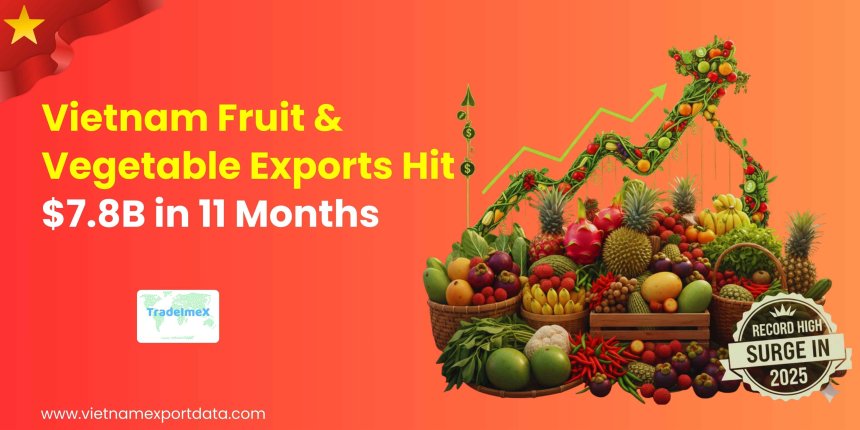
Vietnam’s fruit and vegetable industry is stepping into 2025 with record-breaking momentum. In the first 11 months of 2025, export earnings reached $7.8 billion, the highest figure Vietnam has ever achieved, an 18% increase year-on-year compared with the same period in 2024, as per the Vietnam export data. This surge is not a lucky streak or one-off spike. It is the result of major structural shifts inside the country’s farm sector, a more competitive supply chain, and an international market that is increasingly turning toward Vietnam for high-value tropical produce, as per the latest Vietnam customs export data of fruits & Vietnam vegetables export data.
Vietnam's imports of fruits and vegetables totaled $2.44 billion, a 15% increase. Consequently, the industry produced a trade surplus of around $5.4 billion throughout that time. What makes the 7.8 billion dollar mark remarkable is not just the number itself. It is the scale of growth, the speed of market expansion, and the transformation in how Vietnam grows, processes, and ships its fruit and vegetables. The industry is now set to cross the 8.3 to 8.5 billion dollar range for the full year, pushing Vietnam into a stronger global position than ever before.
This blog breaks down the Vietnam fruit & vegetable export data, drivers, risks, and the outlook for 2025.
The Scale of the Surge: Why The Record Exports Matter
Vietnam’s agricultural exports often rise and fall based on global demand cycles. But the current performance is different, as per the global trade data. From January to November:
-
Export earnings hit $7.8 billion.
-
Year-over-year growth stood above 70 percent, one of the strongest growth rates in Vietnam’s entire export basket.
-
Fruit and vegetables now earn more than several of Vietnam’s long-standing export categories, such as tea, cashew, coffee derivatives, and even some manufacturing segments.
-
The sector added roughly 3.2 billion dollars in new export value compared to the same period last year.
For a sector that once hovered below 4 billion dollars annually, crossing the 7-billion line in less than a year shows a structural step change.
Breaking Down the Export Composition
While Vietnam exports more than a hundred fruit and vegetable products, the strongest growth has come from:
-
Durian
-
Dragon fruit
-
Banana
-
Mango
-
Longan
-
Jujube
-
Processed fruits
-
Frozen vegetables and ready-to-eat items
Durian is the star. Its exports alone have added more than 2 billion dollars to the trade flow, powered by strong demand from China and a fast-growing presence in South Korea and the Middle East, according to the Durian export data and Vietnam Fruit and Vegetable Association.
Processed fruit exports also expanded fast as more factories met global food safety standards. There is a clear move away from raw produce toward higher-margin products like dried mango, frozen durian, canned lychee, and blended vegetable mixes.
Vietnam Fruit Exports by Country: Where Does Vietnam Export Fruits?
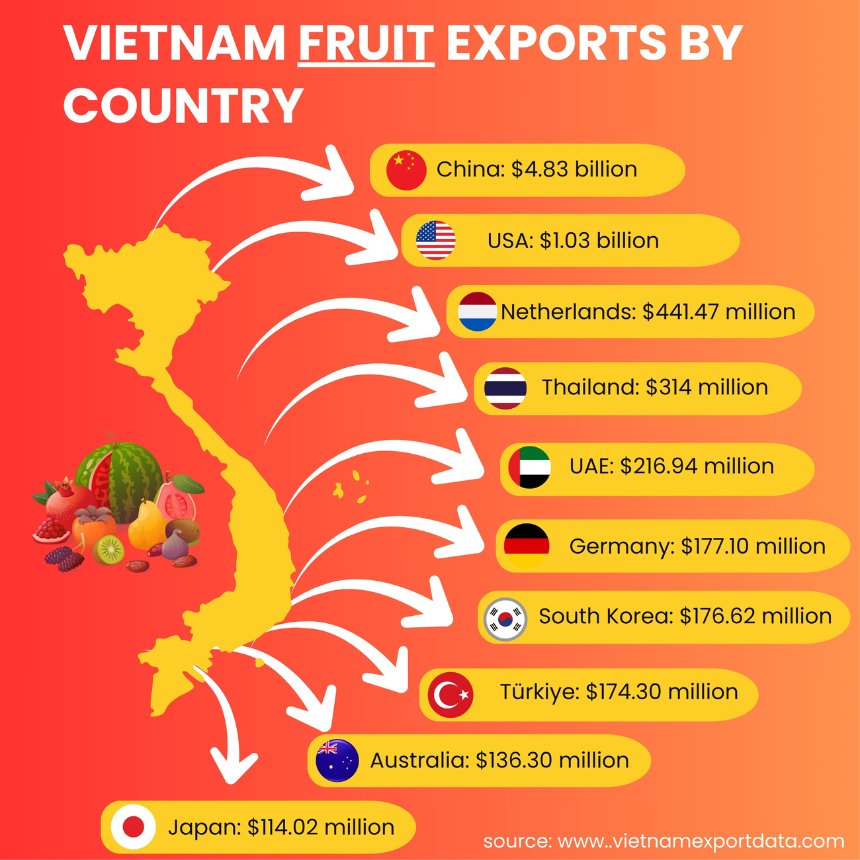
Vietnam exported fruits worth $9.05 billion in 2024-25. Vietnam fruit exports are robust, with the country exporting fruits to a wide array of nations worldwide. Some of the top destinations for Vietnam's fruit exports include the United States, China, Japan, South Korea, and the Netherlands. These countries are major importers of Vietnamese fruits such as dragon fruit, mangoes, lychee, and bananas. The top 10 export destinations for Vietnam fruit exports, as per the Vietnam shipment data & Vietnam fruit export data for 2024-25, include:
1. China: $4.83 billion (53.4%)
China is the leading importer of fruits from Vietnam, accounting for over half of Vietnam's fruit exports, as per the data on Vietnam fruit exports to China by HS code. With a growing middle-class population and increasing demand for healthy food options, China has become a lucrative market for Vietnamese fruits such as dragon fruit, mangoes, and lychees.
2. USA: $1.03 billion (11.5%)
The United States is another significant market for Vietnamese fruits. With a diverse population and a strong demand for exotic fruits, Vietnamese produce like rambutans, longans, and pomelos has found a niche in the US market.
3. Netherlands: $441.47 million (4.9%)
As a hub for European markets, the Netherlands plays a crucial role in distributing Vietnamese fruits across Europe. The country's well-established logistics network and distribution channels make it an attractive destination for Vietnamese fruit exporters.
4. Thailand: $314 million (3.5%)
Thailand is not only a popular tourist destination but also a key market for Vietnamese fruits. With a shared border and proximity, Thailand offers a convenient market for fruits like bananas, mangosteens, and durians from Vietnam.
5. United Arab Emirates: $216.94 million (2.4%)
The United Arab Emirates has emerged as a key market for Vietnamese fruits in the Middle East. With a growing expatriate population and increasing demand for fresh produce, the UAE provides a lucrative market for fruits like mangoes, papayas, and sapodillas from Vietnam.
6. Germany: $177.10 million (2%)
Germany is a major player in the European market and a key importer of Vietnamese fruits. With a focus on sustainability and organic produce, German consumers have shown a growing interest in Vietnamese fruits like passion fruits, pineapples, and star fruits.
7. South Korea: $176.62 million (2%)
South Korea has a strong appetite for fresh fruits, making it an attractive market for Vietnamese exporters. With a preference for premium quality produce, Vietnamese fruits like avocados, persimmons, and tamarinds have gained popularity in the South Korean market.
8. Türkiye: $174.30 million (1.9%)
Turkey, with its strategic location between Europe and Asia, serves as a gateway for Vietnamese fruits to reach both continents. Turkish consumers have shown a growing interest in Vietnamese fruits like limes, jackfruits, and guavas, fueling demand in the Turkish market.
9. Australia: $136.30 million (1.5%)
Australia is an important market for Vietnamese fruits in the Asia-Pacific region. With a diverse population and a strong preference for fresh produce, Vietnamese fruits like lychees, persimmons, and custard apples have found a receptive audience in Australia.
10. Japan: $114.02 million (1.3%)
Japan, known for its high standards of food safety and quality, is a competitive market for Vietnamese fruits. Despite strict regulations, Vietnamese fruits like watermelons, tangerines, and rambutans have managed to establish a presence in the Japanese market.
Vietnam Vegetable Exports by Country: Where Does Vietnam Export Vegetables?
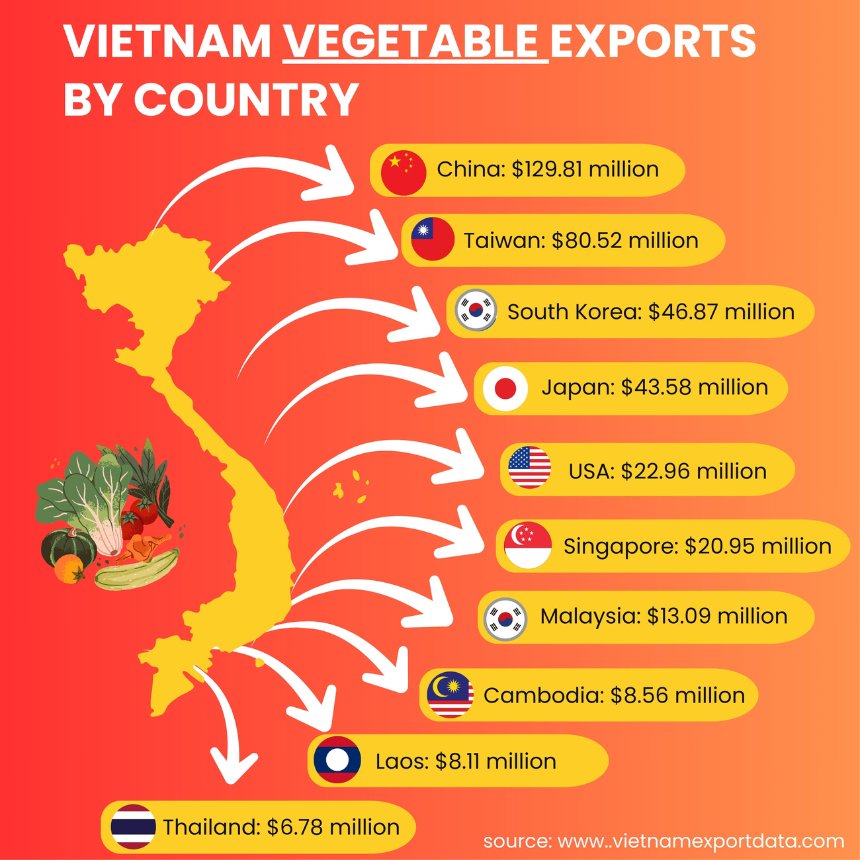
Vietnam's vegetable exports reached a total value of $422.91 million in 2024-25. Vietnam is one of the key players in the global vegetable export market. With a strong agricultural sector, Vietnam exports vegetables to various countries worldwide. Some of the prominent destinations for Vietnam's vegetable exports include the United States, Japan, China, South Korea, and Russia.
These countries value the high-quality and diversity of vegetables that Vietnam produces, creating a mutually beneficial trade relationship. The top 10 countries where Vietnam exports vegetables, as per the Vietnam vegetable exports by country & Vietnam customs data for 2024-25, include:
1. China: $129.81 million (30.7%)
China is the largest importer of Vietnamese vegetables, accounting for almost a third of Vietnam's total vegetable exports. With its huge population and growing middle class, China has a high demand for fresh, high-quality vegetables, making it an important market for Vietnamese farmers.
2. Taiwan: $80.52 million (19%)
Taiwan is another significant market for Vietnamese vegetables, accounting for 19% of Vietnam's total vegetable exports. Taiwanese consumers have a preference for Vietnamese vegetables due to their freshness and quality, making Vietnam a key supplier to this market.
3. South Korea: $46.87 million (11.1%)
South Korea is a major importer of Vietnamese vegetables, with a growing demand for fresh produce, as per the data on Vietnam vegetable exports to South Korea by HS code. Vietnamese farmers have been able to meet this demand by supplying high-quality vegetables to South Korea at competitive prices.
4. Japan: $43.58 million (10.3%)
Japan is known for its high standards when it comes to food safety and quality, making it a challenging market for vegetable exporters. However, Vietnam has been able to establish itself as a reliable supplier to Japan, thanks to its strict adherence to international quality standards.
5. USA: $22.96 million (5.4%)
The United States is a key market for Vietnamese vegetables, with a growing demand for exotic produce from Asia. Vietnamese farmers have been able to capitalize on this trend by exporting a variety of vegetables to the US, ranging from Asian greens to tropical fruits.
6. Singapore: $20.95 million (5%)
Singapore is a small but lucrative market for Vietnamese vegetables, with a high per capita consumption of fresh produce. Vietnamese farmers have been able to tap into this market by supplying a range of vegetables that cater to Singaporean tastes.
7. Malaysia: $13.09 million (3.1%)
Malaysia is a neighboring country to Vietnam and has a close economic relationship with Vietnam. Malaysian consumers have a preference for Vietnamese vegetables due to their freshness and variety, making Vietnam a key supplier to this market.
8. Cambodia: $8.56 million (2%)
Cambodia is a growing market for Vietnamese vegetables, with a growing demand for fresh produce. Vietnamese farmers have been able to establish a strong presence in this market by supplying high-quality vegetables at competitive prices.
9. Laos: $8.11 million (1.9%)
Laos is another neighboring country to Vietnam and has a close economic relationship with Vietnam. Vietnamese farmers have been able to leverage this relationship by exporting a variety of vegetables to Laos, ranging from traditional greens to exotic fruits.
10. Thailand: $6.78 million (1.6%)
Thailand is a competitive market for Vietnamese vegetables, with a strong domestic production of fresh produce. However, Vietnamese farmers have been able to carve out a niche in this market by offering unique vegetables that are not commonly grown in Thailand.
Vietnam Fruit & Vegetable Export Data in the Last 10 Years
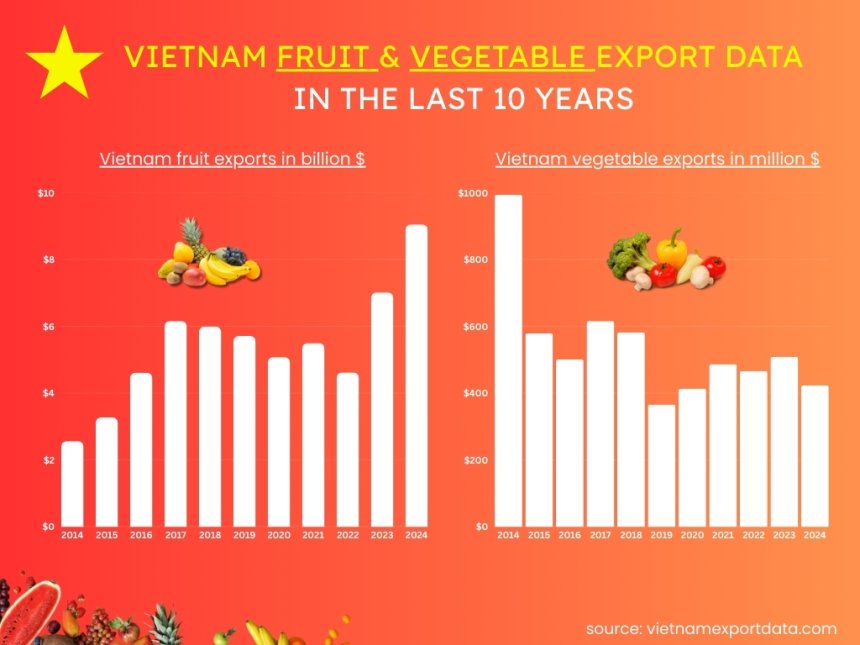
|
Year of Exports |
Vietnam fruit exports ($) |
Vietnam vegetable exports ($) |
|
2014 |
$2.56 billion |
$993.54 million |
|
2015 |
$3.27 billion |
$578.45 million |
|
2016 |
$4.61 billion |
$500.68 million |
|
2017 |
$6.16 billion |
$615.68 million |
|
2018 |
$5.99 billion |
$582.11 million |
|
2019 |
$5.71 billion |
$365.35 million |
|
2020 |
$5.08 billion |
$413.53 million |
|
2021 |
$5.50 billion |
$486.37 million |
|
2022 |
$4.62 billion |
$466.23 million |
|
2023 |
$7.01 billion |
$508.08 million |
|
2024 |
$9.05 billion |
$422.91 million |
China Still Dominates, but the Market Mix is Changing
China remains the biggest buyer. Roughly two-thirds of Vietnam’s fruit and vegetable exports go to China. But the story is more nuanced. Vietnam is no longer dependent on unofficial border trade or informal routes that used to create bottlenecks. Instead:
-
Over 17 fruit categories now have official export protocols to China.
-
Cold-chain and trade cooperation between the two governments has improved.
-
Customs clearance is more predictable through key borders such as Lang Son and Lao Cai.
-
Consumption of tropical fruits in China continues to rise at double-digit rates.
The result is a more stable, regulated, and higher-value relationship.
Growth Beyond China
While China is the engine, Vietnam’s expansion is broad-based.
-
South Korea: Demand for Vietnamese bananas has doubled in two years. Vietnam surpassed the Philippines as South Korea’s top banana supplier in several months of 2024.
-
Middle East: The UAE, Saudi Arabia, and Qatar increased purchases of frozen durian, fresh coconut, and dried jackfruit. These markets value long shelf life and reliable shipping, two strengths of Vietnam’s processors.
-
EU: Although the EU’s phytosanitary requirements are strict, Vietnam’s shipments are rising thanks to the EU–Vietnam Free Trade Agreement. Processed fruits and juices are the key winners.
-
Australia and New Zealand: These are premium markets. Export volume is smaller, but prices are higher. Mango, lychee, and dragon fruit continue to gain approval under new quarantine regulations.
This diversification gives Vietnam a stronger footing for 2025, especially if China’s demand fluctuates.
Durian: The Billion-Dollar King of Vietnamese Fruits
No other fruit has shaped Vietnam’s export performance like durian.
In the last 18 months:
-
Over 300 planting area codes received approval for export.
-
Dozens of packing facilities met China’s strict traceability and safety rules.
-
Durian shipments exceeded 2.5 billion dollars on their own.
The spike in demand is driven by China’s rising middle class, which embraces durian both as a fresh fruit and as an ingredient in pastries, ice cream, yogurt, and beverages. Vietnam stepped into the gap created by supply constraints in Thailand and Malaysia. It offered competitive prices, shorter transport routes, and faster growth in planting areas.
But this growth also comes with risks. Rapid expansion can lead to oversupply, inconsistent quality, and farmland mismanagement. The government is now tightening control over planting area codes and traceability to avoid long-term issues.
The Rise of Vietnamese Vegetables: Quiet Winners in the Export Surge
While fruit gets the spotlight, vegetables are quietly growing in value.
Key rising categories include:
-
Frozen mixed vegetables
-
Bell peppers
-
Sweet corn
-
Okra
-
Fresh herbs
-
Cabbage and leafy greens
-
High-grade mushrooms
Vietnam Vegetable exports benefit from stable demand across Korea, Japan, and Europe, where ready-to-cook and health-focused products are trending. Processing factories in Lam Dong, Da Nang, Hai Duong, and the Mekong Delta are running at higher capacity as more global buyers request long-term contracts.
Vegetables may not yet match durian’s explosive numbers, but they provide stability, diversification, and strong growth potential as global diets shift toward healthy and plant-based foods.
What Enabled the Export Boom? The Structural Drivers
Vietnam’s fruit and vegetable sector did not reach 7.8 billion dollars by chance. Several structural changes laid the foundation.
1. Rapid Expansion of Planting Areas
Durian, mango, banana, and dragon fruit acreage increased sharply. More plantations now follow standardized farming practices, traceability systems, and pesticide control.
2. Better Trade Protocols
China approved more fruit categories for official import. Australia, New Zealand, and Japan approved new products. The EU agreement cut tariffs on processed fruit.
3. Investments in Processing Capacity
Dozens of new facilities have come online:
-
Frozen fruit plants
-
Drying and dehydration factories
-
Canning and juice lines
-
IQF vegetable systems
This allowed Vietnam to sell higher-value branded products instead of raw produce alone.
4. Rise of Agricultural Cooperatives
Farmers now work in cooperative clusters that follow unified standards. This strengthens credibility with foreign buyers.
5. Private Sector Innovation
Vietnamese brands are expanding into snacks, beverages, freeze-dried formats, and blended fruit products targeted at global retail shelves.
These changes are long-term and structural, not seasonal, which is why the export surge looks sustainable.
Challenges Ahead: Can Vietnam Sustain This Growth?
Reaching 7.8 billion dollars is a milestone, but maintaining momentum will not be easy. Several risks need attention.
1. Overdependence on China
China is the lifeline of Vietnam’s tropical fruit sector. A slowdown, regulatory shift, or competition from Thailand could disrupt the flow.
2. Oversupply Risks
Durian and banana plantations are expanding fast. Without careful planning, Vietnam could face price crashes.
3. Traceability and Food Safety
Global buyers are raising standards every year. Any lapse in pesticide control or certification can lead to bans.
4. Climate Change
Heat waves, droughts, and saltwater intrusion in the Mekong Delta threaten production stability.
5. Slow Branding Development
Thailand and the Philippines have strong fruit brands. Vietnam still relies heavily on bulk exports. Brand-building will determine long-term market power.
Can the Vietnam Fruit & Vegetable Sector Break $10 Billion?
With 7.8 billion dollars already achieved in eleven months, the sector is positioned for another strong year.
Positive Indicators for 2025
-
Durian demand will stay high as China’s consumption keeps rising.
-
Banana and mango markets will expand in Korea, Japan, and the Middle East.
-
Frozen and processed fruit exports will grow as more factories operate at full capacity.
-
New export protocols with China, Japan, and Europe will open more doors.
-
Vietnam’s domestic logistics will keep improving, cutting waste and extending shelf life.
Estimated 2025 Revenue Potential
-
Baseline forecast: 9.2 to 9.5 billion dollars
-
Optimistic forecast: 10 to 10.5 billion dollars if China’s demand stays strong and processed exports keep rising
-
Downside forecast: 8.5 to 8.8 billion dollars if pricing pressure hits durian or if planting areas expand too fast
Crossing the 10-billion mark is achievable, but it requires strong quality control, market diversification, and better branding.
The Biggest Winners In the Sector
Durian exporters
They dominate growth. More companies are investing in smart farms, blockchain traceability, and ultrafast exports into China.
Banana producers
Vietnam is now the leading supplier to South Korea and is gaining share in Japan.
Dragon fruit growers
Even though prices fluctuate, demand in China and Southeast Asia remains steady.
Processors and cold-storage companies
As value shifts toward frozen and dried products, companies with modern technology will capture the highest margins.
What Vietnam Must Do Next
To sustain the surge, Vietnam needs four strategic moves:
1. Build National Fruit Brands
Without strong branding, exporters face price pressure. Thailand wins premium pricing for durian because of strong national branding.
2. Regulate Planting Area Expansion
Smart planning will prevent oversupply. Regions should focus on certified zones, not scattered small plots.
3. Expand into Non-Chinese Markets
The Middle East, South Asia, Korea, and the EU offer long-term opportunities.
4. Push for More Processing
Higher-value products can double Vietnam’s earnings even if export volume stays the same.
Conclusion: A Defining Moment for Vietnam’s Fruit & Vegetable Industry
In conclusion, the 7.8 billion dollar export milestone signals a new chapter for Vietnam. It proves that Vietnam can deliver massive quantities of high-quality produce, meet strict global standards, and build a resilient farm-to-export ecosystem. If the country manages its risks and stays focused on quality, sustainability, and branding, Vietnam can become one of the world’s top fruit and vegetable exporters by 2025. The runway for growth is long. The momentum is real. And Vietnam’s fruit and vegetable industry is only getting started.
We hope you liked our data-driven & insightful blog report on the booming Vietnam fruit & vegetable export data 2025. For more information on the latest Vietnam import-export data, or to search live data on Vietnam fruit & vegetable exports by country, visit VietnamExportdata. Contact us at info@tradeimex.in for customized trade reports & verified databases of the top fruit exporters & top vegetable exporters in Vietnam, as per your requirements.
Share
What's Your Reaction?
 Like
0
Like
0
 Dislike
0
Dislike
0
 Love
0
Love
0
 Funny
0
Funny
0
 Angry
0
Angry
0
 Sad
0
Sad
0
 Wow
0
Wow
0