Vietnam Dragon Fruit Export Data: Vietnamese Dragon Fruit Export Trends & Market Analysis 2026
Explore Vietnam dragon fruit export data & market analysis for 2026. Discover top export destinations, growth insights, & key trade statistics driving Vietnam’s fruit export industry.


Vietnam’s dragon fruit industry has long been a symbol of the country’s agricultural export success. Once a billion-dollar export category, it has faced a turbulent few years marked by falling demand, market overdependence, and rising competition. Now, in 2026, early data suggests something important: a gradual recovery is underway. Vietnam Dragon fruit exports reached $485 million in the first 11 months of 2025, down 0.8% year over year and the lowest level since 2014, according to Vietnam export data and Vietnam customs export data of dragon fruit. Vietnam exported dragon fruits worth $108.5 million in the first 2 months of 2026, showing a strong recovery from the previous years.
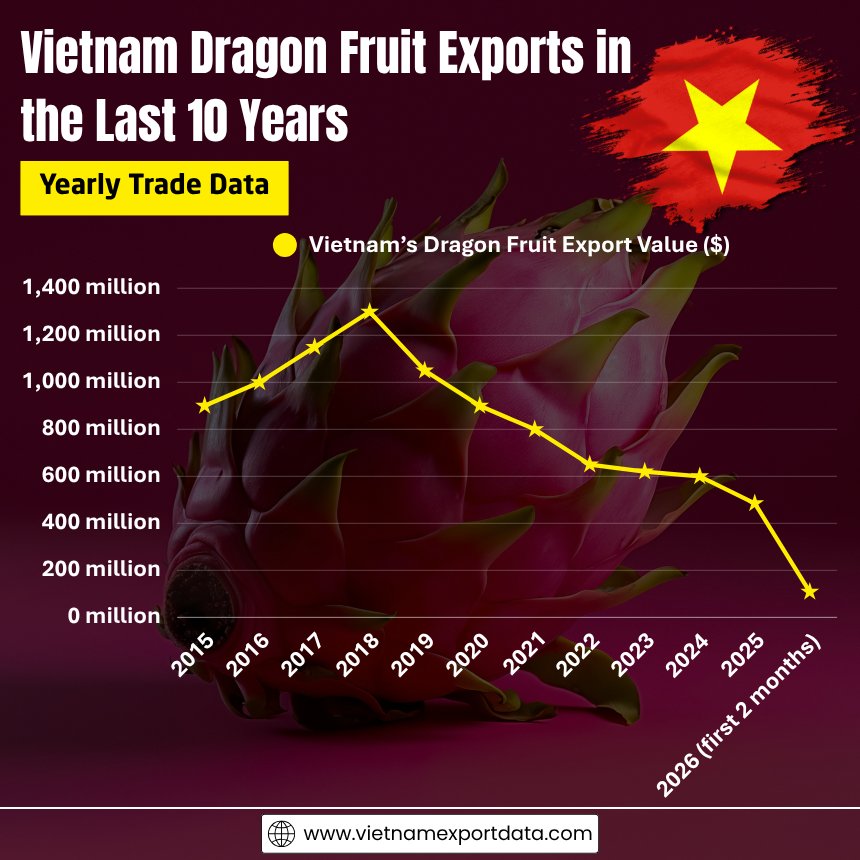
Vietnam's dragon fruit exports increased significantly between 2014 and 2018, with annual sales exceeding $1 billion and peaking at almost $1.3 billion in 2018. However, since 2019, exports have slowed and begun to decline due to rapid shifts in global markets & intensifying competition. Vietnam is the largest exporter of dragon fruit worldwide, according to global trade data. This blog breaks down the latest export data, examines long-term trends, and provides a grounded market analysis of where Vietnam’s dragon fruit sector is heading next.
Dragon Fruit Snapshot 2026: Early Signs of Export Recovery
Recent data indicate that Vietnam’s red dragon fruit exports rebounded in 2026 after a prolonged decline.
-
Export value reached approximately $108.5 million in the first two months of 2026
-
Growth was driven by:
-
Strong demand from Thailand (exports up over 2.7x YoY)
-
Rising imports from the Middle East, especially the UAE (+57%)
-
Seasonal demand linked to the Lunar New Year boosted consumption across markets
This rebound is modest but meaningful. It suggests that demand has not disappeared; it has simply shifted geographically and structurally. Another key factor behind this recovery is off-season production techniques. Vietnamese farmers are increasingly using artificial lighting to induce flowering earlier in the year, allowing exports during periods of limited global supply.
The Bigger Picture: From Boom to Correction
To understand 2026, we need to zoom out.
Peak Years (2014–2018)
-
Vietnam’s dragon fruit exports exceeded $1 billion annually
-
Peaked at around $1.3 billion in 2018
Decline Phase (2019–2025)
-
Structural decline began post-2019
-
Export value dropped to:
-
$485 million in the first 11 months of 2025
-
This marks the lowest level in over a decade
Why the decline?
-
China’s self-sufficiency strategy
-
China expanded dragon fruit cultivation to 1.6 million tons annually, surpassing Vietnam
-
Overdependence on a single market
-
Around 62%–68% of exports still go to China
-
Global competition intensifying
-
Emerging producers:
-
India
-
Mexico
-
Thailand
-
Price volatility and supply imbalance
-
Export value fell from $1.2 billion (2018) to $614 million (2023)
In simple terms, Vietnam went from market dominance to market correction.
Vietnam Dragon Fruit Exports by Country: Top Destinations for Vietnamese Dragon Fruit
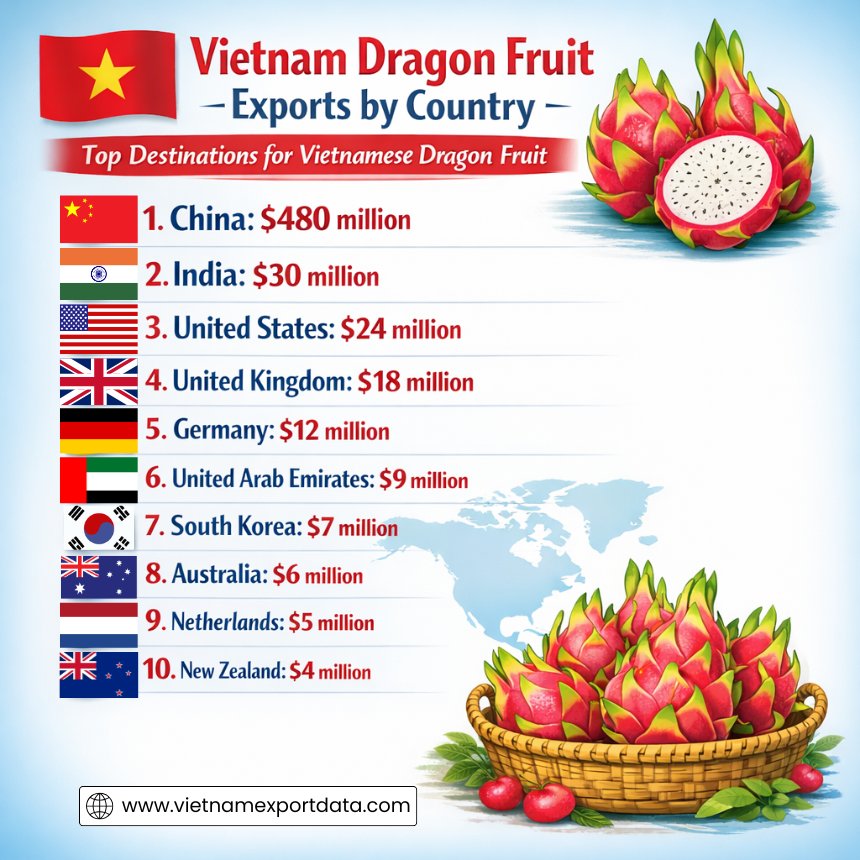
Vietnam is a key player in the global fruit export market, particularly when it comes to dragon fruit. The country's dragon fruit exports are robust, with top destinations including countries like the United States, China, Japan, and South Korea. Vietnamese dragon fruit is renowned for its sweetness, vibrant colors, and health benefits, making it a popular choice among consumers worldwide. The top destinations for Vietnamese dragon fruit exports, according to the Vietnam shipment data for 2025, include:
1. China: $480 million (80%)
China is by far the largest importer of Vietnamese dragon fruit, accounting for a staggering 80% of the total exports as per the data on Vietnam dragon fruit exports to China. The demand for dragon fruit in China has been steadily rising due to its unique taste and health benefits. Vietnamese farmers have been able to capitalize on this demand by increasing their exports to China and establishing themselves as the leading supplier of dragon fruit to the country.
2. India: $30 million (5%)
India is the second-largest importer of Vietnamese dragon fruit, accounting for 5% of the total exports. The demand for dragon fruit in India has been growing in recent years, as more people become aware of its health benefits. Vietnamese exporters have been able to tap into this market by providing high-quality dragon fruit at competitive prices.
3. United States: $24 million (4%)
The United States is another key destination for Vietnamese dragon fruit, accounting for 4% of the total exports. The American market has shown a growing interest in exotic fruits like dragon fruit, leading to an increase in imports from Vietnam. Vietnamese exporters have been able to establish a strong presence in the US market by meeting the demand for fresh and high-quality dragon fruit.
4. United Kingdom: $18 million (3%)
The United Kingdom is also a significant importer of Vietnamese dragon fruit, accounting for 3% of the total exports. The demand for exotic fruits in the UK has been on the rise, with dragon fruit being a popular choice among consumers. Vietnamese exporters have been able to capitalize on this trend by providing fresh and flavorful dragon fruit to the UK market.
5. Germany: $12 million (2%)
Germany is another important destination for Vietnamese dragon fruit, accounting for 2% of the total exports, as per the data on Vietnam dragon fruit exports to Germany by HS code. The German market has shown a growing interest in exotic fruits like dragon fruit, leading to an increase in imports from Vietnam. Vietnamese exporters have been able to establish a strong presence in Germany by providing high-quality and organic dragon fruit to German consumers.
6. United Arab Emirates: $9 million (1.5%)
The United Arab Emirates is a growing market for Vietnamese dragon fruit, accounting for 1.5% of the total exports. The demand for exotic fruits in the UAE has been increasing, with dragon fruit being a popular choice among consumers. Vietnamese exporters have been able to meet this demand by providing fresh and premium dragon fruit to the UAE market.
7. South Korea: $7 million (1.2%)
South Korea is another key destination for Vietnamese dragon fruit, accounting for 1.2% of the total exports. The demand for dragon fruit in South Korea has been on the rise, as more people become aware of its health benefits. Vietnamese exporters have been able to tap into this market by providing high-quality dragon fruit to South Korean consumers.
8. Australia: $6 million (1%)
Australia is a growing market for Vietnamese dragon fruit, accounting for 1% of the total exports. The demand for exotic fruits in Australia has been increasing, with dragon fruit being a popular choice among consumers. Vietnamese exporters have been able to establish a strong presence in the Australian market by providing fresh and flavorful dragon fruit to Australian consumers.
9. Netherlands: $5 million (0.8%)
The Netherlands is a significant importer of Vietnamese dragon fruit, accounting for 0.8% of the total exports. The demand for dragon fruit in the Netherlands has been growing, as more people are looking for healthy and exotic fruits. Vietnamese exporters have been able to meet this demand by providing high-quality and organic dragon fruit to the Dutch market.
10. New Zealand: $4 million (0.5%)
New Zealand is a small but important market for Vietnamese dragon fruit, accounting for 0.5% of the total exports. The demand for exotic fruits in New Zealand has been on the rise, with dragon fruit being a popular choice among consumers. Vietnamese exporters have been able to establish a presence in the New Zealand market by providing fresh and high-quality dragon fruit to New Zealand consumers.
Vietnam Dragon Fruit Exports in the Last 10 Years: Yearly Trade Data
|
Year of Exports |
Vietnam’s Dragon Fruit Export Value ($) |
|
2015 |
$900 million |
|
2016 |
$1 billion |
|
2017 |
$1.15 billion |
|
2018 |
$1.30 billion |
|
2019 |
$1.05 billion |
|
2020 |
$900 million |
|
2021 |
$800 million |
|
2022 |
$650 million |
|
2023 |
$620 million |
|
2024 |
$600 million |
|
2025 |
$485 million |
|
2026 (first 2 months) |
$108.5 million |

Export Market Structure: Diversification in Progress
China: Still dominant, but declining
-
Share dropped from 79% (2023) to 67.8% (2024)
-
Export value to China is declining due to:
-
Domestic production growth
-
Stricter import standards
-
Shift from informal to formal trade channels
Despite this, China remains the single most important market.
Emerging Markets: The New Growth Engine
Vietnam is actively diversifying. Growth in alternative markets is notable:
-
India: +25.9% export growth
-
United States: +47.2%
-
South Korea: +26.8%
-
UAE: +35.5%
-
Australia: +45.9%
While these markets are smaller, they are critical for risk diversification and long-term stability.
Pricing, Profitability & Farmer Economics
Dragon fruit pricing remains relatively stable despite export fluctuations:
-
Average export price: $0.63/kg
-
Premium (GlobalGAP-certified):
-
White flesh: >$0.85/kg
-
Red flesh: $1.27/kg
Farmers currently enjoy:
-
30–40% profit margins under stable pricing conditions
However, this profitability is fragile due to:
-
Input cost inflation
-
Climate-related risks
-
Demand volatility
Production Strategy Shift: The Rise of Off-Season Farming
One of the most important developments in 2026 is the strategic shift in production timing.
Traditional Cycle:
-
Main harvest: May–September
New Strategy:
-
Off-season production: January–May
-
Enabled by:
-
Artificial lighting
-
Controlled flowering cycles
Why it matters:
-
Export during low global supply windows
-
Capture premium pricing opportunities
-
Meet seasonal demand (e.g., Lunar New Year)
This shift is a key reason why exports showed early recovery in 2026.
Global Demand Trends: Why Dragon Fruit Still Matters
Despite recent setbacks, the long-term outlook remains positive.
-
Global dragon fruit market projected to reach $995 million by 2030
-
Expected CAGR: 7.99% (2025–2030)
Key demand drivers:
-
Health & nutrition trends
-
High antioxidants
-
Low-calorie fruit appeal
-
Exotic fruit consumption growth
-
Especially in Europe and North America
-
Rising Asian intra-regional trade
-
Asia imported 17.3 million tons of fruit in 2024 (+10.2%)
Dragon fruit fits perfectly into this broader demand shift.
Dragon Fruit Competitive Landscape: Vietnam vs the World
Vietnam is no longer alone in this market.
Major competitors:
|
Country |
Competitive Advantage |
|
China |
Scale, domestic supply |
|
Thailand |
Strong regional trade |
|
India |
Emerging low-cost producer |
|
Mexico |
Proximity to the US market |
Vietnam still holds advantages:
-
Established export infrastructure
-
Ability to produce off-season fruit
-
Experience in large-scale cultivation
But the gap is narrowing.
Structural Challenges Facing the Industry
1. Market Concentration Risk
Heavy reliance on China remains the biggest vulnerability.
2. Quality & Compliance Pressure
-
EU, US, Japan require:
-
Traceability
-
Certification (e.g., GlobalGAP)
-
Strict phytosanitary controls
3. Climate Change
-
Increased pests
-
Yield instability
-
Higher production costs
4. Price Competition
-
Competing countries offering lower prices
-
Commoditization of white-flesh varieties
Opportunities for Growth in 2026 and Beyond
Despite challenges, several growth levers are emerging:
1. Market Diversification
Reducing reliance on China is already underway.
2. Value Addition
-
Processed products (juice, dried fruit)
-
Longer shelf life = easier exports
3. Premium Segments
-
Organic dragon fruit
-
Red-flesh varieties
-
Certified produce
4. Trade Agreements
-
CPTPP
-
EVFTA
These open access to high-value markets with reduced tariffs.
Strategic Outlook: What Happens Next?
Short-Term (2026–2027)
-
Gradual recovery, not a sharp rebound
-
Continued volatility
-
Growth led by secondary markets
Medium-Term (2027–2030)
-
Stabilization through diversification
-
Increased role of processed exports
-
Stronger compliance-driven exports
Long-Term
Vietnam’s success will depend on one thing: Transitioning from volume-driven exports to value-driven exports.
Conclusion and Final Thoughts
In conclusion, Vietnam’s dragon fruit export sector is no longer in its boom phase, but it is far from decline. The 2026 data show a sector in transition.
-
The early-year recovery signals that demand still exists
-
Market diversification is gaining traction
-
Production strategies are evolving
-
Global demand remains strong
However, the industry must adapt quickly.
The future of Vietnam’s dragon fruit exports will not be defined by how much it produces, but by where it sells, how it differentiates, and how well it manages risk.
If Vietnam can successfully pivot toward higher-value markets, improve quality standards, and reduce dependency on a single buyer, the dragon fruit industry could enter a more stable and sustainable growth phase in the coming decade.
Note For Our Readers
We hope you found this blog on Vietnam Dragon Fruit Export Data: Vietnamese Dragon Fruit Export Trends & Market Analysis 2026 useful and insightful. If you’re looking to go beyond surface-level insights and explore detailed & live data on Vietnam’s dragon fruit exports by country, seasonal shipment patterns, pricing trends, or emerging market opportunities, feel free to connect with VietnamExportData.
We provide comprehensive & up-to-date Vietnam import-export databases, including shipment-level records, buyer-supplier insights, and country-wise fruit export data. This enables businesses, traders, and analysts to make informed decisions with clarity and confidence. Whether you are tracking dragon fruit export recovery trends, identifying new international buyers, analyzing competitive markets, or planning to enter Vietnam’s fresh produce trade, our data solutions are designed to support your objectives. For exclusive access, customized reports, or a tailored Vietnam dragon fruit exporters database, contact us at info@tradeimex.in today.
Share
What's Your Reaction?
 Like
0
Like
0
 Dislike
0
Dislike
0
 Love
0
Love
0
 Funny
0
Funny
0
 Angry
0
Angry
0
 Sad
0
Sad
0
 Wow
0
Wow
0