Vietnam-EU Upgrade Trade Ties with Comprehensive Strategic Partnership
Vietnam & the EU upgrade ties to a Comprehensive Strategic Partnership, reshaping trade, investment, & foreign cooperation across Southeast Asia & Europe.

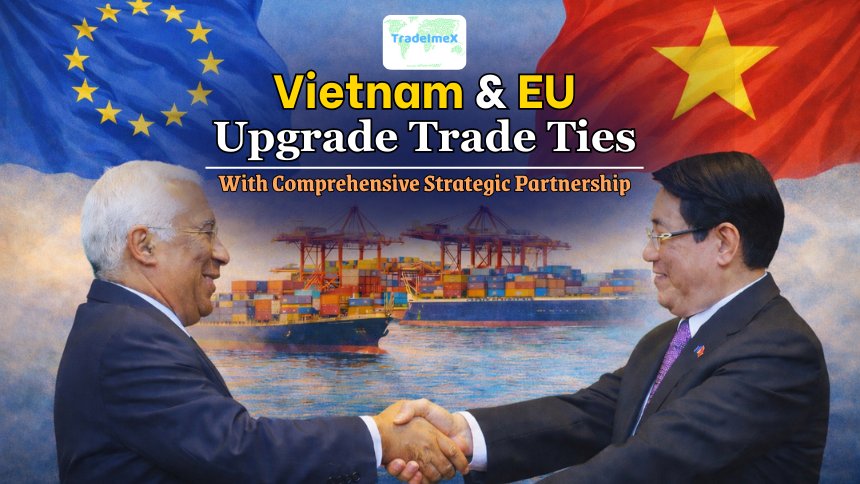
How a historic pact is reshaping economic relations in Southeast Asia and beyond
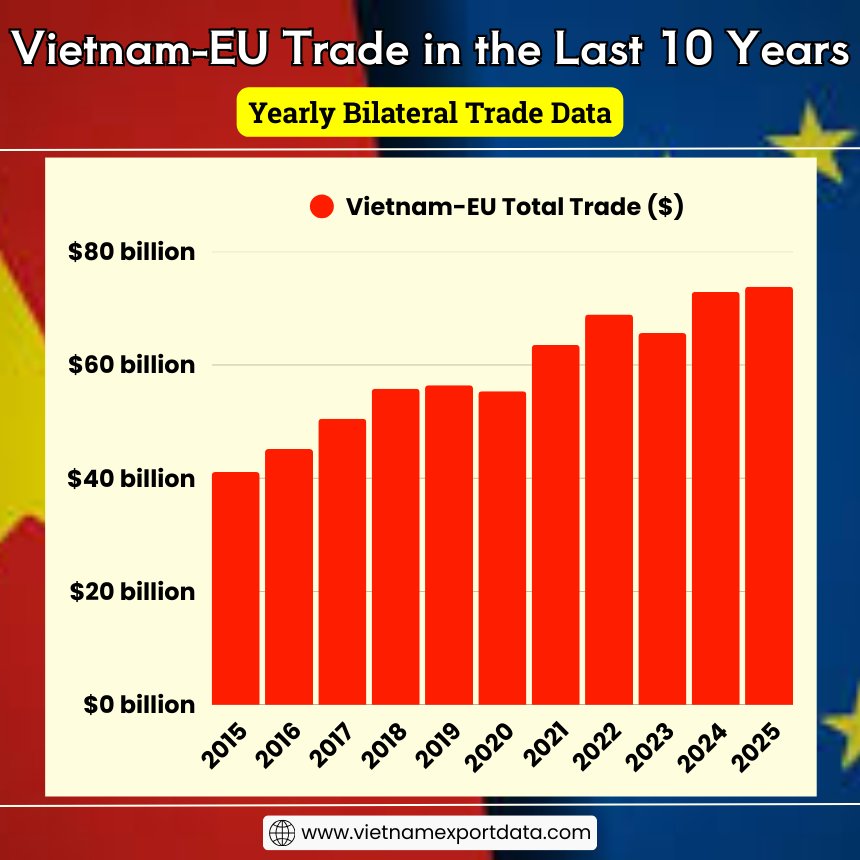
On January 29, 2026, Vietnam and the European Union (EU) formally elevated their bilateral relationship to a Comprehensive Strategic Partnership, the highest level of diplomatic engagement Vietnam has with any regional bloc. The announcement was made in Hanoi during the visit of European Council President António Costa to Vietnam, marking a pivotal moment after over 35 years of diplomatic relations. According to the latest Vietnam export data and the Europe trade data, the total value of the Vietnam-EU bilateral trade reached $73.8 billion in 2025, a 10% increase from the previous year. Vietnam is the EU’s 16th largest trade partner globally and the largest trading partner in ASEAN, according to the Vietnam customs data and global trade data.
This blog explores the Vietnam-EU trade relations, economic and trade implications, geopolitical context, sectoral cooperation prospects, and future outlook of this landmark trade agreement.
What Is a Comprehensive Strategic Partnership (CSP)?
A Comprehensive Strategic Partnership is more than a diplomatic label. It signifies a deep, long-term commitment across political, economic, security, and social domains between two parties. In practical terms, a CSP between Vietnam and the EU is intended to:
-
Elevate political dialogue and high-level engagement on global issues.
-
Provide strong, structured frameworks for economic cooperation, including trade, investment, and industrial collaboration.
-
Expand cooperation beyond traditional commerce into digital transformation, energy transition, innovation, climate, and sustainable development.
-
Align both parties more closely on international law, multilateralism, and rules-based trade, while managing broader geopolitical tensions.
Vietnam is now the EU’s first Comprehensive Strategic Partner in the ASEAN region.
Historical Context: From EVFTA to CSP
The EU–Vietnam Free Trade Agreement (EVFTA)
The foundation for deep economic ties was laid in 2020, when the EU–Vietnam Free Trade Agreement (EVFTA) came into force. Over the past few years, this comprehensive Free Trade Agreement has been central to bilateral trade growth:
-
Since EVFTA entered into effect, trade and investment expanded significantly, benefiting businesses and citizens on both sides.
-
The EU became one of Vietnam’s largest trade partners globally and the biggest in Southeast Asia.
Key provisions of the EVFTA include the elimination of tariffs on most goods, improved market access for services, enhanced intellectual property protections, & mechanisms for dispute settlement. Over time, these elements helped build confidence & economic interdependence.
What the CSP Adds
While EVFTA regulates trade and investment pathways, the Comprehensive Strategic Partnership broadens cooperation to additional domains and provides a structured roadmap for deeper collaboration, including:
-
Enhanced political dialogue and coordination
-
Sector-specific cooperation (e.g., tech, semiconductors, 5G)
-
Shared frameworks for sustainable development and green economy
-
Expanded mechanisms for crisis management, labor rights, & digital governance
In essence, the CSP elevates the EVFTA from a trade treaty to multi-sectoral strategic cooperation.
Trade & Economic Dimensions of the CSP
Trade Growth Trends
Before the CSP, Vietnam and the EU already maintained robust trade relations:
-
In January–November 2025, bilateral trade reached USD 66.8 billion, representing a 6.6% annual increase.
-
The EU stood as Vietnam’s third-largest export market and fourth-largest trading partner overall.
This expanding trade is rooted in several sectors:
-
Manufactured goods: Electronics, machinery components, and textiles remain dominant in exports from Vietnam to the EU.
-
Agriculture and seafood: Growing markets in processed foods and aquaculture products.
-
Services and digital trade: A fast-growing frontier as digital platforms and service exports rise.
The CSP is expected to accelerate these trends through easier regulatory cooperation, stronger intellectual property protection, and deeper integration of supply chains.
Investment & Supply Chains
One of the strategic economic goals of the CSP is to diversify and strengthen supply chains.
The joint statement emphasizes collaboration in:
-
Critical raw materials (e.g., rare earths, gallium, tungsten).
-
Semiconductor assembly and production.
-
Trusted telecommunications infrastructure, including secure 5G and satellite connectivity.
This signals a shift from pure trade toward industrial cooperation, especially relevant as global supply chains are reevaluated due to geopolitical tensions and tariff regimes.
Beyond Tariffs: Digital, Energy & Innovation
Trade is no longer just goods and services; it also encompasses technology, data, and energy flows. The CSP highlights:
-
Digital transformation cooperation, including AI and cybersecurity.
-
Green transition initiatives, such as sustainable energy and low-carbon technology.
-
Trade and infrastructure connectivity, particularly transport links between Europe and Southeast Asia.
These elements reflect how modern trade agreements increasingly include cross-border digital and energy ecosystems, not just tariff-free goods.
Vietnam-EU Trade in the Last 10 Years: Yearly Bilateral Trade Data
|
Year of Trade |
Vietnam-EU Total Trade ($) |
|
2015 |
$41.10 billion |
|
2016 |
$45.17 billion |
|
2017 |
$50.51 billion |
|
2018 |
$55.79 billion |
|
2019 |
$56.43 billion |
|
2020 |
$55.36 billion |
|
2021 |
$63.53 billion |
|
2022 |
$68.89 billion |
|
2023 |
$65.63 billion |
|
2024 |
$72.90 billion |
|
2025 |
$73.80 billion |
Vietnam’s Key EU Trade Partners by Value
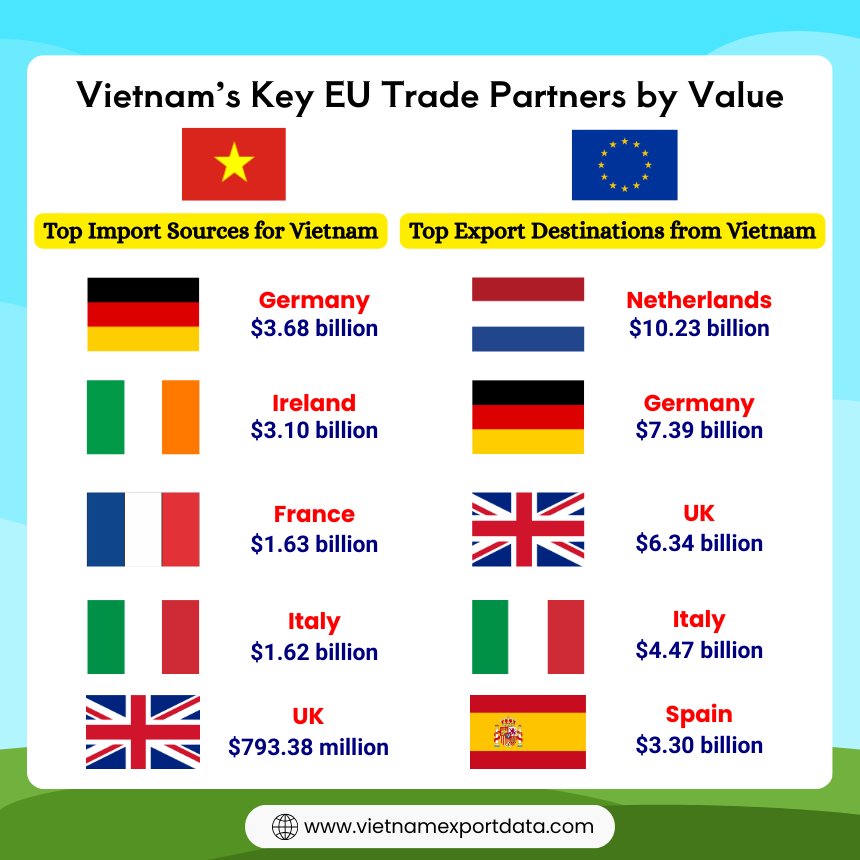
Vietnam’s trade ties with EU member states have expanded steadily in recent years, making the European Union one of Vietnam’s most important trading partners. Annual bilateral trade now runs into tens of billions of dollars, reflecting deeper economic integration. The upgraded comprehensive partnership has played a key role in this growth by reducing trade barriers and strengthening cooperation across multiple sectors, creating mutual benefits for both sides.
Within the EU, Germany has emerged as Vietnam’s largest source of imports, as per the Vietnam import data, while the Netherlands stands as Vietnam’s biggest export destination, as per the data on Vietnam exports to the Netherlands. Based on Vietnam shipment data and EU–Vietnam trade figures for 2024–25, the following countries rank among Vietnam’s leading trade partners in the EU:
Top Import Sources for Vietnam
-
Germany: $3.68 billion
-
Ireland: $3.10 billion
-
France: $1.63 billion
-
Italy: $1.62 billion
-
United Kingdom: $793.38 million
Top Export Destinations from Vietnam
-
Netherlands: $10.23 billion
-
Germany: $7.39 billion
-
United Kingdom: $6.34 billion
-
Italy: $4.47 billion
-
Spain: $3.30 billion
Geopolitical & Strategic Motivations
Reshaping Trade Amid Global Tensions
The CSP announcement comes at a time of heightened global trade tensions, particularly due to U.S. tariff policies and supply chain realignments. Reports show that the CSP was partly driven by:
-
Concerns about U.S. tariffs reshaping global supply patterns
-
The EU’s desire to diversify trading partners amid geopolitical uncertainties
-
Vietnam’s strategic position as a manufacturing hub & export gateway in Southeast Asia
For the EU, strengthening ties with Vietnam reduces over-dependence on a single geography and aligns with broader Indo-Pacific trade and investment strategies.
Balancing Great Power Interests
Vietnam has a longstanding foreign policy of multilateralism and diversification, seeking cooperation with major powers (EU, U.S., China, Japan) without aligning exclusively with any. This partnership approach:
-
Helps avoid over-dependence on one market
-
Secures economic and security interests across blocs
-
Maintains strategic autonomy amid shifting global alignments
The CSP also reinforces Vietnam’s role as a bridge between ASEAN and the EU, supporting deeper inter-regional cooperation ahead of major milestones like the 50th anniversary of ASEAN-EU relations in 2027.
Sectoral Impact: Who Wins and How
Manufacturing & Trade Sectors
Vietnam’s export-oriented industries, especially electronics, garments, and footwear, stand to gain from:
-
Broader EU market access
-
Regulatory alignment with EU standards
-
Strengthened investor confidence
European firms also benefit through better trade predictability and lower barriers to Vietnam’s fast-growing consumer market.
Technology & Digital Economy
Digital economy cooperation is a key pillar, with mutual interests including:
-
Development of secure digital infrastructure
-
AI and cloud computing standards
-
Data protection frameworks that facilitate cross-border digital trade
This is a forward-looking dimension as digital flows account for a growing share of global economic value.
Green & Clean Energy Sectors
Sustainability is central to the CSP, with cooperation intended in:
-
Renewable energy deployment
-
Circular economy and waste management
-
Climate-adaptive infrastructure
-
Just energy transitions in line with global climate goals
The EU, a leader in green technologies, brings technical and financial resources, while Vietnam offers rapidly expanding energy demand and renewable potential.
Challenges and Risks
While the CSP promises broad benefits, several challenges remain:
Regulatory & Implementation Hurdles
Fully realizing the CSP’s potential requires:
-
Effective implementation of EVFTA commitments
-
Resolution of non-tariff barriers
-
Strengthened legal and regulatory frameworks in Vietnam to match EU norms
Trade Surplus Concerns
Europe has previously signaled concerns about trade imbalances and market access issues with Vietnam. Addressing these concerns will require ongoing negotiation and adjustment.
Geopolitical Sensitivities
Vietnam must balance deeper EU integration with its existing ties with China and the U.S., ensuring that enhanced cooperation with one doesn’t adversely impact others. This balancing act requires skilled diplomacy.
What Comes Next?
The CSP establishes a roadmap, but full implementation will occur over the coming years. Immediate priorities include:
-
Action plans for key sectors.
-
Strengthening existing cooperation mechanisms.
-
Expanding political and parliamentary exchanges.
-
Joint working groups on digital, energy, and investment issues.
Both Vietnam and the EU have expressed intent to make this partnership a model for future cooperation between the EU and Southeast Asian nations.
Highlights of the Vietnam-EU Comprehensive Strategic Partnership
Main Announcement
-
Vietnam and the European Union officially upgraded their bilateral relationship to a Comprehensive Strategic Partnership.
-
The announcement was made by Vietnam’s State President Lương Cường and European Council President António Costa during talks in Hanoi on January 29, 2026.
Significance & Context
-
The upgrade marks a new high in diplomatic ties between Vietnam and the EU after over 35 years of relations.
-
EU Ambassador Julien Guerrier emphasized that Costa’s visit signaled the EU’s desire to deepen cooperation with global partners and support a rules-based multilateral order.
-
The move reflects both sides’ confidence that bilateral relations have matured across multiple areas and are ready for a more strategic phase.
Trade & Economic Profile
-
Bilateral trade between Vietnam and the EU in the first 11 months of 2025 reached more than US$66.8 billion, increasing 6.6% year-on-year.
-
The EU is Vietnam’s fourth-largest trading partner, third-largest export market, and fifth-largest import market.
-
Vietnam ranks as the EU’s 16th-largest trading partner globally and its largest in ASEAN.
Areas of Deepening Cooperation
-
Relations now span beyond economic ties to include investment, sustainable development, security, defense, diplomacy, and people-to-people exchanges.
Conclusion and Final Thoughts
The Vietnam–EU Comprehensive Strategic Partnership is a watershed moment in global trade and geopolitics. It advances economic integration between a dynamic Southeast Asian economy and one of the world’s largest trading blocs. While rooted in decades of cooperation and prior trade agreements, this new partnership reflects modern priorities: digitalisation, sustainability, supply chain resilience, and strategic autonomy. For Vietnam, it means bolstered growth prospects, diversification of economic ties, and enhanced global standing. For the EU, it means new avenues to balance global trade tensions and strengthen its presence in the Indo-Pacific region.
As implementation unfolds, the impact will extend across industries, policy domains, and international relationships, setting a blueprint for 21st-century strategic economic partnerships in an interconnected world.
We hope that you liked our data-driven & insightful blog report on the Vietnam-EU Comprehensive Strategic Partnership. For more insights into the latest Vietnam trade data, or to search live Vietnam import-export data by country, visit VietnamExportdata. Contact us at info@tradeimex.in for customized trade reports and market insights.
Share
What's Your Reaction?
 Like
0
Like
0
 Dislike
0
Dislike
0
 Love
0
Love
0
 Funny
0
Funny
0
 Angry
0
Angry
0
 Sad
0
Sad
0
 Wow
0
Wow
0